If your EHR slows notes, billing, reporting, and follow-up, it’s not just annoying – it can cost your organization time, money, and visibility. In many behavioral health groups, weak systems lead to more claim denials, more after-hours charting, more no-shows, and less trust in the data.
Here’s the short version: if your team is spending extra hours on documentation, fixing claims by hand, chasing records, or building reports in spreadsheets, your EHR is likely getting in the way. And for a mid-sized agency, that can mean $50,000 to $250,000+ a year in delayed or lost reimbursement, plus staff burnout and slower decisions.
The 7 signs are:
- Clinicians spend too much time on documentation
- The workflow doesn’t fit behavioral health care
- Reporting is too limited for compliance and leadership
- Patient engagement tools are weak or missing
- Billing and claims bottlenecks slow reimbursement
- Data silos hurt care coordination
- The system can’t support growth across programs or sites
What this means for you: a behavioral health EHR should help notes move into billing, flag claim issues before submission, support care between visits, and show live performance data without manual cleanup.
Less admin.
Stronger teams.
Better client outcomes.
See how behavioral health organizations streamline documentation, staffing, and client engagement with ContinuumCloud.
Which solution would you like to explore?
Strategically Address Behavioral Health EHR Challenges | Select, Optimize, Implement Your EHR
Quick Comparison
| Warning sign | What you’ll notice first | What it can lead to |
|---|---|---|
| Too much documentation time | Clinicians chart after hours | Burnout, late claims, poor data |
| Poor workflow fit | Repeated entry and workarounds | Missed steps, uneven records |
| Limited reporting | Spreadsheet-based reporting | Audit stress, slow decisions |
| Weak engagement tools | More no-shows and phone follow-up | Lost visits, thin outcome data |
| Billing bottlenecks | Denials and claim rework | Slower cash flow, write-offs |
| Data silos | Faxing, calls, re-entry | Care gaps, claim issues |
| Poor support for growth | New sites need manual setup | Delays, uneven processes |
Bottom line: if your EHR makes staff work around the system instead of inside it, it’s holding the organization back.
Why Behavioral Health Organizations Feel EHR Strain More Than Others
Behavioral health documentation leans heavily on narrative, but many general EHRs were made for short, structured visits. That’s the core problem. Clinicians get pushed into rigid templates that don’t match therapy notes, risk assessments, or long-term treatment records. The result is more clicking, more workarounds, and more time spent trying to make the system fit the care. Research shows that behavioral health clinicians spend roughly 1–2 hours on documentation for every 1 hour of direct patient care[5].
The strain gets worse because behavioral health care is rarely handled by one person alone. A single client may have a therapist, a psychiatrist, a case manager, a peer support specialist, and a nurse all working in the same chart. If the EHR doesn’t support shared treatment plans, role-based views, and internal tasking, updates slip through the cracks. And once that starts happening, day-to-day work gets messy fast.
Prior authorization is where the money problem becomes hard to ignore. Manual authorization tracking, paired with weak payer-specific documentation, slows care and leads to denials. It’s a bit like trying to run a busy front desk with sticky notes instead of a system. Things get missed. Payments get delayed. And behavioral health billing denial rates are already 85% higher than in other medical specialties[2].
Then there’s the service-line problem. Many behavioral health groups don’t run just one type of care. They may handle therapy, psychiatry, case management, peer support, and more. Each one comes with its own workflow, billing rules, and documentation demands. When one platform can’t handle all of that cleanly, silos start to form and reporting gaps show up right behind them.
The seven warning signs below show where that strain starts to hurt performance.
The 7 Warning Signs at a Glance
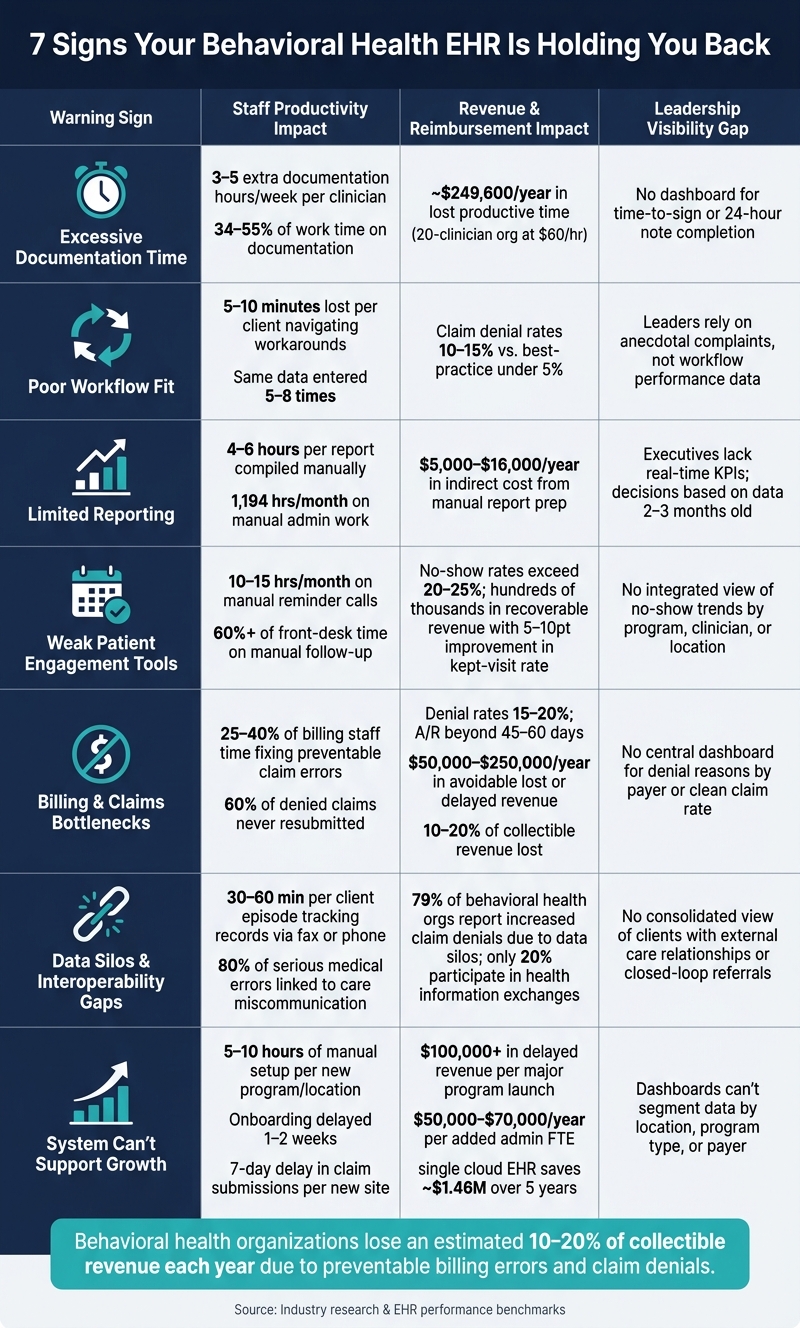
The table below shows where an EHR starts creating drag across the four areas leaders usually feel first: staff productivity, care quality and continuity, revenue and reimbursement, and leadership visibility.
| Warning Sign | Staff Productivity | Care Quality & Continuity | Revenue & Reimbursement | Leadership Visibility |
|---|---|---|---|---|
| 1. Excessive documentation time | 3–5 extra documentation hours/week per clinician | More than 30% of treatment plans not updated within required review intervals | About $249,600/year in lost productive time for a 20-clinician organization at $60/hour | No dashboard for time-to-sign or 24-hour note completion |
| 2. Poor workflow fit | 5–10 minutes lost per client navigating workarounds | Inconsistent risk assessment documentation across caseloads | Claim denial rates of 10%–15% versus best-practice rates under 5% | Leaders rely on anecdotal complaints rather than workflow performance data |
| 3. Limited reporting | 4–6 hours per report compiled manually | No visibility into PHQ-9, GAD-7, or C-SSRS trends across caseloads | $5,000–$16,000/year in indirect cost from manual report preparation | Executives lack real-time KPIs for caseload acuity or care-gap rates |
| 4. Weak alumni engagement tools | 10–15 hours/month spent on manual reminder calls and chasing paperwork | No-show rates exceeding 20%–25% with minimal automation | Hundreds of thousands of dollars in recovered revenue for mid-size agencies with a 5–10 percentage-point improvement in kept-visit rate | No integrated view of no-show trends by program, clinician, or location |
| 5. Billing and claims bottlenecks | 25%–40% of billing staff time spent fixing preventable claim errors | Services downcoded or omitted due to documentation gaps | Denial rates of 15%–20% and A/R beyond 45–60 days; $50,000–$250,000/year in avoidable lost or delayed revenue | No central dashboard for denial reasons by payer or clean claim rate |
| 6. Data silos and interoperability gaps | 30–60 minutes per client episode tracking records via fax or phone | Fragmented histories with critical medication and hospitalization data missing | Unbilled care coordination and case management services | No consolidated view of clients with external care relationships or closed-loop referrals |
| 7. The system can't keep up with growth | 5–10 hours of manual setup per new program/location; onboarding delayed 1–2 weeks | Uneven adherence to clinical pathways across sites | $100,000+ in delayed revenue per major program launch; $50,000–$70,000/year per added administrative FTE | Dashboards can't segment data by location, program type, or payer |
These signs often overlap. So a single EHR gap can hit productivity, revenue, and care at the same time.
Next, each warning sign is broken down by where it shows up in daily work.
1. Clinicians Spend Too Much Time on Documentation Instead of Client Care
Documentation has always been part of clinical work. But when it starts taking more time than direct care, the problem isn’t the clinician. It’s the system.
In behavioral health, that usually shows up first in the time spent documenting. Clinicians can spend 34–55% of their total working time on documentation tasks [1]. In day-to-day work, that often means long notes, duplicate data entry, and charting that drags into the evening.
Without behavioral-health-specific templates, clinicians have to bounce between screens to document treatment plans, risk assessments, and interventions. It’s clunky. And when notes don’t get finished during the day, clinicians end up charting at home, which stretches the workday and adds to burnout. It also eats into time that should go to care coordination with primary care, schools, or social services.
There’s also a client-care cost. When clinicians are focused on the EHR during a session, they’re simply less present. A rushed note can lead to incomplete risk assessments and missed changes in suicidality, substance use, or safety planning.
That same friction creates problems for leadership too. Late or incomplete notes can skew productivity and outcome reporting, delay claims submission, and slow reimbursement. So this isn’t just a workflow headache. It affects data quality, cash flow, and the day-to-day picture leaders rely on.
When an EHR creates this much drag, the next red flag is usually a poor fit for behavioral health workflows.
2. Your EHR Doesn't Match Behavioral Health Workflows From Intake to Discharge
Behavioral health EHRs fall apart when the chart can't move with the client from intake through discharge. If the system was built for short, one-off visits, it creates drag almost everywhere. You see it at intake first, and then the same problem keeps showing up through treatment and discharge.
Generic templates often skip details behavioral health teams need, like trauma history, social determinants, substance use patterns, family dynamics, and risk factors. At the same time, staff get stuck filling out fields that don't matter. That slows intake down, and it creates another problem: information entered up front often doesn't flow into treatment plans or progress notes later on. In some setups, teams have to enter the same patient data 5–8 times, which can eat up 5–8 hours per week [4].
The breakdown doesn't stop there. During care, clinicians may have to jump between separate, poorly linked areas for therapy notes, psychiatric follow-ups, and case management updates. There isn't one chart view that shows the full care episode in one place. Referrals to community resources end up in spreadsheets. Group therapy scheduling can turn into a mess too, with staff relying on workarounds for recurring sessions, attendance, and rosters. Bit by bit, those gaps create more room for missed details.
Billing gets hit next. If documentation doesn't connect to billing the right way, teams can miss required items like authorizations, service codes, and level-of-care flags, or enter them unevenly. That leads to manual claim cleanup.
When the workflow still doesn't fit, reporting and reimbursement usually break next.
3. Reporting for Compliance, Outcomes, and Leadership Is Too Limited
When documentation problems and workflow gaps stack up, they often point to a deeper issue: the EHR can’t generate reports people can actually use. Maybe your team can pull a census count or appointment total. But if it struggles to report on clinical outcomes, payer denials, or documentation completion, that’s not a small annoyance. It’s a serious operational gap.
In that situation, data stops being a tool for better care. It becomes a cleanup job. Teams end up building reports by hand, jumping between screens, matching fields that don’t line up, and patching spreadsheets just to answer compliance questions or get a board update ready. One analysis found that behavioral health organizations may spend about 1,194 hours per month on manual administrative work, with 570 of those hours spent on billing summaries alone [2].
Audit prep is often where weak reporting hits hardest. Behavioral health organizations may need to pull missing signatures, overdue assessments, incomplete notes, and unresolved discharge steps on short notice. If the EHR can’t produce those reports fast, teams go into scramble mode. And when that happens, findings become more likely.
For organizations working under CCBHC requirements, the pressure is even higher. CCBHCs must collect, report, and track encounter, outcome, and quality data across 9 categories, with reporting due 9 months after the end of the measurement year [8].
Leadership feels the pain too. Weak reporting often leaves executives making calls based on data that’s 2 to 3 months old [3]. That’s simply too late for day-to-day course correction. Questions like which programs are underperforming, where are no-show rates highest, or what are our denial trends by service line should take minutes to answer, not days of manual digging.
The clearest red flag is simple: if staff rely on shadow spreadsheets to trust the numbers, the EHR is getting in the way. And when reporting is this limited, client engagement tools usually start showing the same strain.
4. Alumni Engagement Tools Fall Short of What Behavioral Health Care Requires
When reporting starts to crack, the next problem usually shows up between visits. And in behavioral health, that time matters a lot. If your EHR can’t support what happens outside the session, care gaps open up fast and client engagement starts to slip.
Behavioral health clients often need a simple set of tools between appointments: secure messaging, digital intake and consent, self-service scheduling, telehealth, and symptom check-ins. If those tools aren’t built in, clients can lose momentum. At the same time, clinicians lose sight of what’s happening between visits.
The attendance numbers make that plain. No-show rates for first psychiatric appointments can top 30% when automated engagement tools aren’t in place [2]. And one meta-analysis found that clients who got reminders were 25% less likely to no-show overall [9].
Telehealth should sit inside that same workflow, not off to the side. After clinics moved to telehealth, patients attended 26% more sessions and were five times more likely to avoid canceling or missing all scheduled sessions [10].
The staff impact is just as clear. Without automated intake, reminders, and messaging inside the EHR, front-desk teams can spend more than 60% of their time on manual follow-up. By contrast, digital intake can shrink onboarding from 4 hours to 45 minutes [2]. That’s not just routine admin work. It’s wasted time tied straight to missing engagement tools.
There’s another issue here too: outcomes tracking. If clients can’t complete measures like the PHQ-9 or GAD-7 through a portal or app, symptom data often stays incomplete and paper-based. That makes it hard to follow progress over time, compare program performance, or show payers what care is doing. Measurement-based care tools can make clients 3.5 times more likely to achieve long-term, reliable change [7]. Without that setup, leaders are left with patchy data and a weak case for value.
5. Billing and Claims Bottlenecks Are Slowing Down Reimbursement
Once engagement gets better, billing often becomes the next pain point. That’s where weaker EHRs start to show cracks. If billing workflows are disconnected, money gets stuck in rework instead of moving cleanly from service to payment. In behavioral health, that usually means unsubmitted encounters, denied claims, and staff losing too much time fixing errors that could have been avoided.
Denials can climb fast when billing workflows are weak. If an EHR can’t keep up with behavioral health billing rules – codes, authorizations, and telehealth modifiers – mistakes slip through and hit the claim stage. Then billing teams spend hours every week chasing down missing progress notes and fixing service codes. A 2025 audit of a residential SUD facility found that 18% of charges went uncollected because of missing prior authorizations and incorrect CPT codes. About 60% of denied claims are never resubmitted because corrections take too long[1][2]. On top of that, preventable billing errors can drain 10% to 20% of collectible revenue[1][2].
That kind of rework hits cash flow hard. Clean claims may get paid in 15–30 days, but behavioral health organizations average 52 days in accounts receivable – well above the broader 35-day standard[6]. Finance leaders need denial and A/R dashboards in one place so they can spot trouble early and manage reimbursement before it turns into a bigger mess.
And when claims rely on outside records, interoperability gaps make reimbursement even tougher.
6. Data Silos and Interoperability Gaps Are Breaking Care Coordination
Data silos often cause billing mistakes before a claim is even sent. When records sit in separate systems, each handoff turns into a manual patch job.
When systems can't share data, staff end up acting as the bridge. They re-enter the same details into multiple platforms, track down records by phone or fax, and piece together client histories by hand. That isn't just frustrating. It creates risk. 80% of serious medical errors in healthcare are caused by miscommunication between caregivers[11] – and fragmented systems make that kind of miscommunication much more likely.
A therapist may miss a recent medication change from a prescriber. A case manager may have no idea a client skipped their last appointment. Small gaps like these can shift clinical decisions in a big way.
The money side gets hit too. 79% of behavioral health organizations report an increase in claim denials due to data gaps caused by siloed systems[4]. And data sharing across the field is still weak. Only about 20% of behavioral health facilities participate in health information exchanges[12]. Hospitals send summary-of-care records to behavioral health providers for most or all patients only about 17% of the time[13][14].
That leaves outpatient and community teams working from partial information: missing discharge notes, incomplete medication lists, or no crisis plan at all. That's not just an admin problem. It's a patient safety problem.
If staff have to re-enter data, hunt down records by fax, or ask the same intake questions twice, the EHR is slowing care at every transition. And as organizations add programs, services, or locations, those cracks get harder to patch.
7. The System Can't Keep Up With Growth Across Programs or Locations
The last warning sign shows up when growth starts exposing every crack in the system. Growth should make things run better. It shouldn't leave your team juggling more tools, more exceptions, and more patchwork fixes. If every new program or location needs its own workaround, the EHR isn't keeping pace with the organization.
Disconnected systems can add a 7-day delay to claim submissions and chip away at margins as organizations add clinicians, programs, or sites [4]. And that kind of lag doesn't stay boxed in billing. It spills into reporting gaps, slower decisions, and more pressure on staff.
Without centralized reporting, leaders often end up pulling site-level reports together by hand. That's slow, and it makes it harder to spot performance differences from one location to another.
The same issue shows up in care workflows. If each site uses different intake forms or different PHQ-9 and GAD-7 processes, outcomes stop being comparable. Care starts to vary by location, and the problem gets messier as more sites come online.
This is where one cloud-based EHR can make a big difference. Switching to a single system can cut costs by about $1.46 million over five years [15]. Those savings come from removing duplicate setup, manual reconciliation, and inconsistent data across locations. At that point, leaders need a stack that standardizes operations across every site.
What Behavioral Health Leaders Should Expect From Their Technology Stack

A modern behavioral health stack should cut manual work across clinical, financial, and workforce operations. Put simply, each part of the stack should fix a clear operating problem.
The EHR should support behavioral health workflows from intake through discharge. It should also cut documentation time without creating compliance risk. Coleman Health Services did this by connecting an AI-powered documentation tool to its EHR. The result was a 70% drop in documentation time, note submission timeliness improved from five days to 1.5 days, and clinical staff satisfaction reached 92% [4]. That’s the bar a purpose-built stack should hit. When documentation works with the workflow instead of against it, reporting becomes much more useful.
Leaders also need self-service reporting for revenue, billing, reimbursement, workflow, and efficiency data. A reporting library with more than 1,200 self-service reports across those areas – and the ability to benchmark against industry data – helps teams make faster, better decisions [16]. Then comes the next test: can the system support client engagement between visits?
The stack should connect clinical, alumni engagement, and workforce data so leaders can see one operating picture and act faster. The next section maps those capabilities to the gaps they fix.
EHR Gaps and the Capabilities That Fix Them
The table below links each warning sign to the missing capability behind it – and the day-to-day impact that follows.
| Warning Sign | Capability Gap | Operational Impact |
|---|---|---|
| 1. Excessive documentation time | Role-based templates, smart forms, clinical decision support, mobile charting, and auto-populated fields | Less after-hours charting; more direct client contact time |
| 2. Workflow mismatch | Configurable workflows for intake, treatment planning, progress notes, discharge, and transitions of care | Fewer missed documentation steps; better audit readiness across programs |
| 3. Limited reporting | Embedded analytics, dashboards, and standard compliance reports filtered by program, location, clinician, payer, and time period | Faster board and compliance reporting; clearer visibility into outcomes |
| 4. Weak alumni engagement | Patient portals, secure messaging, appointment reminders, self-assessments, telehealth, and surveys | Higher engagement between visits; fewer no-shows; stronger client connection |
| 5. Billing bottlenecks | Integrated revenue cycle tools, clearinghouse integration, eligibility and authorization workflows, claim scrubbing, and EDI/ERA support | Lower denial rates; faster reimbursement; fewer write-offs |
| 6. Interoperability gaps | FHIR/HL7 interfaces, APIs, HIE connectivity, and structured data exchange | Fewer broken care transitions; more complete records across providers |
| 7. Scaling across programs or locations | Cloud-based architecture, multi-site support, role-based access, centralized workforce management, and multi-entity HR/financial management | Faster program onboarding; consistent workflows; lower IT overhead |
These gaps show where leaders should focus next.
Conclusion
When an EHR slows clinicians, billing, and leadership, it stops helping the organization do its job. And the cost doesn’t just sit on a financial report. It shows up in day-to-day work: behavioral health organizations lose an estimated 10% to 20% of collectible revenue each year due to preventable billing errors and claim denials [4][2].
You can feel that drag across the whole operation. Teams spend more time fixing avoidable issues, leaders have less visibility, and staff end up working around the system instead of with it. As Dr. Omar Fattal, System Chief of Behavioral Health at NYC Health + Hospitals, said:
"You cannot do this work without data. You cannot fly this plane completely blind." [4]
A good next move is a simple internal review. Have clinical, billing, IT, and program leaders score each of the seven areas from 1–5, then flag anything rated 3 or below.
The right EHR supports compliance, reimbursement, and scale. If these signs sound familiar, your EHR isn’t supporting performance – it’s limiting it.
FAQs
How do I know if our EHR is hurting reimbursement?
Your EHR may be cutting into reimbursement if claim denials are high. In fragmented systems, denial rates often land around 5% to 10%. In unified platforms, that number is often less than 1%.
A few billing trouble spots tend to show up again and again:
- Manual charge entry
- Too many charge lag days
- Denied claims that never get resubmitted
- Missing prior authorizations
- Incorrect CPT coding
- Progress notes that don’t clearly support medical necessity
This is where things can snowball. A missed authorization here, a coding mistake there, and suddenly cash flow starts to slow down.
What should a behavioral health EHR do better?
A behavioral health EHR should be a unified, purpose-built platform that cuts down on manual workarounds and disconnected software.
It should give clinicians better support with narrative-driven documentation templates like SOAP, DAP, and BIRP, link treatment plans to progress notes and outcomes, give teams real-time visibility across programs and locations, and automate compliance and revenue cycle workflows to reduce claim denials and staff burnout.
How can we assess whether it’s time to switch systems?
Start with a growth readiness assessment to spot gaps in scalability, integration, and workflow efficiency.
Then compare your current setup against a few clear warning signs:
- Too much clinician time spent on documentation
- Weak fit for behavioral health workflows
- Limited reporting
- Billing bottlenecks
- Poor interoperability across programs or locations
A workflow audit and ROI calculators can help put numbers to the operational and productivity impact.