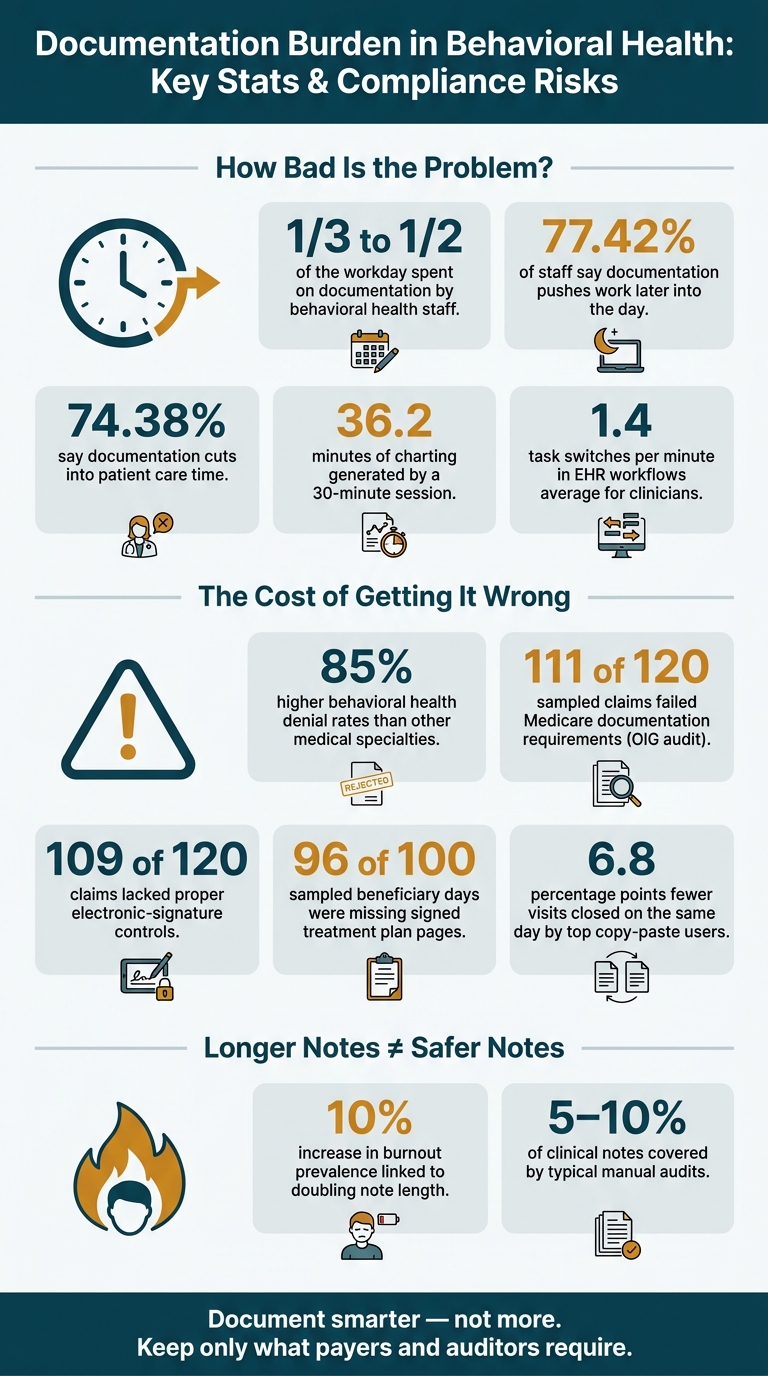
You do not need more charting. You need less repeat work and tighter rules. In behavioral health, staff can spend one-third to one-half of the workday on documentation, and 77.42% say it pushes work later while 74.38% say it cuts into patient care time. At the same time, denial rates in behavioral health are 85% higher than in other medical specialties.
Here’s the short answer: I’d cut burden by keeping only what payers and auditors expect, removing duplicate fields, limiting copy-forward use, setting note deadlines, and checking charts on a set schedule.
What matters most:
- Keep the must-haves: client identifiers, date of service, time for time-based codes, clinical note details, consent records, and signed entries with name, credentials, and timestamp
- Cut the extras: repeated demographics, cloned text, boilerplate, and long summaries that do not change care
- Make notes easier to finish: use structured templates, role-based ownership, and systems that fill in known data
- Reduce risk: watch copy/paste, missing signatures, weak goal linkage, and late notes
- Check your process often: sample charts each quarter, review templates each year, and run signature and aging reports
A short note can still support care, billing, and review. A long note is not always a safer note. In fact, doubling note length has been linked to a 10% increase in burnout prevalence.
| Focus area | Keep | Cut |
|---|---|---|
| Note content | Session-specific intervention, client response, progress toward goals | Repeated history, generic statements, cloned text |
| Workflow | Templates, required fields, note deadlines, role ownership | Fuzzy handoffs, manual re-entry, extra forms |
| Compliance checks | Chart samples, signature reports, template review | Reviewing everything by hand, waiting until billing problems show up |
Bottom line: I’d make documentation shorter, clearer, and tied to the visit - while keeping the items that support payment and audit review.
Less admin.
Stronger teams.
Better client outcomes.
See how behavioral health organizations streamline documentation, staffing, and client engagement with ContinuumCloud.
Which solution would you like to explore?
What Compliance Still Requires
Before you streamline documentation, lock down the nonnegotiables. Cut waste, not required items. The goal is to know the minimum that every compliant note must include.
Core Documentation Elements to Protect
Federal, state, Medicaid, Medicare, and payer requirements generally require documentation to be appropriately dated, timed, and authenticated, but specific requirements vary by service, program, payer, and jurisdiction. That’s the floor. On top of that, behavioral health progress notes need a clear set of items if they’re going to hold up in payer review and audits.
Each note should include accurate client identifiers: full name, date of birth, and chart number. Use MM/DD/YYYY for the date of service and, when needed, document local start and stop times.
The clinical part matters just as much. Notes need to show the intervention used, the client’s response, progress toward goals, and the clinical reason for the visit. The note should also connect the diagnosis, treatment plan, and session note so the record supports medical necessity.
Every note also needs an authenticated signature with name, credentials, and date/time stamp. Consent records for treatment, telehealth, and release of information, along with HIPAA privacy safeguards, complete the baseline.
Required Elements vs. Avoidable Extras
Use this split to remove work that doesn’t help with compliance.
| Required | Avoidable |
|---|---|
| Accurate client identifiers (full name, date of birth, and chart number) | Repeated demographic fields in every progress note |
| Date of service (MM/DD/YYYY) and authenticated signature with date/time | Copy-forward text from prior sessions |
| Start and stop times for time-based billing codes | Repeated narrative summaries that don't change by encounter |
| Session-specific interventions and client response | Boilerplate language not tied to the actual visit |
| Progress toward treatment plan goals and clinical rationale | Generic intervention language across visits |
| Consent records and HIPAA privacy documentation when applicable | Excessive cloned content across visits |
Copy-forward and note cloning need extra attention. CMS explicitly recommends monitoring copy/paste use through EHR audit logs because repeated or identical notes can trigger denials, audits, and investigations. A long note isn’t the same as a complete one. What matters is accuracy and detail tied to that session.
Copy-forward becomes the biggest risk when teams mistake efficiency for completeness.
How to Streamline Documentation Workflows at the Point of Care
Knowing the rules is only half the job. The other half is setting up workflows that let clinicians meet those rules without spending most of the day buried in charts. Clinicians can spend one-third to one-half of the workday on documentation, and a 30-minute session can lead to 36.2 minutes of charting. Finishing notes the same day helps cut recall mistakes and reduces after-hours work.
Use Standardized Templates and Structured Note Formats
Templates should take the guesswork out of documentation. Set up structured fields for goals, interventions, responses, and progress so clinicians can record what compliance calls for without stopping to decide what belongs in each note.
The best templates lean on drop-down menus, checkboxes, and short narrative fields instead of wide-open text boxes. For example, a clinician can pick the active treatment goal from a list linked to the client’s plan, select the intervention used, score progress on a standard scale, and add a short narrative for clinical context. That setup keeps notes consistent and ready for audit, without reducing documentation to a string of boxes.
AHIMA's guidance on electronic documentation templates describes prompts and structured fields as tools to trigger missing or required information during the visit. It also helps to add validation rules that stop a note from being finalized when a required field - such as time in/time out or rendering provider - is blank. That shifts compliance into the workflow itself instead of leaving it for someone to catch later.
Templates also work better when each role is responsible for a clear part of the note.
Define Documentation Ownership Across Teams
Documentation slowdowns usually start with fuzzy handoffs. A role-ownership matrix can fix that by assigning each step to a specific team member.
With a role-ownership model, everyone has a clear lane. Front-office staff handle demographic and insurance fields at intake. Clinicians handle progress notes, diagnoses, and treatment plan content. Supervisors handle review and approval. Billing staff handle coding validation. Written time standards matter too. A rule like "progress notes completed within 24 hours of service" makes timeliness a team expectation instead of an unwritten hope.
Clear ownership cuts delays and helps avoid rework. When front-office staff keep demographic and insurance data up to date, clinicians don’t have to type the same details into every note, and billing staff don’t have to fix those errors later.
That setup gets even better when the system also cuts duplicate entry and manual handoffs.
Speed Up Completion With a Connected Cloud-Based Platform
Fragmented systems are a major reason documentation takes so much time. When clinicians bounce between tools to review history, write notes, check goals, and send notes for signature, every switch adds friction. Research shows clinicians average 1.4 task switches per minute in EHR workflows.
A connected cloud-based platform keeps client data in one place, auto-populates key fields, and keeps audit trails in place without manual reentry. Client identifiers, active diagnoses, and treatment goals can flow from the initial assessment straight into progress notes, so clinicians can review and confirm instead of retyping. Role-based access also limits each user to the fields they need, which cuts clutter and reduces errors.
How to Cut Low-Value Documentation Work
Once workflows are set, the next job is to trim the charting habits that still waste time. That means removing fields, templates, and note patterns that create extra work without helping care.
Remove Redundant Fields and Repeated Narratives
Demographic details, diagnoses, risk ratings, and active treatment goals often show up in multiple places: intake assessments, treatment plans, progress notes, and internal forms. That sounds harmless at first. But when the same information lives in four different spots, staff end up updating it four different times.
A better move is to map every form used across the care cycle, spot repeated fields, and keep one source of truth for demographics, diagnoses, risk, and goals.
Large-scale EHR analyses show duplication is common, so it makes sense to review templates on a regular basis to catch it early. Pairing those reviews with compliance audits can help teams spot new redundancies before they turn into routine behavior.
Replace Over-Documentation With Clinically Relevant Notes
Longer notes are not safer notes. In fact, research shows that doubling clinical note length is associated with a 10% increase in burnout prevalence. The Office of Inspector General has also identified improper copy-and-paste use and record cloning as compliance risk areas.
So what should go into the note? Stick to what matters:
- What intervention was provided?
- How did the client respond?
- What changed in risk, status, or progress toward the treatment plan goal?
For example:
"Client reports daily panic attacks, down from twice weekly. Provided CBT psychoeducation and breathing practice; anxiety decreased from 8/10 to 5/10. Safety plan reviewed; exposure exercises added next visit."
That note is short and specific. It supports medical necessity without replaying the client’s full history every time.
By contrast, generic lines like "Client remains stable; continue current plan" repeated across visits add length without adding meaning. During an audit, they can also look suspicious. That’s why supervisors should push for note quality, not note volume, during chart reviews.
There’s also a productivity cost. Clinicians in the top decile of copy-paste use closed 6.8 percentage points fewer visits on the same day and spent more time in the EHR after hours and on days off.
These fixes don’t hold on their own. Teams need regular audits and template reviews to keep documentation lean and clean.
Build a Lasting Compliance Review Process
Cleaned-up documentation only stays compliant if you keep reviewing it. That means turning the cleanup work into a process your team can repeat. The same templates, ownership rules, and note standards you put in place earlier need scheduled review, or they drift.
Use Audits, Template Reviews, and Signature Monitoring
Most organizations should run clinical documentation audits at least quarterly. Higher-risk programs may need them more often. You do not need to audit every chart. In most cases, that’s not realistic anyway. Manual audits usually cover only 5% to 10% of clinical notes, so a risk-based sample makes more sense. Pull a set number of charts per clinician, per program, or per payer each cycle, and review the items most likely to trigger denials, paybacks, or other issues.
Signature problems deserve close attention because they show up often and can get expensive fast. A federal OIG audit of psychotherapy services found that 111 of 120 sampled claims failed to meet Medicare documentation requirements, and 109 of 120 claims had treatment notes signed only with digital images of clinicians' signatures and lacked proper electronic-signature controls. In another OIG review, 96 of 100 sampled beneficiary days were missing signed treatment plan pages. Internal checks should catch those problems before claims are submitted.
Template review matters too. Review templates at least once a year and again after payer or regulatory changes. Bring in clinical, compliance, billing, and IT teams, and strip out fields that no longer tie back to a requirement. If a field no longer serves a purpose, it shouldn’t keep taking up space.
Use audit results to spot the biggest trouble areas first. Here are the controls that line up with the issues teams run into most:
| Documentation Risk Area | Common Issue | Internal Control |
|---|---|---|
| Missing or late progress notes | Services billed without timely documentation | Set a 24–72 hour completion policy; run monthly aging reports; flag repeated issues for supervisor review |
| Weak treatment-plan linkage | Notes don't reference goals or interventions | Require goal selection in note templates; include treatment-plan alignment as a standing audit item |
| Missing or incomplete signatures | Clinician, supervisor, or client signatures absent or undated | Use electronic signatures with date/time stamps; run weekly signature completeness reports; include in pre-billing checks |
| Inadequate medical necessity | Notes lack symptoms, functional impairment, or service rationale | Embed prompts for diagnosis, functional impact, and response to treatment; audit for clinical justification |
| Incorrect or missing service details | Billing data doesn't match documentation | Make service details required fields; compare billed codes with documented services in routine audits |
| Improper corrections or amendments | Changes look like rewrites instead of addenda | Require addenda with date, time, and author; configure EHR audit trails; train staff on compliant correction practices |
| Record retention gaps | Records deleted or inaccessible before retention period ends | Keep a retention schedule, test archive access, and document secure destruction |
It also helps to watch patterns across notes, not just one chart at a time. If one program keeps producing late notes, that usually points to a workflow or scheduling issue, not just a few staff mistakes. That’s where review data becomes useful. You can tighten templates, shift workloads, or reset team expectations before the same problem keeps showing up.
Conclusion: Less Burden, Stronger Standards
When these checks become routine, simpler documentation stops creating hidden compliance problems. The way out of documentation fatigue isn’t to document less - it’s to document smarter. Ongoing audits, yearly template cleanup, and steady signature monitoring help keep lean documentation safe over time while protecting the organization from recoupments and keeping the record centered on the care being delivered.
FAQs
How can we shorten notes without increasing audit risk?
Use AI tools inside your electronic health record to turn session conversations or short notes into structured, clinically accurate documentation.
Real-time compliance auditing can review documentation for gaps and help align records with regulatory standards, including the Golden Thread, before submission. That means notes stay concise, accurate, and ready for audit.
Which documentation elements are truly required for compliance?
To support compliance and medical necessity, documentation should tell a consistent story from assessment and diagnosis through the treatment plan, services provided, and progress toward goals — often referred to as the 'Golden Thread. That means the diagnosis, treatment plan, and progress notes all need to line up. Each part should support the next, like one clear story in the chart.
You also need a few core pieces in place. Notes should include face-to-face time, be dated and signed, and stay legible. They should also explain the clinical rationale behind care and include key clinical data, such as, when clinically appropriate, relevant assessment measures such as PHQ-9 or GAD-7 scores, along with other assessment tracking.
On the admin side, keep records like:
- Consent forms
- Privacy notices
- Authorization logs
If any of those pieces are missing, the chart can start to look incomplete fast.
How often should we audit charts and review templates?
Use a steady review cadence: quarterly audits and annual assessments to check intake forms, confirm privacy policies are up to date, and make sure data collection still aligns with current regulations.
Update evidence files, including those tied to parity enforcement, every 90 days. When possible, use integrated EHR tools to review documentation at the point of care, so compliance checks happen as care is delivered.