Using the wrong EHR system while scaling your behavioral health organization can lead to inefficiencies, financial losses, and staff burnout. What might seem like small frustrations – manual data entry, clunky workflows, or disconnected systems – can snowball into major barriers as your organization grows. Here’s the crux of the issue:
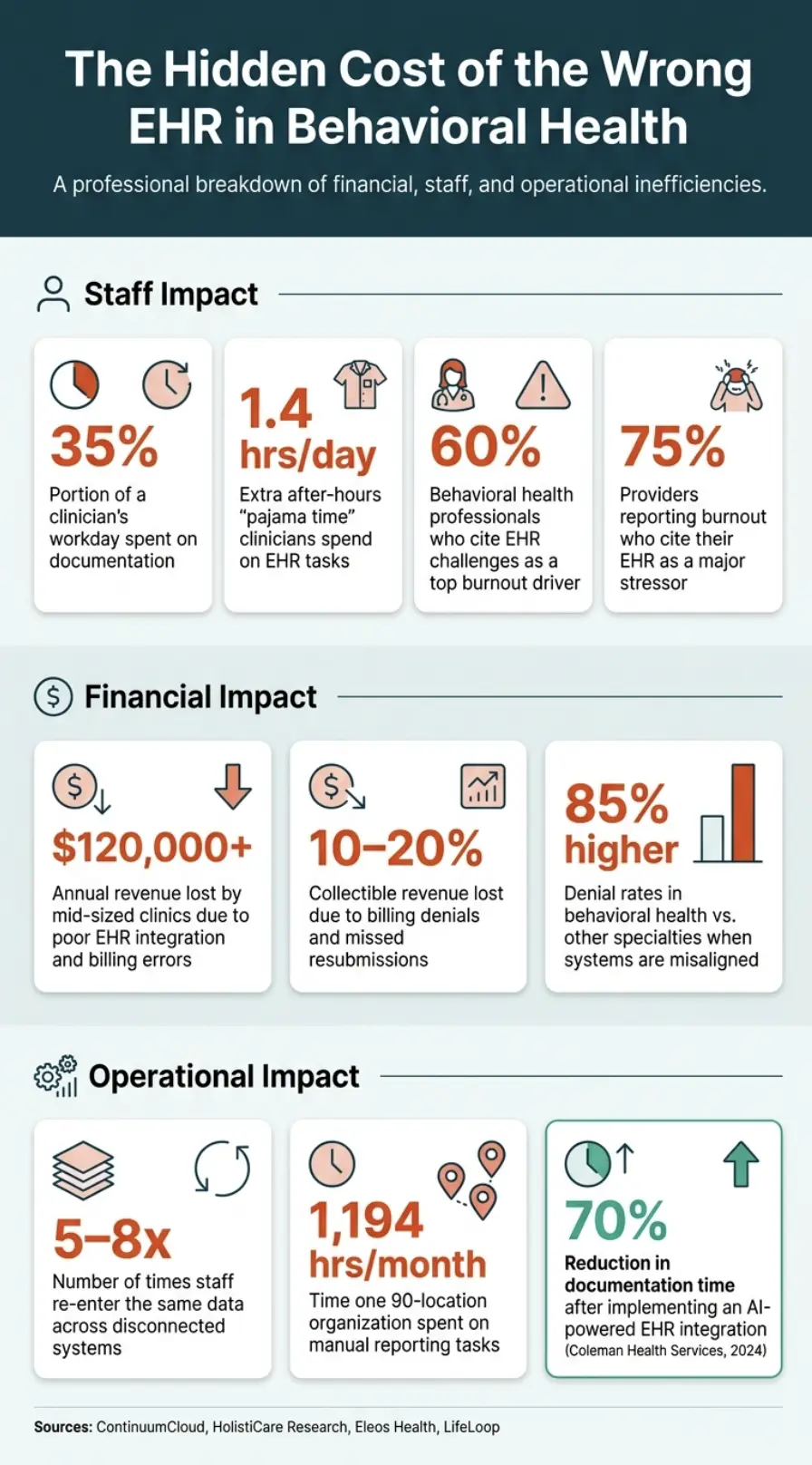
- Lost Revenue: Poor EHR integration can cost mid-sized clinics over $120,000 annually in missed revenue and billing errors.
- Staff Burnout: Clinicians spend 35% of their day on documentation, often working an extra 1.4 hours after hours (“pajama time”).
- Growth Challenges: Inefficient systems slow down scaling efforts, with organizations losing time to manual processes and fragmented data.
The solution? A scalable EHR tailored to behavioral health minimizes inefficiencies, streamlines billing, and reduces documentation time, allowing your team to focus on what matters most: client care. It minimizes inefficiencies, streamlines billing, and reduces documentation time, allowing your team to focus on what matters most: client care. Transitioning to the right system may require effort, but the long-term benefits far outweigh the costs.
The Slow Build of Inefficiency
Daily Workflow Friction That Adds Up
EHR inefficiencies rarely hit you all at once. Instead, they creep in slowly – an extra click here, a duplicate entry there, or a note that takes longer than expected to complete. On their own, these issues might feel like small annoyances. But over time, they stack up, draining productivity and driving up costs day after day.
Behavioral health clinicians already dedicate 35% of their workday to documentation, spending an average of 16 minutes per patient encounter. When EHR systems aren’t tailored for behavioral health needs, this documentation load only gets heavier. Many clinicians find themselves completing notes after hours – what’s often called “pajama time” – racking up an additional 1.4 hours of work each day. Unsurprisingly, 60% of behavioral health professionals cite EHR challenges as a top reason for burnout.
The problem becomes worse with fragmented systems. If scheduling, documentation, and billing tools don’t integrate, staff are forced to re-enter the same data across multiple platforms – sometimes as many as 5 to 8 times for a single record. This manual repetition shifts the burden from the technology to the people using it.
These inefficiencies don’t just waste time; they also create a ripple effect, leading to financial and operational challenges that grow alongside your organization.
How These Problems Grow With Your Organization
What starts as minor inefficiencies can snowball into significant barriers to growth. Every extra minute spent on redundant tasks feeds into larger issues that strain your organization’s resources. Errors in billing, missed authorizations, and higher staff turnover all add up, compounding the time and money already lost to daily workflow friction.
As your organization scales – whether through new programs, more clinicians, or additional locations – these inefficiencies only intensify. For example, one organization operating across 90+ service locations was found to spend 1,194 hours each month on manual reporting tasks. Of that, a staggering 570 hours were used solely to compile billing summaries. That’s not just a small inconvenience – it’s a structural problem caused by systems that weren’t built to handle growth.
The Financial Cost of the Wrong EHR
Billing Delays and Lost Revenue
When clinical documentation systems don’t connect properly, billing processes take a hit – and so do finances. Missing prior authorizations, incomplete progress notes that don’t establish medical necessity, and manual charge entry can cause denial rates to soar, sometimes up to 85% higher than in other specialties. This can lead to organizations losing between 10% and 20% of their collectible revenue. Even worse, about 60% of denied claims are never resubmitted because manual processes make it too time-consuming to fix them.
Take this example: In 2025, an audit of a 32-bed residential substance use disorder facility in Ohio revealed that 18% of all charges went uncollected due to preventable errors. This resulted in a six-figure annual loss. As Cortney Swartwood, a behavioral health billing specialist, puts it:
“If your billing model can’t keep up, the answer isn’t always more people. It’s often better prevention, better visibility, and better ownership.”
The cost of addressing just one denied claim ranges from $25 to $181 in staff time. These inefficiencies not only cut into revenue but also force staff to rely on manual processes, further driving up administrative expenses.
Rising Administrative Overhead
Without EHR automation, many routine tasks fall back on manual labor. Eligibility checks, charge reconciliation, and reporting all demand significant time and effort. To make up for the system’s shortcomings, staff often create informal workarounds – like using spreadsheets, manual logs, or desktop procedures. While these stopgaps might seem like a solution, they come with hidden costs. Dylan Souza, Vice President of Marketing at ContinuumCloud, highlights this issue:
“In healthcare, redundancy accounts for one of the biggest wastes in terms of resource allocation.”
These workarounds can be deceptively expensive. Chris Sawotin, CEO of CureIS Healthcare, explains:
“Desktop procedures are an infrastructure problem masquerading as operational inevitability… when you pay analysts six figures to run desktop procedures, the spend moves off the technology budget and onto payroll.”
The reliance on manual processes not only strains budgets but also diverts skilled staff from focusing on more impactful tasks. This creates a cycle of inefficiency that’s difficult to break without the right technology in place.
The Operational Toll on Staff and Processes
Clinician Burnout and Staff Turnover
When inefficiencies pile up, the weight inevitably falls on frontline staff. A poorly matched EHR system doesn’t just strain budgets – it takes a toll on the people using it. For clinicians in behavioral health, mismatched documentation systems mean spending an average of 16 minutes per patient encounter on paperwork that doesn’t directly contribute to care.
On top of that, inefficient systems force clinicians to dedicate an additional 1.4 hours after their shifts to EHR-related tasks. Unsurprisingly, nearly 75% of providers who report burnout symptoms cite their EHR as a major stressor. In behavioral health inpatient and residential settings, where turnover rates already exceed 50%, this added burden only worsens the situation.
“With clinicians stressed and overburdened, patients simply aren’t going to receive the best care possible.” – Dror Zaide, Co-founder and COO, Eleos Health
This issue becomes even more pronounced when organizations try to scale. Adding new programs or locations increases the volume of documentation, but without improvements to the system, the strain on staff only intensifies. This doesn’t just lead to individual burnout – it fragments care across service lines, making it harder to deliver consistent, high-quality treatment.
Process Gaps Across Programs
Disconnected systems in residential and outpatient programs create a whole host of problems. Critical details like behavioral care plans, medication lists, and session notes often end up scattered across platforms. Staff are left manually re-entering data, which increases the risk of errors and missing information.
But the problem goes beyond manual data entry. When systems don’t integrate, there are invisible handoff failures where no one has a full view of a client’s care journey. This makes coordinated treatment nearly impossible at scale. Generic EHRs also fall short in behavioral health documentation, often lacking templates like SOAP, DAP, or BIRP notes. Without these, clinicians resort to free-text fields or external documents, leading to inconsistent records and greater audit risks. In fact, organizations using disconnected systems report a 41% increase in documentation gaps and a 26% rise in underreported incidents.
How the Wrong EHR Limits Growth and Decision-Making
Barriers to Expanding Programs and Locations
Growing a behavioral health organization isn’t just about adding locations or programs – it’s about creating systems that can handle that growth smoothly. Unfortunately, when an EHR is rigid and outdated, every expansion becomes a manual headache instead of a streamlined process. Instead of benefiting from economies of scale, organizations end up with operational debt – those small inefficiencies that seem manageable at first but snowball into major obstacles as the organization grows.
Relying on a single “hero” employee to manage workarounds or navigate inflexible workflows creates a fragile system. What happens when that person isn’t available? This dependency not only slows down the rollout of new programs but also makes it harder to adapt to the unique requirements of operating in multiple states. Telehealth and crisis care regulations vary widely, and disconnected systems often can’t keep up.
On top of that, when an EHR forces clinical teams to adjust their processes to fit the technology, launching new programs or adapting to changing reimbursement models becomes unnecessarily complicated. Instead of supporting innovation, the system becomes a roadblock.
These operational challenges lead directly to another major issue: a lack of clear, actionable data across the organization.
Poor Data Visibility Across the Organization
Even beyond workflow issues, the wrong EHR can cripple an organization’s ability to make informed decisions. While legacy systems may store data, they often fail to turn it into insights leaders can actually use. This creates what some call an “analytics black box” – data is there, but it’s inaccessible or too time-consuming to process.
Consider this: one behavioral health organization with over 90 locations reported spending 1,194 hours per month on manual reporting tasks. Of that, 570 hours were spent just on billing summaries. That’s not just an inconvenience – it’s a massive drain on resources that could be better used to fuel growth.
“The practical consequence [of legacy EHRs] is slower decisions and reliance on anecdote rather than operational intelligence.” – HolistiCare Research Report
Without real-time insights into key metrics like capacity utilization, provider performance, and payer trends, leadership is left in the dark. Problems that could have been addressed early escalate, and as value-based care models become more common, the stakes get even higher. Organizations that can’t prove measurable outcomes risk losing the contracts they need to grow.
“If your billing model can’t keep up, the answer isn’t always more people. It’s often better prevention, better visibility, and better ownership.” – Cortney Swartwood, Behavioral Health Billing Specialist
Conclusion: Choose an EHR Built to Scale With You
The challenges of scaling on an outdated EHR system are far from hypothetical. Issues like billing delays, clinician burnout, manual reporting headaches, and stalled growth are almost guaranteed when your system isn’t equipped to handle expansion. The numbers don’t lie: organizations lose 10%–20% of revenue, clinicians spend 35% of their time on paperwork instead of patient care, and 60% of professionals report EHR frustrations as a key factor in burnout. These problems only multiply as you grow, adding more programs, locations, and staff.
A well-designed behavioral health software solution becomes the backbone of your operations, seamlessly connecting intake, documentation, billing, and reporting. With the right system, clinical notes can automatically generate claim lines, intake processes shrink from hours to minutes, and leadership gains real-time insights into capacity, payer trends, and outcomes.
For behavioral health organizations, these features are even more critical. A purpose-built EHR should offer tools like group therapy documentation, treatment planning aligned with ASAM criteria, 42 CFR Part 2 consent management, and measurement-based care tools such as the PHQ-9 and GAD-7. These aren’t just extras – they’re essential for supporting your clinical model rather than working against it.
To make these benefits a reality, start by identifying your top three workflow bottlenecks (e.g., group billing or residential census management) and ensure the system you choose addresses them natively. Also, plan for a realistic transition timeline. For a mid-sized center, implementation typically takes 60 to 180 days, and it’s wise to include a 120-day billing buffer to handle any claim disruptions during the switch. While the upfront effort may seem daunting, it’s a small price to pay compared to the long-term costs of sticking with an inadequate system.
FAQs
How do I know if our EHR is limiting growth?
If your EHR system is holding your practice back, you might notice some common red flags. These include too much manual data entry, trouble accessing or sharing patient information, and challenges reconciling data between systems. Other issues often involve billing mistakes, delays in claims processing, rising administrative expenses, and even signs of staff burnout. You may also experience slower growth, difficulty scaling operations, or inconsistent workflows.
To pinpoint these problems, consider conducting workflow audits and reviewing key operational metrics. These steps can reveal whether your EHR is causing bottlenecks that are slowing down your practice’s ability to grow.
What EHR features matter most for behavioral health?
When it comes to behavioral health, having the right tools in an EHR system is crucial. Features like structured documentation templates – such as SOAP, DAP, or BIRP notes – are designed specifically for mental health and substance use treatment, helping clinicians maintain organized and consistent records.
Another must-have is integrated billing that connects directly to clinical notes. This ensures accuracy in revenue management while streamlining administrative tasks.
Additionally, modern EHRs should include:
- Telehealth support to facilitate remote sessions.
- Outcome tracking to monitor patient progress over time.
- Client portals that allow patients to access their information easily.
- Care coordination tools, such as automated follow-ups and real-time updates, to maintain seamless communication and continuity of care.
These features work together to support both the clinical and operational needs of behavioral health providers.
How can we switch EHRs without disrupting billing?
Switching EHRs while keeping billing operations smooth demands a well-thought-out approach. Start by confirming that all payer connections are established, claims testing is complete, and the ERA (Electronic Remittance Advice) setup is ready before the new system goes live.
To minimize risk, operate both the old and new systems simultaneously for 3–6 months. During this period, enter new appointments into both systems and reconcile payments every day. Focus on aggressively clearing out accounts receivable. For unresolved claims, you can either migrate them to the new system or keep the old system running until they are fully processed.
Throughout the transition, keep a close eye on claim acceptance rates and regularly reconcile payments to maintain a steady workflow. This proactive monitoring ensures that billing processes remain uninterrupted.