When behavioral health organizations grow, they face mounting challenges in four key areas: intake, clinical documentation, billing, and compliance. These processes, often reliant on outdated systems, can lead to revenue loss, staff burnout, and compliance risks. Here’s the issue:
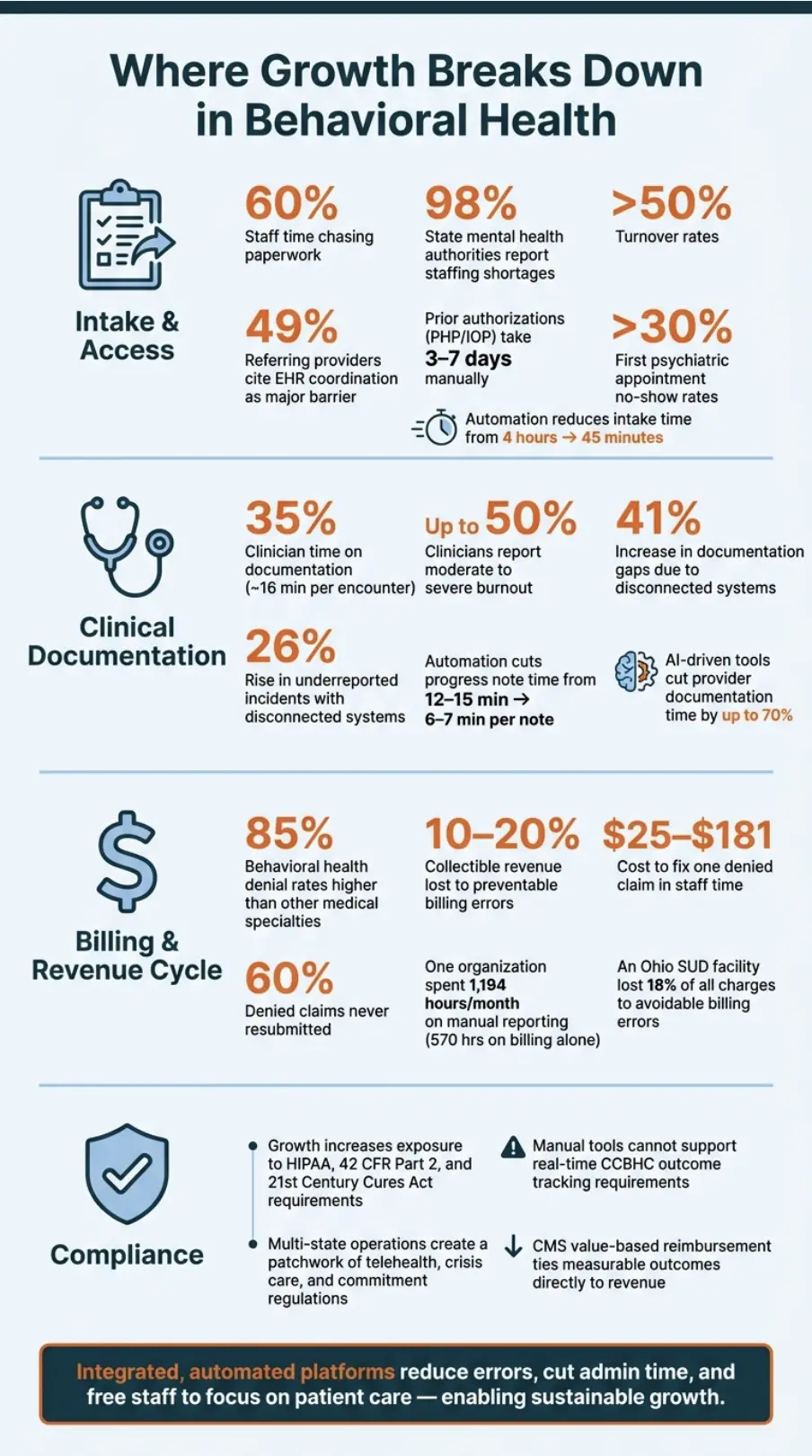
- Intake: Manual processes delay patient onboarding, with staff spending 60% of their time chasing paperwork. Automation reduces intake times from hours to minutes.
- Documentation: Clinicians spend 35% of their time on paperwork, contributing to burnout. Standardized templates and automation cut documentation time in half.
- Billing: Behavioral health faces denial rates 85% higher than other specialties. Errors cost organizations up to 20% of revenue. Integrated billing systems reduce errors and improve collections.
- Compliance: Growth increases regulatory risks. Disconnected systems make it harder to track authorizations and meet complex requirements. Centralized tools ensure real-time oversight and audit readiness.
The solution? Integrated, automated platforms that streamline workflows, reduce errors, and free up staff to focus on patient care. Investing in scalable systems is the key to sustainable growth.
Less admin.
Stronger teams.
Better client outcomes.
See how behavioral health organizations streamline documentation, staffing, and client engagement with ContinuumCloud.
Which solution would you like to explore?
Intake & Access: Where Problems Start
Why Patient Intake Gets Delayed
As behavioral health organizations expand, their intake processes often struggle to keep up. Many teams still depend on outdated tools like spreadsheets and manual chart reviews – approaches that simply can’t handle the demands of growth. When patient numbers rise, staff spend more time chasing down paperwork instead of processing referrals efficiently.
The challenges are compounded by workforce issues. Nearly 98% of state mental health authorities report staffing shortages in inpatient and residential settings. On top of that, turnover rates exceed 50%, further delaying intakes and leading to longer wait times. These delays frustrate referral sources and leave patients waiting for care they urgently need.
How Fragmented Systems Cause Lost Referrals
Referrals often come in through various channels – fax, phone, online portals, and EHR systems – but without a centralized way to manage them, things can quickly fall through the cracks. Administrative staff end up spending over 60% of their time on follow-ups via phone and fax, leaving less time to move patients through the system.
Coordination issues add to the problem. About 49% of referring providers cite EHR coordination problems as a major barrier to successful referrals. Manual processes for prior authorizations, especially for programs like PHP and IOP, can take 3 to 7 days. During this time, patients may drop out or face escalating crises. First psychiatric appointments often see no-show rates exceeding 30%, leading to lost billable hours and missed care opportunities.
Addressing these inefficiencies requires streamlined systems, and automation provides a direct solution.
How Automation Fixes Intake Bottlenecks
To resolve intake delays, a complete overhaul of the system is necessary. Automation can consolidate referral sources into a single, unified queue that prioritizes cases based on urgency, making triage more efficient. Tools that sync directly with EHR systems can also automate scheduling, matching patients with providers based on real-time availability. This shift can reduce intake times from an average of 4 hours to just 45 minutes.
Automation doesn’t stop at scheduling. AI-powered communications handle referral management, appointment confirmations, and follow-ups, freeing staff to focus on patient care while reducing no-show rates.
Solutions like ContinuumCloud‘s Welligent EHR tackle these challenges head-on by integrating intake, scheduling, documentation, and billing into one cloud-based platform. By eliminating manual data entry and reconciliation, these systems ensure intake information flows seamlessly into clinical and billing processes. This streamlined approach accelerates care delivery, reduces errors, and sets the stage for accurate clinical documentation and billing from the start.
Clinical Workflows: Documentation Burden and Process Gaps
The Weight of Manual Documentation
After intake, clinicians often face a mountain of paperwork. On average, they spend about 35% of their time on documentation, equating to roughly 16 minutes per patient encounter. While structured EHRs (Electronic Health Records) help reduce inefficiencies – cutting an 8.5% time loss and boosting time for face-to-face care – these tasks still loom large. Many clinicians find themselves completing notes after hours, during so-called “Pajama Time.” This added workload has significant consequences, with up to 50% of clinicians reporting moderate to severe burnout symptoms.
“Extra administrative tasks have been shown to divert time and focus from ‘providing actual care to patients’ and may prevent clients from receiving the most appropriate care.” – Eleos Health
When Workflows Vary Across Providers
Inconsistent documentation practices within teams can create major challenges. When clinicians use different formats or provide varying levels of detail, it becomes harder to track care effectively. This inconsistency can obstruct the ability to establish medical necessity or link symptoms to interventions clearly. For instance, behavioral health billing denial rates are 85% higher than in other medical specialties. Additionally, organizations relying on disconnected systems report a 41% increase in documentation gaps and a 26% rise in underreported incidents.
Tools That Bring Consistency to Clinical Work
Standardized templates offer a way to tackle these problems head-on. By guiding clinicians to capture key data – such as mental status exams, objective measures like the PHQ-9, and start/stop times – templates ensure documentation is both consistent and audit-ready. Digital automation tools take this a step further, cutting the time spent on progress notes from 12–15 minutes to just 6–7 minutes per note, all while preserving quality.
An example of this approach in action is ContinuumCloud’s behavioral health solutions, including the Welligent EHR,. By embedding structured templates and workflow tools into the clinical process, this platform integrates scheduling, documentation, and billing into one seamless system. This reduces the need for clinicians to switch between tools, allowing them to spend more time focusing on patient care. Beyond streamlining daily tasks, consistent documentation also supports accurate billing and compliance, making it a cornerstone of effective clinical workflows.
Revenue Cycle Management: Billing Delays and Claim Denials
The Cost of Billing Errors and Claim Denials
Billing mistakes don’t just delay payments – they often lead to permanent revenue loss. Behavioral health providers face denial rates that are 85% higher than other medical specialties. On top of that, organizations lose between 10% and 20% of collectible revenue due to preventable billing errors.
Fixing a single denied claim can cost anywhere from $25 to $181 in staff time and administrative expenses. Multiply that across hundreds of claims each month, and the financial hit becomes enormous. Even worse, 60% of denied claims are never resubmitted, leaving that revenue uncollected.
Common reasons for denials include missing prior authorizations, incorrect use of time-based CPT codes (like billing for a 90837 session without sufficient documentation), and progress notes that fail to establish medical necessity. For instance, a 2025 audit of a 32-bed residential SUD facility in Ohio revealed that 18% of all charges went uncollecteddue to avoidable billing errors, costing the facility six figures annually.
Why Manual Processes Create Financial Risk
Manual billing processes often lead to costly mistakes. A simple error, like a wrong member ID or outdated NPI, can affect hundreds of claims before anyone notices. Missed authorization expiration dates, late filings, and “silent underpayments” – where payers under-reimburse without detection – are all risks that increase without automated checks.
The administrative workload is staggering. One behavioral health organization with over 90 service locations reported spending 1,194 hours per month on manual reporting tasks, with 570 of those hours solely focused on billing summaries. This isn’t just a staffing issue – it highlights the inefficiency of outdated systems.
How Automated Revenue Cycle Management Helps
Automated tools tackle these problems at their source. When an EHR integrates scheduling, documentation, and billing into a single system, data flows seamlessly from clinical notes to claims, reducing the chances for manual errors. Real-time eligibility checks using automated 270/271 transactions help identify coverage issues before claims are submitted.
Automated alerts can flag expiring authorizations ahead of time, avoiding denials in the middle of treatment. Claim scrubbing tools catch errors like incorrect telehealth modifiers (e.g., -95 vs. GT), minimizing technical rejections.
ContinuumCloud’s Welligent EHR combines these features on one platform. By integrating clinical documentation with billing, it reduces errors that affect revenue and compliance. It also gives finance teams real-time insights into accounts receivable and payer performance, making the billing process more efficient and reliable. This not only protects revenue but also improves compliance oversight.
Compliance: Growing Risk and Limited Visibility
How Growth Increases Compliance Risk
As behavioral health organizations grow, so does their exposure to regulatory challenges. Expansion means handling more psychotherapy notes, substance use disorder (SUD) records, and consent authorizations – all of which demand strict adherence to HIPAA, 42 CFR Part 2, and the 21st Century Cures Act. With more locations, the provider network grows, increasing the chances of inconsistent documentation, unauthorized access, and missed consent updates.
Operating across multiple states adds even more complexity. Each state has its own regulations for telehealth, crisis care, and involuntary commitment procedures, creating a patchwork of compliance requirements. This growing risk underscores the importance of having unified reporting systems, as explored below.
Behavioral health practices are under increasing scrutiny as they manage some of the most sensitive patient data, making them prime targets for audits and compliance reviews.
The Problem With Disconnected Compliance Reporting
When systems don’t work together, compliance oversight suffers. Authorizations become scattered, consent records go missing, and there’s no single source for regulatory reviews. This is especially problematic for organizations providing SUD treatment, where updated 42 CFR Part 2 rules demand precise control over who has access to records and under what circumstances.
Manual processes only make things worse. For example, organizations pursuing certifications like CCBHC face intense requirements for tracking services and reporting outcomes in real time – tasks that spreadsheets and disjointed tools can’t handle effectively. With CMS moving toward value-based reimbursement models, the ability to demonstrate measurable outcomes directly affects an organization’s revenue. These challenges mirror the inefficiencies often seen in other operational areas, like intake and billing.
Using Dashboards and Audit Trails to Stay Compliant
Integrated compliance tools offer a way to address these challenges. Centralized dashboards simplify oversight by providing a single view of documentation, consent statuses, and provider activity across all locations. Instead of scrambling to gather records for an audit, leaders can monitor compliance in real time. Automated audit trails also log every system interaction, creating the transparency that regulators now expect.
Platforms like ContinuumCloud’s Welligent EHR are built to support this level of compliance. With features like real-time tracking, automated consent management (complete with expiry alerts), and audit-ready workflows, the platform integrates compliance into daily operations. For organizations expanding across multiple locations or service lines, these tools ensure compliance evolves alongside growth, reducing the risk of falling behind or scrambling to catch up.
Conclusion: Building Systems That Support Growth
Growth in behavioral health is fundamentally a systems issue. As discussed earlier, manual workflows, limited visibility, and overwhelmed staff create roadblocks to scaling up. This often leaves organizations increasing patient volume while struggling to match that growth with adequate capacity.
Consider this: clinicians spend an average of 35% of their time on paperwork, and burnout affects between 21% and 67% of mental health professionals. Adding more patients without scalable systems only worsens these pressures. As Cortney Swartwood, Behavioral Health Billing Specialist, explains:
“If your billing model can’t keep up, the answer isn’t always more people. It’s often better prevention, better visibility, and better ownership.”
The solution lies in creating scalable, integrated systems.
Organizations that invest in integrated, cloud-based platforms often see transformative results. For instance, virtual tools can reduce intake wait times from 60 days to as little as 1–3 business days. Similarly, AI-driven documentation tools have been shown to cut provider documentation time by up to 70%. These examples highlight the potential of systems designed to grow alongside organizational needs.
ContinuumCloud offers a tailored suite of tools to address these challenges. Their Welligent EHR streamlines clinical and revenue cycle workflows, DATIS optimizes workforce management, and CaredFor enhances alumni engagement. Instead of relying on additional staff to fill gaps, these tools tackle the core issues: fragmented data, excessive manual work, and a lack of real-time insights.
For sustainable growth, organizations need systems that provide real-time data and enable proactive care. This approach not only ensures consistent revenue but also maintains high-quality care as demand increases. The key to solving bottlenecks lies in building infrastructure that scales effectively.
FAQs
Where should we start fixing bottlenecks first?
What should an integrated EHR and billing system include?
An integrated EHR and billing system for behavioral health is designed to streamline processes, enhance accuracy, and maintain compliance. Critical features include automated claims management, which simplifies submission and reduces errors, and real-time tracking, allowing providers to monitor claims throughout the process. The inclusion of payer-specific rule engines helps minimize delays and denials by ensuring submissions meet unique requirements.
Such systems should also seamlessly connect with clinical documentation, support telehealth billing, and offer tools for measuring outcomes. These functionalities ensure that both clinical and financial workflows are aligned. Additionally, comprehensive reporting and analytics are essential for tracking financial performance and ensuring compliance with regulations like 42 CFR Part 2. These capabilities empower providers to maintain efficiency while adhering to strict industry standards.
How do we stay audit-ready as we add locations and services?
To keep your operations audit-ready during growth, it’s crucial to establish systems that support both scalability and compliance. Prioritize maintaining precise documentation, following federal and state billing regulations, and leveraging technology that enhances compliance visibility.
Automating workflows and integrating reliable revenue cycle tools can significantly cut down on errors and risks. Additionally, providing regular training for your team on updated standards ensures everyone stays informed. Systems offering real-time insights are especially valuable – they allow you to spot and resolve potential problems early, helping you stay compliant as your business expands.