If your EHR adds clicks, late notes, denials, and staff frustration, it’s not just annoying - it’s slowing your whole organization down.
I’d look for four problem areas first: productivity, documentation, staff strain, and billing. In many behavioral health settings, clinicians spend about 35% of the workday on documentation, denial rates run much higher than other specialties, and after-hours charting becomes part of the job.
Here’s the short version of what this article shows:
- Routine tasks take too many clicks
- Workflows don’t fit behavioral health care
- Documentation takes too much of the day
- Staff rely on spreadsheets, paper, and side systems
- Reports don’t help leaders make day-to-day decisions
- Billing errors and denials happen too often
- The EHR doesn’t connect well with other systems
- Group services and team-based care are hard to document
- The system gets worse as the organization grows
- Clinicians feel drained by the EHR
These signs often show up together. More clicks lead to slower notes. Slower notes lead to billing delays. Weak reporting makes it harder to spot the problem until time and money are already slipping away.
Less admin.
Stronger teams.
Better client outcomes.
See how behavioral health organizations streamline documentation, staffing, and client engagement with ContinuumCloud.
Which solution would you like to explore?
Quick Comparison
|
Area |
What trouble looks like |
What to check |
|
Productivity |
Too many screens, repeated data entry, slow charting |
Clicks per task, time to finish routine notes |
|
Documentation |
Late notes, copied text, thin clinical detail |
After-hours charting, note completion time |
|
Staff workflow |
Spreadsheets, paper tracking, email-based handoffs |
Number of side processes staff use |
|
Reporting |
Old data, manual exports, weak visibility |
Time to pull caseload, denial, and outcome reports |
|
Billing |
Missing auths, code mismatches, denied claims |
First-pass denial rate, A/R days, rework volume |
|
Growth |
More staff needed just to keep up with admin work |
Reporting hours, chart lag by site or program |
|
Staff strain |
Burnout, frustration, turnover tied to the system |
Staff survey feedback, overtime, turnover trends |
Bottom line: if your team is spending too much time documenting, fixing claims, and working around the system, your EHR may be part of the bottleneck - not the fix.
Why EHR Misalignment Hits Behavioral Health Harder
Those demands point to a bigger problem: most EHRs were built for discrete medical visits, not for behavioral health care that unfolds over time.
Behavioral health isn't centered on a procedure or a one-off encounter. Clinicians need to document therapy methods, observed responses, risk factors, and progress toward treatment goals. Most EHRs still don't handle that well.
EHRs designed for acute care focus on single events. Behavioral health is longitudinal, so clinicians need the full story, not just the last visit. When a system organizes records around separate encounters, staff end up clicking through visit after visit just to figure out where a client stands today.
Narrative note formats like DAP, BIRP, and SOAP matter here. They hold psychosocial context, clinical judgment, and the therapy process itself. But when those notes get squeezed into medical exam templates built around checkboxes and problem lists, clinicians face a bad tradeoff: rewrite the note or lose detail. Either way, documentation takes longer and the record gets weaker. Psychiatrists already spend roughly 20% of their working hours on administrative tasks - the highest share among physician specialties - and therapists often tack on 15 to 25 minutes of documentation to every 50-minute session.
Treatment planning adds another layer. Behavioral health teams need treatment plans and authorizations in one workflow, not in separate places. These plans usually follow a goal–objective–intervention structure tied to payer rules, DSM-5-TR criteria, and utilization review. Payers want to see measurable progress, proof of medical necessity, and a clear link to approved goals. When the EHR doesn't connect treatment plans, session notes, and authorization tracking in one place, staff end up managing the work by hand - often in spreadsheets or separate tracking tools. That's when missed authorization deadlines and preventable claim denials start piling up.
Group therapy is another pain point. It's central to care and tied directly to revenue in behavioral health, yet many general EHRs treat it like an afterthought. Properly documenting group sessions, tracking attendance, and billing them the right way calls for workflows built for that setting. And when therapists, psychiatrists, case managers, and peer support specialists can't work from one shared treatment plan or see notes in the right context, coordination starts to slip. Records get fragmented. Work gets duplicated. Handoffs get missed. Care gaps follow.
Those structural gaps show up in the daily workflow problems that come next.
1. Too Many Clicks and Screen Switches for Routine Tasks
In behavioral health, routine work should move fast. Scheduling, notes, treatment plans, and authorizations should take seconds, not feel like a maze.
But many EHRs turn one client encounter into a slog. Staff may need to move through 6 to 10 screens and dozens of clicks just to finish basic work. And once that happens, the drag doesn’t stay in one place. It spills into documentation, billing, and day-to-day oversight.
The numbers back that up. Research shows that streamlining EHR navigation can cut EHR time by 18.5% and reduce the steps for some documentation tasks by 88–97%.
That kind of gap matters. When staff have to bounce between screens to verify codes, link notes, and check authorization status, claims slow down and mistakes pile up. Behavioral health groups can lose 10% to 20% of collectible revenue because of preventable billing errors and claim denials tied to fragmented systems.
There’s another problem here too: click-heavy workflows make it harder to spot what’s going wrong. Friction at the staff level often shows up in reporting and management. People rush through queues, leaders lose real-time visibility, and clinicians end up finishing charts after hours.
A JAMA study estimated that U.S. physicians spent 1.84 hours per day on documentation outside office hours, adding up to about 125 million hours of after-hours EHR work in 2019 alone. In behavioral health, that same pattern shows up when routine charting spills into evenings. At that point, the issue usually isn’t the clinician. It’s the workflow.
2. Workflows That Don't Fit Behavioral Health Care
The deeper issue isn't just extra clicking. It's that the workflow itself often doesn't match behavioral health care.
Most general-purpose EHRs are built for short, structured visits. Behavioral health works differently. It's conversation-led, long-term, and often shared across a team. So when the EHR doesn't match that day-to-day reality, staff end up squeezing behavioral health work into a system that was built for something else.
That mismatch slows documentation down. Clinicians often have to bounce between disconnected screens to finish tasks that should live in one simple flow. And this isn't a small annoyance. In a cross-sectional survey of 282 clinicians, 86.9% cited excessive data entry requirements as a major EHR design concern tied to stress and burnout.
Reporting takes a hit too. If the EHR is shaped around generic encounter types, leaders can lose track of behavioral health metrics like treatment engagement, visit adherence, and movement toward individualized goals. On top of that, documentation starts to vary from clinician to clinician, which makes caseload management less dependable.
The end result is familiar: slower charting, more manual cleanup, and documentation you can't always count on. When the workflow doesn't match the care model, staff fall back on manual steps, consistency slips, and reporting gets weaker.
When the system doesn't fit the work, staff build shortcuts just to keep the day moving.
3. Documentation Eats Up Most of the Workday
When documentation turns into the bottleneck, everything else starts to drag. If the workflow doesn't match the way care is actually delivered, charting becomes the biggest drain on time.
Research shows clinicians spend about 2 hours on EHR and admin work for every 1 hour of direct patient care. In one national ambulatory study, documentation alone took up 2.3 hours out of every 8 scheduled hours - the largest share of all EHR time. That cuts into time for patients and pushes charting into small gaps between visits or late at night. The result is pretty clear: fewer finished charts, slower throughput, and less time for care.
In psychiatry, the strain is already heavy. Residents average 22 hours per week in the EHR, and that use is strongly tied to emotional exhaustion. That lost time doesn't just hurt one person. It limits capacity across the whole team. It also pushes aside other EHR tasks that help care delivery and day-to-day operations.
Under that kind of pressure, note quality often slips. Staff lean on copy-paste, vague wording, and thin documentation just to keep up. Studies estimate that more than 50% of note text in many settings is duplicated, which can carry old or wrong information forward. And that's where the trouble starts:
- Notes may not clearly support medical necessity
- Treatment plans may not match the patient's actual progress
- Records may fall apart during a payer audit
Delayed notes can also slow claims and hold up reimbursement. Cleaner, faster documentation helps claims keep moving and lowers the odds that revenue gets stuck behind unfinished charts. When that pressure builds, teams often start relying on unofficial workarounds.
4. Staff Rely on Workarounds and Unofficial Systems
When documentation pressure builds, staff stop using the workflow as it was meant to be used. They shift tracking into spreadsheets, paper notes, and email because the EHR software gets in the way of day-to-day work. That's a system issue, not a training issue. And once that shift happens, the workaround becomes the actual process.
Research points in the same direction: most workarounds come from poor workflow design, not lack of training, and staff often fall back on paper aids or enter data later when the system blocks routine tasks. When those workarounds stick around, it's a clear sign the system doesn't fit the work. The fallout shows up fast.
This doesn't just add a little friction. It creates duplicate work and leaves gaps in the record. Staff enter the same information in more than one place, and some organizations have spent more than 1,194 hours per month on manual reporting tasks, with 570 hours of that time spent only on billing summaries. Shadow systems also bury safety flags, care updates, and coordination notes. That's where both operational and clinical risk start to pile up.
After a while, these workarounds stop feeling temporary. They become normal. New hires get shown the spreadsheets right alongside the EHR, and when leadership tries to roll out a new protocol or quality effort, they're stuck dealing with dozens of unofficial tools across programs and locations. At that point, the next problem tends to show up in reports and leadership dashboards.
5. Reports and Analytics Don't Give Leaders What They Need
A lot of these shadow systems exist for one simple reason: the EHR can't give leaders the reports they need, when they need them.
If a program director can't pull real-time caseloads by clinician, or a clinical supervisor has to wait weeks for utilization data, people stop waiting on the system. They build a spreadsheet and use that instead. At that point, the spreadsheet becomes the reporting system. And that gap doesn't stay stuck in the back office. It affects daily staffing, caseload management, and access to care.
Many EHRs do a decent job of documenting services and sending claims. But operational reporting is where things start to fall apart. Reports tend to be template-based and centered on volume: how many visits happened, how many units were billed. That's useful up to a point. But leaders also need the numbers that shape day-to-day choices. They need to see where clients drop out of care. They need to know how long someone waits between referral and first appointment. Too often, getting that view means exporting data, combining it with HR and scheduling files, and rebuilding the whole thing in Excel.
The money side takes a hit too. Without a clear view of denial trends, payer performance, and authorization gaps, revenue leakage can sit there in plain sight and still go unnoticed. Organizations lose 10% to 20% of collectible revenue because of preventable billing errors and weak denial visibility. That's not a rounding error. It's money that should have come in. In one behavioral health organization with 90+ locations, staff were spending 1,194 hours per month on manual reporting tasks alone, and 570 of those hours went only to billing summaries.
Outcome tracking runs into the same problem. Standardized measures like the PHQ-9 or GAD-7 often aren't stored as structured, reportable data. So leaders can't track results over time or compare outcomes by program or clinician without extra manual work. That gets harder as payers push value-based contracts. The NCQA has identified outdated EHRs and non-interoperable data systems as a major source of problems in reporting behavioral health quality measures. If outcomes data isn't structured, leaders can't show progress in a clean way, and they can't run programs with a steady hand.
When data is this delayed, leaders end up making calls based on stale reports and staff anecdotes. Meanwhile, billing problems stay buried until they show up in cash flow. Nearly half of healthcare executives, 49%, say poor or slow decision-making is the biggest financial result of low-quality data. Those blind spots don't stay abstract for long. They turn into denied claims, missed authorizations, and reimbursement delays.
6. Billing Errors and Claim Denials Happen Too Often
Billing issues in behavioral health usually point to a simple problem: the EHR and revenue cycle process aren't working together.
When leaders don't spot authorization gaps early, billing pays the price later. And when documentation, authorization details, and billing fields sit in different places, staff have to enter the same data again and again. That's when avoidable mistakes slip through, like missing authorizations, wrong modifiers, and mismatched codes. Once those fields drift out of sync, denials climb fast.
The numbers are hard to ignore. Behavioral health claim denial rates run 12% to 20% or higher, compared to 5% to 10% for most medical and surgical services. On top of that, 30% of behavioral health claims are denied on first submission, with 23% tied to prior authorization failures and 18% linked to failed benefit verification.
And the cleanup work isn't cheap. The cost to work a single denied claim rose from $43.84 in 2022 to $57.23 in 2023. Worse, about 60% of denied claims are never resubmitted because fixing them takes too long.
That’s why the best answer is prevention, not back-end repair. A better EHR setup can cut denials by:
- linking authorizations to encounters
- checking eligibility in real time
- matching note templates with coding and payer rules
This isn't just an abstract risk sitting on a spreadsheet. In one 2025 audit of a 32-bed residential SUD facility in Ohio, 18% of all charges went uncollected because of preventable billing errors. That led to a six-figure annual revenue loss.
At that point, it's hard to call it a staff issue. It's a system design problem.
7. The EHR Doesn't Connect Well with Other Systems
Poor integration is one of those problems that hides in plain sight. It slows billing, drags down care, and forces staff to do work the system should handle on its own.
A lot of billing issues start when systems don't talk to each other. If an EHR can't exchange data well with labs, pharmacies, payers, billing software, or telehealth tools, staff end up doing the connecting by hand. That means re-entering demographics and insurance details in multiple places, calling around for discharge summaries, and matching up medication lists after outside visits.
The time loss adds up fast. One AMA workflow study found that clinicians spent an average of 1.7 hours per day reconciling external data because interoperability was poor. That's time that could have gone to patients.
The same disconnect can create risk during care transitions. When behavioral health data doesn't move cleanly between residential programs, outpatient teams, psychiatry, and therapy providers, key details can fall through the cracks during handoffs. That includes medication changes, risk assessments, and treatment plan updates. Research summarized by NIH found that more than 80% of surveyed physicians reported difficulty retrieving information from other organizations, and limited interoperability was linked to threats to patient safety.
These handoff problems don't stop at care delivery. They hit the revenue cycle too. In behavioral health, 18–25% of administrative denials in practices using disconnected systems trace back to manual re-entry between the EHR and billing software, and disconnected systems are typically associated with 10–20 extra days in accounts receivable and 3–5% net revenue leakage from manual errors. That's not just a billing team issue. It's a system design issue, and it gets worse week after week when the integration gap stays in place.
This problem is common across behavioral health. Among behavioral health facilities, only 44% can integrate external clinical data without manual entry, and 31% lack the capability to query external records at all. Put simply, nearly one in three behavioral health organizations is stuck with a system that acts more like a data silo than a connected platform - and staff and revenue both take the hit.
8. Group Services and Team-Based Care Are Difficult to Document
An EHR might work fine for one-on-one visits and still fall apart the minute group care enters the mix. Most systems are built around a simple setup: one clinician, one client, one note. That sounds neat on paper. In practice, it creates plain old workflow drag as soon as group services or multidisciplinary charting show up.
The time hit shows up right away. After a 90-minute group session with 10 participants, a clinician may have to finish 10 separate progress notes. That can add 60 to 90 extra minutes of charting time after the session is over. And it doesn’t stop with one group. It grows with every group on the calendar.
That workload turns into a billing issue when the note has to support reimbursement. Group billing depends on complete documentation. For CPT code 90853 (group psychotherapy), payers expect documentation of who attended, the group focus, interventions used, each client's participation and response, and total session duration. If the EHR can’t produce individualized notes in an efficient way, billing teams end up piecing things together from attendance logs, tracking down missing details, and fixing claims later.
Team-based care adds another layer. When psychiatry, therapy, and case management all update the chart in separate parts of the record, people miss the full picture. A medication change, an updated safety plan, and a closed referral can all happen on the same day without any shared view tying them together. That leaves staff trying to figure out what coworkers already handled, while treatment plans drift out of sync with active care.
The effect on staff is hard to miss. When clinicians spend too much time repeating nearly the same group documentation over and over, the EHR can start to feel like an obstacle instead of a tool. And as organizations add more groups, more programs, and more locations, that friction grows fast.
9. The System Struggles to Keep Up as Your Organization Grows
As your organization adds locations, programs, and users, small EHR headaches can turn into a scale problem. A few extra seconds here and there may not seem like much at first. But across every patient encounter, those delays stack up. And for clinicians, front-desk staff, and billing teams, the drag gets worse with each new service line, site, and user added to the system.
That slowdown hits both clinical throughput and admin capacity. Once volume goes up, poor system speed stops being a minor annoyance and starts showing up in the data. In a cross-sectional survey of 282 clinicians, slow system response times had a statistically significant association with higher stress and burnout (β̂ = 0.42; P < .001). Put simply, if the system lags under pressure, your staff feels it.
Admin work also climbs as volume grows. When an EHR can't scale, teams often end up patching the gaps with manual workarounds, spreadsheets, and extra reporting work. One example found that organizations with 90+ service locations spent 1,194 hours per month on manual reporting tasks, with 570 of those hours going to billing summaries alone.
At that point, the EHR isn't helping growth anymore. It's getting in the way. And when you have to hire people just to work around the system, that's a pretty clear sign the system can't keep up.
10. Clinicians Are Frustrated and Burned Out by the EHR
EHR frustration isn't just a morale problem. It's an operational risk.
The research points in the same direction: a one-point increase in EHR usability score is linked to about a 3% drop in burnout odds. When the system is hard to use, the strain builds in the background and pushes staff closer to burnout.
The day-to-day drag matters too. All those extra clicks, tabs, and screen changes wear clinicians down. In behavioral health, care depends on human connection. So when the workflow keeps pulling a clinician back to the screen, attention shifts away from the client.
And when charting already takes a big chunk of the day, the work doesn't stop at clock-out. Thirty percent of clinicians spend more than six hours a week on EHR tasks outside normal work hours. That means late-night notes, tired decision-making, and more room for missed safety signals. In behavioral health, that's a serious issue because risk assessment is part of routine care.
This strain doesn't stay personal for long. It turns into a staffing problem. Staff turnover in behavioral health inpatient and residential settings exceeds 50%, and replacing a single employee lost to burnout typically costs between $30,000 and $50,000. And that doesn't even include lost billable hours, claim denials tied to incomplete documentation, or the cost of hiring in a labor market that's already tight.
What Modern Behavioral Health Platforms Do Differently
The fix is pretty straightforward: cut down clicks, keep data in one place, and flag problems before they slow care down.
Most of the pain points fall into four buckets: workflow friction, weak visibility, revenue leakage, and trouble scaling. Cloud-based behavioral health software built for the industry tackles those issues in the day-to-day workflow, not just with a nicer-looking interface.
In practice, that means the right platform does more than store notes. It fits the way behavioral health care is actually delivered. Documentation built around behavioral health standards and common screening tools means clinicians don't have to squeeze their work into forms made for a general medical visit. Pre-filled fields, plus fields that appear only when needed, cut repetitive data entry and make routine notes faster to finish from one screen.
The same idea applies to group care and team-based care. Shared group encounter tools let staff record session details once, then add individual details only where needed. Interdisciplinary teams can work from the same treatment plan, read each other's notes, and coordinate care without long email chains or side spreadsheets.
On the financial side, connecting appointments, codes, and authorizations helps catch mistakes before claims go out. Automation cuts manual rework that drags out the revenue cycle and helps keep claims moving instead of sending them back for back-end fixes.
Direct data exchange with referral sources, labs, and payers cuts duplicate entry. At the same time, dashboards give leaders real-time visibility into denial rates, documentation timeliness, caseload distribution, and outcome trends. Behavioral health leaders need timely, actionable data to make informed decisions about capacity, outcomes, staffing, and revenue.
Those differences show up fast in daily operations, and the comparison below makes them easier to spot.
Side-by-Side Look at the Operational Impact
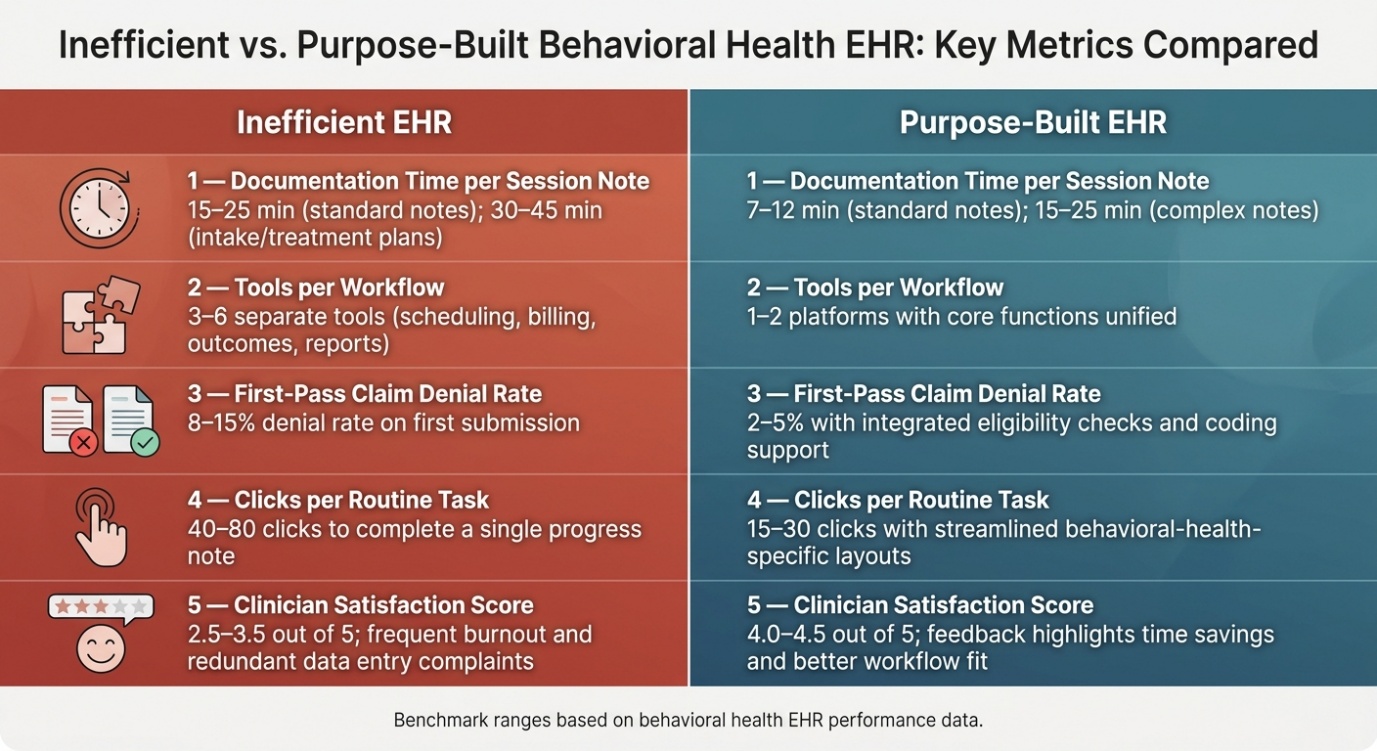
These differences show up in day-to-day work, not just on a feature checklist. The benchmark ranges below can help you compare your own documentation logs, denial reports, and staff survey results against what’s happening in your current workflow.
|
Metric |
Inefficient Behavioral Health EHR |
Behavioral Health EHR Built for the Workflow |
|
Documentation time per session note |
15–25 min (standard); 30–45 min (intake/treatment plan) |
7–12 min (standard); 15–25 min (complex) |
|
Tools per workflow |
3–6 tools (separate scheduling, billing, outcomes, reports) |
1–2 platforms with core functions in one environment |
|
First-pass denial rate |
8–15% on first submission |
2–5% with integrated eligibility checks and coding support |
|
Clicks per routine task |
40–80 clicks to complete a single progress note |
15–30 clicks with streamlined, behavioral-health-specific layouts |
|
Clinician satisfaction score |
2.5–3.5 out of 5; frequent comments about burnout and redundant data entry |
4.0–4.5 out of 5; feedback highlights time savings and better workflow fit |
High click counts slow charting down. They also add friction to routine work and can push burnout risk higher.
You see the same pattern in reporting. Volume numbers by themselves don’t tell you whether care is flowing well. Gaps in reporting can affect staffing, access, and outcomes. Billing-only reports show volume. Modern dashboards show capacity, outcomes, and access side by side.
|
Reporting Dimension |
Limited Billing-Only Reporting |
Modern Behavioral Health Dashboard |
|
Caseloads |
Visits billed per clinician; static monthly exports |
Real-time caseload size, acuity, new intakes, and time to first appointment |
|
Client outcomes |
Inferred from service volume; tracked in separate spreadsheets |
Integrated PHQ-9, GAD-7, and other scales tied to visits and treatment plans |
|
Utilization |
Units billed and revenue by payer |
Schedule fill rates, no-show patterns, wait times, and capacity by site |
|
Referral visibility |
Total new intakes; referral source rarely tracked |
End-to-end funnel from referral received through intake and ongoing engagement |
In many cases, the problem isn’t a lack of data. It’s that the data sits in the wrong systems, shows up too late, or takes so much manual work that teams can’t use it when they need it.
Conclusion
These signs point back to the same issue: the EHR doesn't fit the way behavioral health teams actually work. And when that happens, everything gets slower - care, documentation, and billing.
The money side follows the same pattern. Billing mistakes that could have been avoided, plus manual steps that pile up, chip away at revenue and create extra work across the organization.
If this sounds familiar, run a workflow audit now.
Start simple. Time a few routine documentation tasks. Ask clinicians where the most friction shows up. Write down every spreadsheet, side process, and workaround your team relies on. Then check your denial rate and how often charting spills into after-hours work.
Those signs connect to numbers you can track across the same problem areas:
- clicks
- documentation time
- workarounds
- reporting gaps
- denials
- after-hours charting
That data helps you see where the EHR is costing the most in time and money.
Run the audit with clinicians, billing, program, and leadership teams in the room. Each group sees a different part of the problem. Put those views together, and scattered complaints start to look like a clear, shared list of what needs to change for clients.
FAQs
How can I audit our EHR workflow?
Start with internal assessments and key operational metrics to spot workflow bottlenecks.
Then use EHR-embedded tools and centralized dashboards to review documentation, consent status, and provider activity in real time across locations. Your system should also provide audit trails that help verify record accuracy and support regulatory compliance.
Which metrics matter first?
Start with metrics tied to clinical quality, operational efficiency, and financial health. Set baselines before you change anything so you can see what improved and by how much.
Focus on a short list of measures that matter most:
- First-pass claim success
- Billing denial rates
- Documentation turnaround time
- Note completion time
- Staff workarounds
- No-show or attendance rates
That mix gives you a clear view of care, workflow, and revenue without drowning in data.
When is it time to replace the EHR?
It may be time to replace your behavioral health EHR when it stops keeping up with your organization’s growth or changing care needs.
Some of the most common signs are manual workarounds, trouble managing multiple levels of care or service lines, heavy documentation demands, claim denials caused by data gaps, limited real-time reporting, and difficulty scaling during mergers or acquisitions.