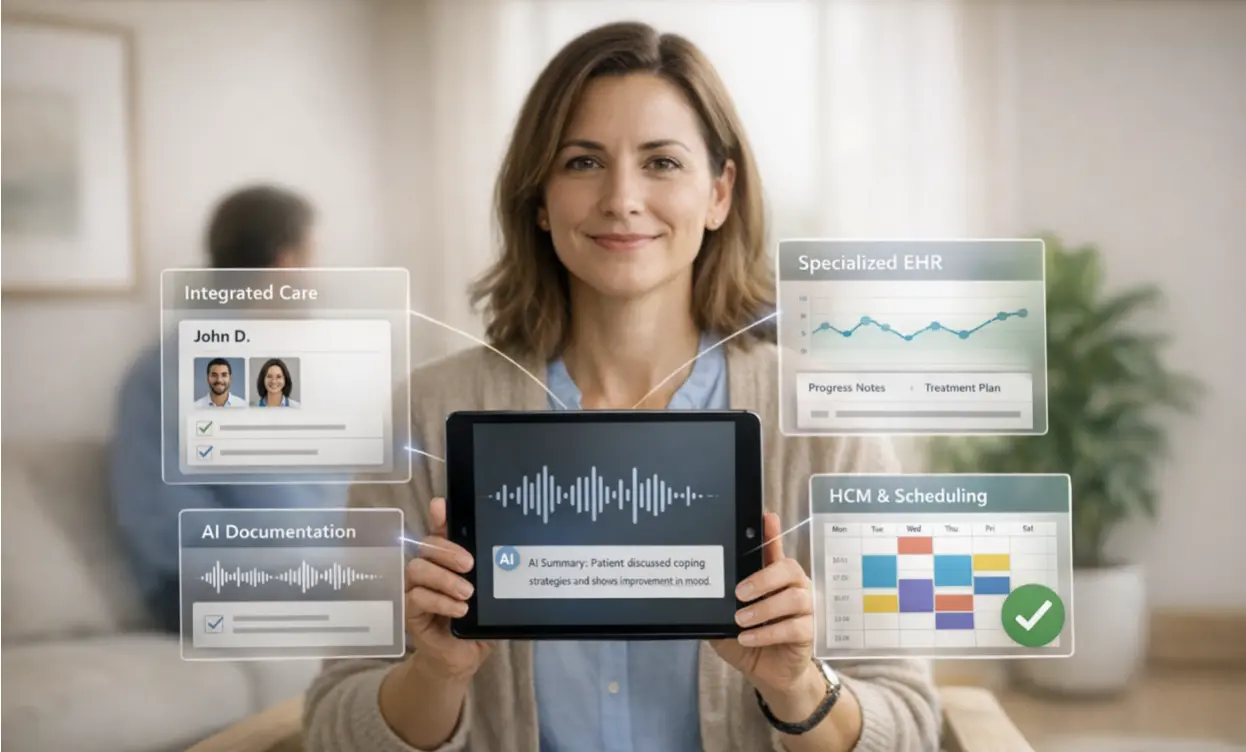
Patient engagement in behavioral health has transformed with digital tools like patient portals, telehealth, and mobile apps. These innovations help patients stay involved in their care by simplifying appointment scheduling, offering virtual therapy, and providing personalized resources. The shift to digital engagement improves treatment adherence, reduces no-shows, and supports better outcomes, addressing common challenges like staff shortages and medication non-adherence.
Key strategies include:
- Automated Reminders: Reduce missed appointments with text/email notifications and online scheduling.
- Secure Messaging: Enable HIPAA-compliant communication between patients and providers.
- Outcome Tracking: Use digital surveys to monitor progress and adjust care plans.
Tools such as ContinuumCloud‘s CaredFor platform integrate these features, offering 24/7 access to resources, peer support, and real-time data tracking. Metrics like Patient Activation Measures (PAM) and portal adoption rates demonstrate the effectiveness of these tools. As behavioral health moves toward value-based care, digital engagement is becoming essential for success.
How Patient Engagement Improves the Behavioral Health Experience for Clients & Clinicians
Core Strategies for Patient Engagement
Behavioral health providers are turning to technology to keep patients actively involved in their care. These tools address common hurdles like missed appointments, communication breakdowns, and difficulties in tracking progress. By weaving these strategies into everyday workflows, providers can make the most of digital solutions to boost engagement and improve treatment outcomes. Here are three key approaches that are making a difference.
Automated Reminders and Scheduling
Automated text and email reminders are proving effective at reducing no-shows, especially for patients who may face cognitive challenges. Online scheduling adds another layer of convenience, allowing patients to book, reschedule, or even join waitlists without needing to call. This not only saves time but also minimizes administrative back-and-forth. Metrics like cancellation-to-reschedule ratios help providers measure how well appointments are being managed. Together, these tools create a smoother, more consistent care experience.
Secure Two-Way Messaging
HIPAA-compliant messaging platforms enable private and convenient communication between patients and providers. These tools offer a safe space for patients to ask questions, share concerns, or request help without the pressure of an in-person visit.
“HIPAA-compliant messaging… is a vital component of behavioral health care because it helps ensure that patient information is confidential and that healthcare providers can meet patients where they are.” – Dylan Souza, Vice President of Marketing, ContinuumCloud
To make the most of this feature, providers should establish clear response protocols to ensure timely replies. Automated responses can also help set expectations about when patients will hear back. Tailoring the tone, language, and timing of messages to align with a patient’s treatment goals strengthens the therapeutic bond, even outside traditional sessions.
Outcome Tracking and Data-Driven Feedback
Digital surveys and assessments, such as PAM and PROM, allow providers to collect real-time data on a patient’s emotional and physical well-being. This information helps providers adjust treatment plans quickly and effectively. It also empowers patients by giving them tools to track their moods, set goals, and monitor their progress – keeping them actively engaged in their recovery.
Validated tools like the Medication Adherence Rating Scale (MARS) provide objective insights into how well patients are following their treatment plans. This data enables providers to deliver tailored interventions, whether that means tweaking medications, introducing peer support, or addressing external challenges like housing or transportation barriers. These strategies, when paired with advanced digital tools, are transforming how behavioral health providers engage with their patients.
Technologies Driving Patient Engagement in Behavioral Health
Three key digital tools – patient portals, telehealth, and mobile apps – are breaking down barriers like distance, administrative delays, and gaps in support. With 80% of mental health facilities now offering telehealth services, these innovations are reshaping how patients manage their care, access services, and receive personalized support.
Patient Portals: A Hub for Self-Management
Patient portals serve as a one-stop shop for lab results, prescription refills, appointment scheduling, and more, giving patients the tools to take charge of their care. In fact, 80% of people who accessed their online medical records found the information clear and helpful. These portals also play a crucial role in reinforcing treatment goals, especially since research shows patients forget up to 80% of what clinicians discuss during appointments.
Providers benefit too – patients who use portals are 2.6 times more likely to stick with their current healthcare provider. The key to increasing portal adoption lies in making registration part of routine care. For example, Inova Health collaborated with the Office of Evaluation Sciences to redesign their after-visit summaries. By adding larger text, clear action steps, and simple instructions for signing up, they boosted patient portal activation rates by 10%. As Josh Gray, Vice President at athenaResearch, puts it:
“It is the difference between asking whether a patient would like to register for the portal versus communicating that portal registration is expected and is integral to the care process”.
By offering continuous access to vital health information, patient portals empower individuals to stay engaged in their treatment.
Telehealth Platforms: Expanding Access
Telehealth has revolutionized behavioral health by removing geographic barriers, making care more accessible in rural and underserved areas. These platforms support a wide range of services, from one-on-one therapy and group sessions to substance use disorder treatment. They also help reduce the stigma of visiting a physical clinic. Since the start of the COVID-19 pandemic, telehealth usage in behavioral health has skyrocketed – growing 45 times over.
Interestingly, a 2020 review found that electronically delivered Cognitive Behavioral Therapy (CBT) was, in some cases, more effective than traditional face-to-face CBT. Telehealth also benefits providers, enabling them to expand their reach without increasing overhead costs. When combined with client engagement tools, telehealth services can drive patient satisfaction rates as high as 98%.
By addressing long-standing accessibility challenges, telehealth is reshaping how behavioral health services are delivered.
Mobile Apps: Personalizing Care
Mobile apps add a new layer of engagement by offering real-time tools like mood tracking, psychoeducation, and crisis support between appointments. For instance, the U.S. Department of Veterans Affairs National Center for PTSD has developed coaching apps tailored to help veterans cope with trauma, enhancing the effectiveness of their care.
Prescription Digital Therapeutics (PDTs) take this a step further by delivering evidence-based interventions like CBT or Contingency Management (CM). These often require FDA clearance, ensuring their quality and reliability. However, it’s worth noting that while thousands of behavioral health apps are available, only about 3% to 4% are backed by evidence. To ensure quality, providers can consult trusted resources like the M-Health Index & Navigation Database (MIND) or One Mind PsyberGuide when recommending apps. Cost remains a hurdle, though – just 39% of these apps are completely free, which can limit access for some users.
Together, these digital tools are transforming patient engagement, paving the way for platforms like ContinuumCloud’s CaredFor to deliver more responsive and connected care experiences.
How ContinuumCloud‘s CaredFor Platform Improves Patient Engagement

ContinuumCloud’s CaredFor platform steps in to address a critical gap – only 17% of organizations currently use a dedicated patient engagement app. Tailored specifically for behavioral health and human services, CaredFor integrates the digital tools previously mentioned into one HIPAA-compliant ecosystem, supporting patients, families, and alumni throughout their care journey. By bringing these tools together, it creates a cohesive and user-friendly experience.
CaredFor Platform Features
At its core, the platform focuses on personalized care journeys that extend support far beyond the walls of traditional appointments. Providers can design automated care sequences triggered by specific events, such as admission, discharge, or even a patient’s first login. This automation ensures patients receive timely interventions without adding to staff workloads.
A white-labeled mobile app, customized to reflect an organization’s branding, provides 24/7 access to resources. One standout feature is the peer support community, offering patients and alumni a secure space to share experiences and celebrate milestones. As Ryan Chapman, CEO of Integrative Life Center, puts it:
“With the CaredFor app, their peer support network and ILC family is just a click away”.
The platform also integrates seamlessly with EHR systems, reducing redundant data entry and ensuring smoother workflows. Additionally, digital surveys allow for real-time tracking of treatment outcomes, giving providers valuable insights into patient progress. Other features include telehealth capabilities, automated reminders to reduce no-shows, and a curated content library tailored to align with an organization’s clinical programs.
Michael Arnold, Director of Alumni and Recovery Support Services at Harmony Foundation, highlights its transformative impact:
“It has literally been a game changer for our alumni and for our patients when they leave – to feel supported and comfortable, really easing into this new way of life in recovery”.
CaredFor vs. Traditional Engagement Methods
CaredFor sets itself apart from traditional approaches, offering solutions that are both modern and scalable. Here’s how it stacks up against older methods:
|
Feature |
CaredFor Platform |
Traditional Engagement (Phone/Paper) |
|
Accessibility |
24/7 access via mobile app; peer support is “just a click away” |
Limited to office hours or scheduled appointments |
|
Adherence |
Automated reminders, digital interventions, and personalized care journeys |
Manual follow-up calls and paper-based plans that are easily misplaced |
|
Scalability |
High; automated workflows and digital communities support larger populations |
Low; requires significant staff time for individual outreach |
|
Data Collection |
Real-time digital surveys and automated outcome reporting |
Manual data entry from paper forms; slower feedback loops |
|
Community |
Built-in secure peer networks for patients and alumni |
Often nonexistent or limited to in-person support groups |
Pat Brown, LCSW at Mirmont Treatment Center, underscores the platform’s clinical importance:
“It’s important to have a vessel that’s HIPAA compliant and in line with my values as a social worker to deliver the services that I do; and CaredFor is the only tool I feel comfortable using to achieve family and alumni services post-discharge”.
Measuring Success and Future Trends
Tracking the right metrics is key to evaluating how well your engagement strategy is working. One reliable tool to start with is Patient Activation Measures (PAM). PAM assesses a patient’s knowledge, skills, and confidence in managing their own health. By comparing PAM scores before and after introducing new engagement tools, you can gauge the impact of your efforts and determine the return on investment.
But activation is just one part of the puzzle. Metrics that track day-to-day engagement are equally important. For instance, treatment attendance rates show how often patients follow through on scheduled appointments. The cancellation-to-reschedule ratio – calculated by dividing the number of rescheduled cancellations by total cancellations – can reveal patterns where follow-through might need improvement. Additionally, monitoring Patient-Reported Outcome Measures (PROM) response rates provides insight into how often patients complete surveys about their emotional and physical well-being. These traditional metrics, when combined with digital analytics, offer a more comprehensive view of patient interaction.
Digital tools open the door to even more real-time insights. Metrics like portal adoption rates, secure messaging volumes, and mobile app activity (e.g., logins, content views, and tracked actions) help you understand how patients engage with your platform. These engagement indicators often correlate with clinical outcomes, such as symptom improvement or relapse rates. To improve secure messaging, organizations can establish protocols for timely responses and use auto-replies to set clear expectations for patients. Together, these digital insights complement clinical data and help refine engagement strategies.
Looking ahead, the rise of value-based care is reshaping how engagement metrics are viewed. No longer a bonus, they are becoming crucial for financial success. The shift toward digital care journeys – personalized treatment plans that include automated interventions and peer support – provides real-time data through integration with Electronic Health Record (EHR) systems. This connectivity allows clinicians to make informed, data-driven decisions without waiting for periodic reviews or manual audits. By tying these digital insights to value-based care models, healthcare providers can align clinical decisions with broader strategic goals. Organizations that embrace these advancements will be better equipped to thrive in an increasingly digital and results-focused healthcare environment.
Conclusion
Engaging patients in behavioral health care today means maintaining an ongoing digital connection – bridging the gaps between therapy sessions, post-discharge periods, and the recovery journey as a whole. Digital platforms are stepping up to tackle challenges like treatment dropouts, relapse risks, and the need for consistent peer support beyond the walls of care facilities.
The CaredFor platform by ContinuumCloud is making waves in this space. With its customizable mobile app, secure peer communities, and automated Care Journeys, it’s reshaping patient engagement. As Michael Arnold shared:
“It has literally been a game changer for our alumni and for our patients when they leave – to feel supported and comfortable, really easing into this new way of life in recovery.”
This innovation fills a critical gap in engagement solutions tailored for behavioral health.
Not only do these tools enhance patient care, but they also deliver measurable results. Metrics like Patient Activation Measures (PAM), cancellation-to-reschedule ratios, and portal adoption rates provide clear evidence of ROI while improving clinical outcomes. With seamless EHR integration, providers can make real-time, data-driven decisions that align with value-based care models. Organizations leveraging strategies such as activation-based segmentation, automated follow-ups, and social determinant screenings are already seeing noticeable improvements in appointment adherence and treatment completion rates.
Looking ahead, the evolution of digital tools promises even more transformative changes for behavioral health. AI-driven insights, personalized care based on social determinants of health, and immersive AR/VR technologies are set to redefine the field. Providers who adopt these advancements using platforms purpose-built for behavioral health will be better equipped to meet patient needs while navigating operational challenges. The real question is: how soon will these digital engagement solutions become the standard for continuous patient support?
FAQs
How do digital tools enhance patient engagement in behavioral health?
Digital tools are transforming behavioral health care, making it more accessible, engaging, and tailored to individual needs. Teletherapy platforms and secure video conferencing have made it possible for patients to attend therapy sessions from the comfort of their homes. This eliminates the need for travel, reduces potential stigma, and still preserves the essential connection between therapist and patient.
Meanwhile, mobile apps and patient portals give patients instant access to their health records, symptom trackers, and secure messaging. These features keep patients informed and involved in their care, even between appointments, fostering a more continuous and proactive approach to mental health management.
Scheduling is also easier than ever, thanks to online appointment booking, automated reminders, and flexible rescheduling options. These tools help reduce missed appointments and encourage consistent treatment participation. By improving communication, providing self-management tools, and enabling real-time feedback, digital tools empower patients to take charge of their care, paving the way for stronger therapeutic outcomes.
How does secure messaging improve patient engagement in behavioral health care?
Secure messaging has become an essential part of modern behavioral health care, offering patients a private, HIPAA-compliant way to stay in touch with their providers beyond scheduled appointments. It allows patients to share updates, ask questions about medications, and access therapeutic resources, all while safeguarding sensitive information. By supporting asynchronous communication, secure messaging minimizes the need for phone calls or in-person visits, making care more accessible and convenient.
When integrated into patient portals, telehealth platforms, or mobile apps, secure messaging enhances the overall care experience. Patients can send symptom updates, get appointment reminders, and ask questions at any time, helping them maintain stronger connections with their providers. This consistent communication keeps patients engaged in their treatment, enables early intervention when challenges arise, and contributes to better outcomes in behavioral health care.
How do telehealth platforms improve access to behavioral health care?
Telehealth platforms have transformed behavioral health care by making it easier for patients to connect with providers from virtually anywhere with an internet connection. With flexible, HIPAA-compliant video sessions, patients can skip long commutes, avoid taking time off work, and sidestep the stigma that sometimes comes with visiting a clinic. This is a game-changer for people in rural or underserved areas where finding specialists can be a challenge.
But telehealth isn’t just about video calls. Many platforms now include patient portals, secure messaging, and mobile apps that offer features like appointment reminders, educational resources, and tools for self-monitoring. These extras keep patients engaged and on track with their care. By cutting out common roadblocks like travel and scheduling conflicts, telehealth boosts attendance, supports treatment plans, and strengthens the bond between patients and their care teams – all of which contribute to better outcomes in behavioral health.