Manual HR work costs behavioral health teams time, money, and staff capacity. If hiring, onboarding, credential checks, payroll updates, and compliance tracking live across spreadsheets, email, PDFs, and paper files, delays pile up fast.
Here’s the short version:
- Hiring slows down, which leaves clinician roles open longer
- Credential and training checks get delayed, which can hold up start dates and billing
- Data errors show up more often when staff enter the same information in many places
- Managers lose hours each week chasing forms, signatures, and missing records
- Compliance risk goes up when licenses, background checks, and training records are hard to track
- Care access suffers when teams stay short-staffed and current employees take on more work
A few numbers make the problem clear:
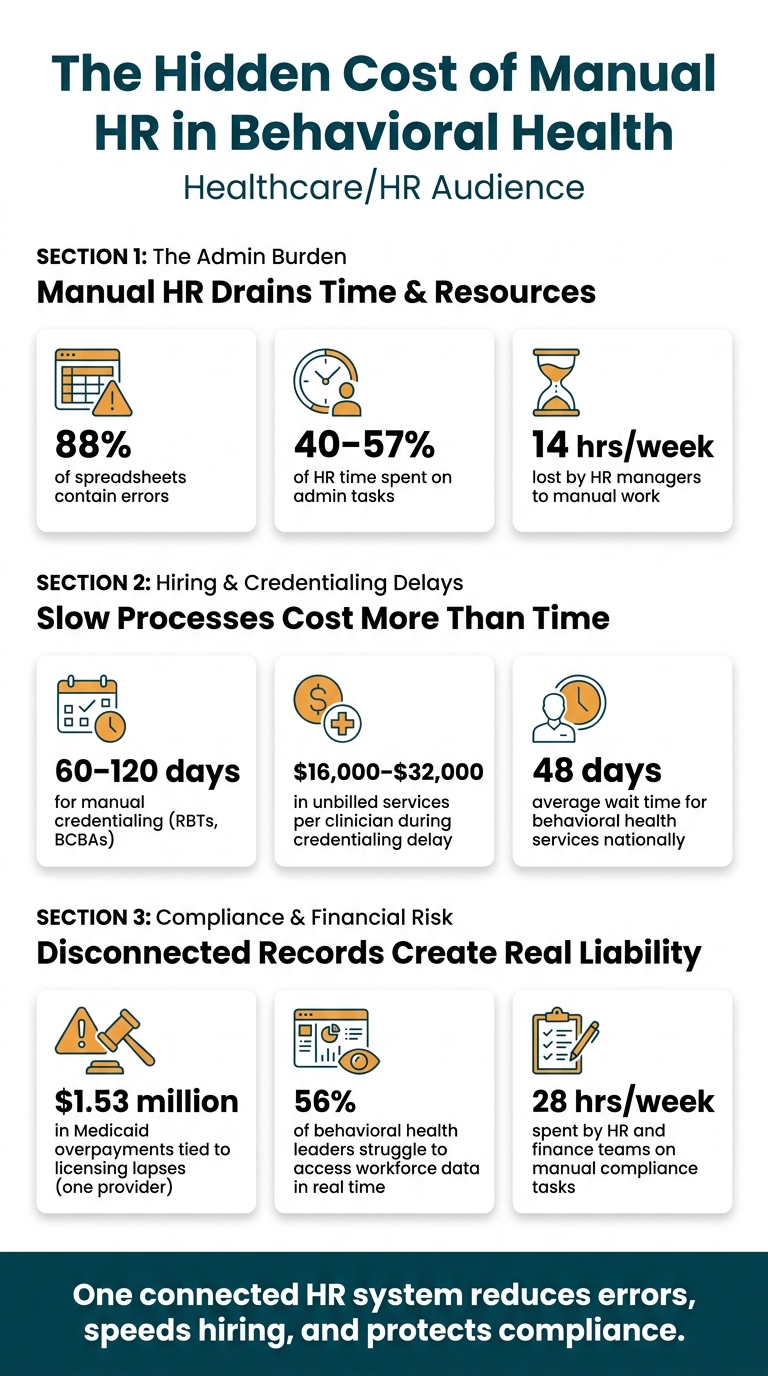
- 88% of spreadsheets contain errors
- HR teams may spend 40% to 57% of their time on admin work
- Some HR managers lose 14 hours per week to manual tasks
- Behavioral health leaders report trouble seeing workforce data in real time
- Manual credentialing can take 60 to 120 days
- That delay can mean $16,000 to $32,000 in unbilled services per clinician
- One provider faced $1.53 million in Medicaid overpayments tied in part to licensing lapses
What fixes it? One connected HR system. When hiring, onboarding, payroll, time tracking, and credential records sit in one place, teams spend less time on duplicate entry, missed follow-up, and record cleanup.
Less admin.
Stronger teams.
Better client outcomes.
See how behavioral health organizations streamline documentation, staffing, and client engagement with ContinuumCloud.
Which solution would you like to explore?
Quick comparison
| Area | Manual HR process | Connected HR system |
|---|---|---|
| Hiring | More delays from email, PDFs, and back-and-forth | Fewer handoffs and a clearer process |
| Data entry | Same information entered many times | Enter data once and use it across tools |
| Credential tracking | Easy to miss renewals or incomplete files | Alerts and shared visibility help teams stay on top of dates |
| Manager time | More time spent chasing paperwork | More time for staff support and care planning |
| Compliance | Problems may show up late, often during reviews | Records are easier to find and check |
| Billing readiness | Start dates and claims can be delayed | Staff can move through clearance steps with less friction |
If I were running a behavioral health team, I’d look at manual HR as more than an admin issue, requiring modern HR management tools. It affects hiring speed, billing, compliance, and client access to care.
Where manual HR processes create daily inefficiency
In behavioral health, manual HR work creates constant interruptions. Teams print forms, collect signatures, scan files, and send them by email. They enter the same details again and again. Supervisors get pulled into finding missing documents. On paper, these may look like small tasks. In practice, they chip away at time and focus all day long.
A lot of that drag starts with disconnected systems.
Disconnected systems cause duplicate work and data errors
When recruiting, HR, payroll, scheduling, and credentialing tools don't connect, staff repeat the same work in each place. A new therapist's license type, pay rate, FTE status, and start date may need to be entered into a recruiting spreadsheet, payroll system, credentialing tracker, and scheduling tool. Every extra entry opens the door to a typo, a wrong date, or a blank field.
Studies show 88% of spreadsheets contain errors, and in behavioral health those errors can affect billing, compliance, and staffing decisions. If a license expiration date is wrong in one system but right in another, the mismatch may sit there until a credential check brings it to light – often at the worst time.
That leads to steady cleanup work. HR teams have to cross-check records, fix mismatches, and figure out which file is the current one. Research shows HR professionals can spend 40–57% of their time on administrative tasks. That's time not spent on hiring, retention, or workforce planning. And it doesn't stop with HR. Routine follow-up pulls in managers and clinical leaders too.
Manual follow-up pulls leaders away from workforce and care priorities
Then there's the follow-up work. Emails for missing signatures. Phone calls to confirm training completion. Reminders to supervisors about onboarding checklists that still haven't come back. CareerBuilder's HR automation survey found that HR managers who do not automate these tasks lose an average of 14 hours per week to manual work.
For program directors and clinical supervisors in behavioral health, that cost hits hard. These leaders often carry both operational duties and clinical oversight. Time spent chasing paperwork is time not spent watching caseloads, helping staff deal with burnout, or making sure high-acuity clients have enough coverage.
Poor visibility makes it worse. When workforce data is scattered across spreadsheets, email threads, and paper files, leaders can't quickly tell who is cleared to work, whose credentials are close to expiring, or where staffing gaps are starting to show. 56% of behavioral health leaders report difficulty accessing workforce data in real time. That means decisions slow down, and risks can stay hidden until they turn urgent. Those delays carry straight into hiring and onboarding.
How manual workflows slow hiring and delay onboarding
Manual handoffs don't just slow admin work. They slow the next step that matters most: getting people hired, cleared, and ready to start. In behavioral health, that delay has a direct effect on care.
Leave one clinician role open for too long, and clients wait longer. The rest of the team has to pick up the slack. That's a big problem when the national average wait time for behavioral health services is already 48 days. Every extra day it takes to clear a new hire adds more strain.
Document collection and approvals create avoidable delays
A lot of the slowdown is baked into the process.
When applications come in by email, onboarding packets go out as PDFs, and approvals move through long email threads, each step creates another pause. No single delay looks huge on its own. Put them together, and days disappear.
Missing or incomplete documents can add several days per candidate. Internal approvals for job requisitions and salary sign-offs can sit untouched when leaders are out in the field or dealing with high-census periods. And when several people need to approve the same request – program director, clinical director, compliance – but there isn't a clear order, it's hard to tell where things stopped. The result is simple: good candidates move on. They take other offers.
Credential and training verification can hold up start dates
Things can slow down even more when a role need verified credentials and pre-service training.
A candidate might accept the offer, send in all their paperwork, and still not be able to see clients right away. In behavioral health, clinical and residential roles often require verified licenses, certifications, and job-specific training before a person can work on their own. When those checks live across state board websites, paper files, LMS exports, and spreadsheets, confirming that everything is in place takes time. And mistakes happen all the time.
Manual credentialing in behavioral health usually takes 60–120 days for roles like RBTs and BCBAs. During that window, newly hired clinicians may be ready to see patients from a clinical standpoint, but they still can't bill insurance. That creates an estimated $16,000–$32,000 in unbilled services per clinician.
Required pre-service training adds another layer. Think crisis intervention, suicide risk screening, and trauma-informed care. If a sign-in sheet never made it into the LMS, the system still marks the training as "incomplete." Then the new hire gets pulled from the schedule while someone hunts down the record.
You can probably guess what happens next: programs run below target capacity, group therapy schedules shift, and current staff cover more than they should. That's the point where manual workflows start to crack – and where automation begins to make a difference.
The compliance risk of disconnected HR records
Hiring delays and admin slowdowns are expensive on their own. But when records are scattered, the problem gets bigger fast. A delay in hiring can turn into a compliance issue. And when HR files live across spreadsheets, paper folders, inboxes, and disconnected systems, the risk spills into billing, staffing, and audit work too.
Expired credentials and incomplete files disrupt day-to-day operations
In behavioral health, one expired license can create a serious billing problem. A single lapse can put claims at risk for the time that person kept working. For example, a New Jersey behavioral health residential treatment provider faced $1.53 million in Medicaid overpayments tied in part to staff who kept billing after their licenses had lapsed or before full licensure was in place.
That kind of issue usually doesn’t start with bad intent. It often starts with messy tracking. If credential tracking sits in a spreadsheet – or, worse, depends on each clinician to report renewals on their own – there’s no dependable way to spot a lapse before it affects a scheduled shift.
Instead, someone has to chase updates by hand. That means emails, reminders, follow-ups, and crossed fingers. And by the time the gap shows up, it may be during an audit or an internal review, when the damage is already done.
Licenses aren’t the only weak spot. Incomplete personnel files create risk too. If an incident happens and the organization can’t show that an employee finished required training or cleared background checks, liability risk goes up.
The same holes that let credentials expire also make audits slower and harder to defend.
Scattered records make audits and reporting harder
Audit readiness comes down to one thing: can you produce full records fast? If HR data is spread across filing cabinets, shared drives, email threads, and separate systems, even pulling a complete file for one employee can take a lot of time. Now picture doing that for the whole staff roster during a state survey or payer audit.
That’s where manual tracking starts to break down.
Research shows that 88% of spreadsheets used for manual tracking contain errors, and HR and finance teams spend about 28 hours per week managing manual compliance tasks. Centralized records cut down on that scavenger hunt. They also make it much easier to show that each requirement was met, when it was met, and where the proof lives.
When everything is in one place, oversight gets faster. And when oversight gets faster, audits become a lot less chaotic.
How automation supports a more efficient HR model
These problems usually come back to the same issue: too many systems, too many handoffs, and too much manual work. Automation deals with that head-on. At that point, automation stops looking like a nice extra and starts looking like the next step.
Unified workflows cut repetitive tasks and improve oversight
A unified HCM platform built for behavioral health keeps complex workforce data in one place. It links recruiting, onboarding, payroll, time and attendance, credential tracking, and reporting through a single database and workflow engine.
Here’s what that looks like in practice: when a new clinician accepts an offer, their name, role, pay rate, and license type are entered once. From there, that data moves into onboarding checklists, benefits eligibility, timekeeping rules, and payroll calculations automatically. No duplicate entry. No bouncing between systems. Records stay in sync.
Organizations that automate have seen drops in HR workload, payroll errors, and hiring cycle time.
The same pattern shows up in credentialing. Automated systems can reduce administrative costs tied to credentialing by 65% to 80%, save 25 to 35 staff hours per month on manual verification, and cut credentialing time by up to 40%. Organizations with automated credentialing also score 34% higher on initial accreditation surveys and need 71% fewer follow-up documentation requests.
Manual versus automated HR workflows
The difference shows up across the full employee lifecycle.
| Workflow Area | Manual HR | Automated/Unified HCM |
|---|---|---|
| Hiring Speed | Weeks of delays; manual credential checks and document follow-up | Days; automated postings, integrated verification, structured checklists |
| Compliance Visibility | Reactive; gaps often found during audits or after a lapse | Proactive; real-time dashboards and 90-, 60-, and 30-day expiration alerts |
| Data Accuracy | High error risk; spreadsheets are prone to mistakes | Single source of truth; up to 90% fewer manual entry errors |
| Administrative Effort | Payroll tasks can take 18+ hours per pay period | Payroll time drops to about 13.5 hours per pay period |
Conclusion: Less manual work, faster hiring, and stronger compliance
Manual HR processes usually don’t break all at once. They wear teams down bit by bit. A delayed hire here. A missed credential renewal there. A payroll correction that eats up half a day. Over time, that drag turns into hard costs: staff hours pulled away from other work, compliance issues that can affect billing, and hiring gaps that put more strain on the rest of the team.
When workflows are unified, the lift can show up fast across hiring, compliance, and day-to-day HR work. Automation takes low-value tasks like chasing documents, re-entering data, and reconciling records off the team’s plate. That gives HR and operations leaders more time for workforce planning, staff engagement, and clinical priorities.
For behavioral health organizations dealing with complex staffing models and tight regulatory demands, that shift goes beyond efficiency. Fragmented workflows create hidden cost. Automation brings back control and gives teams a steadier base for consistent, high-quality care.
FAQs
What are the first HR workflows to automate?
Start with the most manual, error-prone tasks.
Focus first on:
- hiring workflows, including job postings, candidate screening, and credential verification
- onboarding, using role-based templates for consistent, paperless setup
- compliance tracking, with alerts for expiring licenses and certifications
Then move to payroll and timekeeping. Automate overtime tracking and leave management to cut duplicate entry, reconciliation mistakes, and pay delays.
How does HR automation improve billing readiness?
HR automation helps improve billing readiness by cutting down on data gaps and manual mistakes that often lead to claim denials.
When HR, payroll, and clinical systems work together, teams can line up staff credentials, hours worked, and patient services before billing goes out. That matters because even small mismatches can turn into rejected claims.
It also catches documentation errors in real time and helps make sure only properly credentialed staff are placed on billable shifts. The result is cleaner claims and records that are better prepared for audits.
What should behavioral health teams look for in a connected HR system?
Behavioral health teams should look for a unified, cloud-based HCM system that acts as a single source of truth. The goal is simple: cut admin work, lower compliance risk, and give teams one place to manage the workforce without bouncing between disconnected tools.
Key features include:
- Position control for clear visibility into vacancies, salary allocations, and labor budgets
- Automated compliance tracking for licenses, certifications, and exclusions
- Integrated workflows and self-service tools for hiring, scheduling, payroll, and employee support