Slow hiring hurts patient care. When a behavioral health role stays open for 90 to 180 days, patients wait longer, clinicians take on more work, and follow-up starts to slip.
Here’s the short version: filling roles faster helps protect access, continuity, and patient experience. In mental health care, that matters a lot because treatment often depends on trust, routine, and seeing the same clinician over time. And with 137 million Americans living in a mental health shortage area, every open role cuts care capacity.

If I had to sum up the article in a few points, it would be this:
- Open roles slow access to care, with some clinics reporting waits of 10 weeks for adults and 13.6 weeks for children for an initial assessment.
- Vacancies increase caseloads, which can lead to delayed intakes, rushed notes, and missed follow-up.
- Staff turnover breaks continuity, and youth who lose a therapist are 86% more likely to miss a future session.
- Faster hiring helps stabilize care teams, which supports steadier handoffs, lower workload strain, and fewer gaps in treatment.
- The biggest fixes are process fixes: cleaner requisitions, faster approvals, earlier screening, and shorter onboarding and credential checks.
- Connected workforce and care systems help teams act sooner when staffing pressure starts to affect patient access.
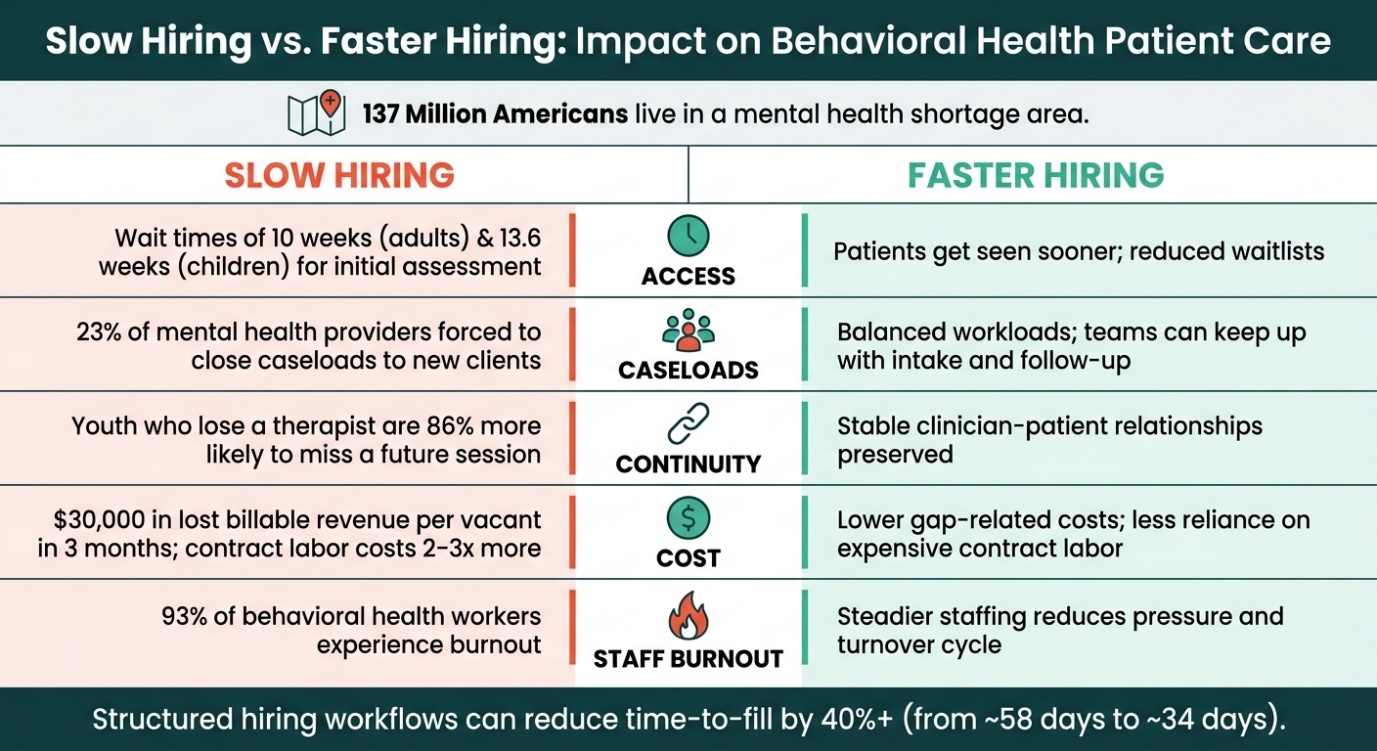
Quick Comparison
| Area | Slow Hiring | Faster Hiring |
|---|---|---|
| Access | Longer waitlists and delayed starts | Patients get seen sooner |
| Caseloads | Higher workload for current staff | Better workload balance |
| Continuity | More handoffs and dropped care | More stable clinician-patient relationships |
| Follow-up | More missed outreach and rushed charting | Better follow-up and cleaner transitions |
| Cost | Lost revenue and more contract labor | Lower gap-related cost pressure |
The main point is simple: in behavioral health, hiring speed is not just an HR measure. It shapes whether patients can get care, stay in care, and move through treatment without extra disruption.
The problem: How hiring delays disrupt patient care
An open role doesn’t stay inside an HR system. It spills into the entire care operation, affecting schedules, caseloads, documentation, and the patient’s day-to-day experience.
Open roles increase caseloads and slow response times
When a clinician leaves, the rest of the team takes on that caseload until someone new is hired. As caseloads climb, tradeoffs start to show. Intakes get delayed. Follow-up visits get packed into tighter windows. Care plan updates slip to the end of a shift, or get missed.
Research on intensive case management shows that larger caseloads reduce the frequency and quality of clinical contact, which directly affects how well patients stay engaged in treatment. Once that pressure builds, it doesn’t stop there. It moves into follow-up, handoffs, and day-to-day coordination.
The result is long waits. Longer vacancies often mean longer waits for care. Outpatient behavioral health clinics have reported average wait times of 10 weeks for adults and 13.6 weeks for children just to receive an initial assessment. Those numbers aren’t just data points. They reflect people waiting for care that can’t happen yet because the people needed to deliver it aren’t in place.
Gaps in handoffs and follow-up weaken continuity of care
As workloads grow, care coordination is usually the next thing to strain. Understaffing doesn’t just slow work down. It creates gaps in the moments that matter most.
That includes:
- Case conferences
- Discharge summaries
- Post-hospitalization outreach
- Proactive check-ins with high-risk patients
All of that takes time and staff capacity that stretched teams often don’t have.
Documentation also starts to slip. When clinicians are covering vacant roles, charting gets pushed late into the day or done in a rush. And rushed documentation can leave out key details, like safety plans, medications, or recent crises. For patients moving from inpatient to outpatient care, a break in follow-up can mean weeks without a scheduled appointment, which increases the risk of relapse or rehospitalization.
How unstable staffing affects patient experience
Patients feel all of this in direct, personal ways: delays, cancellations, and repeated handoffs. From their side, staffing instability looks like longer waits, canceled appointments, and having to explain their history again to one more new provider.
In behavioral health, that repetition is more than frustrating. It can feel retraumatizing. And when patients keep seeing new faces, many start to lose faith that the organization can give them steady support. Some stop engaging with care altogether. These are predictable effects of long vacancies. Stable staffing helps preserve continuity, and continuity helps protect outcomes.
Less admin.
Stronger teams.
Better client outcomes.
See how behavioral health organizations streamline documentation, staffing, and client engagement with ContinuumCloud.
Which solution would you like to explore?
The solution: How faster hiring improves care outcomes
These problems start to ease when vacancies are filled sooner. Care teams can keep up with intake, follow-up, and handoffs. For patients, that often means shorter waits and fewer gaps when care shifts from one clinician to another.
Shorter vacancies support consistent care delivery
When roles are filled sooner, teams are less likely to deal with closed caseloads, missed follow-ups, and expensive stopgap coverage. Faster hiring helps keep schedules steady, cuts down on temporary staffing, and can prevent organizations from closing caseloads to new clients. Right now, that issue affects 23% of mental health providers.
The money side matters too. One vacant clinician role can cost an organization about $30,000 in lost billable revenue in just three months. And if an organization turns to travel or contract staff to cover the gap, costs go up even more. Contract labor usually costs two to three times more than a permanent hire, and those workers often don't have the institutional knowledge that helps teams deliver steady care.
Balanced workloads lead to safer, more effective care
When openings are filled fast, the rest of the team doesn't have to carry the extra load for as long. That's a big deal. 93% of behavioral health workers experience burnout - a rate higher than in most other industries. Burnout isn't just hard on staff. It can also make steady care harder to maintain.
Faster hiring helps stop the turnover cycle that begins when one vacancy puts too much pressure on everyone else. With steadier staffing, clinicians can respond sooner, document with fewer errors, and finish follow-up on time.
Slow hiring vs. faster hiring: a side-by-side comparison
The table below shows how faster hiring helps protect access, continuity, and the patient experience.
| Slow Hiring | Faster Hiring | |
|---|---|---|
| Handoff Consistency | Coverage gaps disrupt care transitions and handoffs | Stable teams support reliable handoffs across the care continuum |
| Access | Longer waitlists; closed caseloads for new patients | Faster access to treatment; reduced wait times |
| Continuity | High patient drop-off; disrupted therapeutic relationships | Preserved therapeutic bonds; reliable follow-up care |
| Follow-up Quality | Redistributed caseloads leave less time for follow-up and documentation | Balanced workloads; more time for complex cases and oversight |
| Patient Experience | Fragmented care; patients often have to start over | More consistent care across settings |
The next step is to shorten the hiring process itself through cleaner requisitions, faster screening, and quicker onboarding.
Workforce processes that reduce time-to-fill
Faster hiring comes from cutting delays in requisitions, screening, and onboarding - the steps that leave roles open and patients waiting.
And most of that comes down to the workflow itself.
Standardize requisitions, approvals, and position control
A lot of hiring slowdowns start before recruiting even begins. If role approval is fuzzy, sign-off has too many layers, or job descriptions change from one request to the next, HR teams can get stuck before a posting ever goes live.
A standard requisition template helps clear that up. It should include details like license level, program type, schedule, funding source, and supervision needs. That cuts the back-and-forth and keeps things moving.
It also helps to set approval SLAs - for example, a three-business-day turnaround with automatic escalation to a backup approver if the main one is unavailable. Position control then links each role to approved headcount and a pay range, which lets teams send offers within 24 to 48 hours of a hiring decision. In plain terms, position control stops unapproved hiring and lets offers move as soon as a vacancy is cleared.
Build stronger recruiting pipelines and screening workflows
Once approvals move faster, the next choke point is candidate flow.
Hard-to-fill roles need a standing talent pool, not a last-minute scramble. That means keeping in touch with past candidates, building ties with graduate programs and professional groups, and running virtual career events. In community behavioral health, psychiatrist time-to-fill can run from 3 to 12 months when organizations rely only on posting after a role opens.
After candidates enter the pipeline, structure matters. Reaching out to qualified applicants within 24 hours, checking licenses and credentials early, and using standard interview scorecards can shrink the gap between application and offer.
These steps aren’t just nice process tweaks. Structured workflows like these can reduce time-to-fill by more than 40% - from about 58 days to 34 - without lowering hiring standards.
Speed up onboarding, credential tracking, and readiness to work
After the offer goes out, onboarding and credential checks need to move just as fast.
In many healthcare settings, onboarding still takes 30 to 90 days. Digital pre-boarding can bring that down to about 10.
For clinical roles, license and credential checks are often one of the slowest steps. Running verification and exclusion checks in parallel with final interviews - instead of waiting until after acceptance - removes a major bottleneck. Automated alerts for expiring licenses, sent 30, 60, and 90 days ahead, help teams stay compliant and avoid last-minute scheduling problems.
Connected workforce systems can also carry role details forward on their own, cutting duplicate entry and helping new hires get ready to work sooner.
Conclusion: Connected workforce and care systems help protect continuity
When hiring moves faster, care tends to improve fast too. Faster hiring is a patient care move. If open roles sit too long, caseloads climb, follow-up starts to slip, and continuity takes a hit. But speed alone isn’t enough. It works best when requisitions, screening, onboarding, and credential tracking all run through one workflow.
How connected systems support staffing stability
Connected systems give teams an earlier read on staffing risk, which means they can act before continuity starts to break down.
When HCM, EHR, and alumni engagement data are shared, teams can spot demand shifts, open roles, and backlog trends soon enough to adjust coverage before patients feel the strain. That kind of early signal matters. It gives leaders time to make staffing changes before wait times start to grow.
Integrated workforce systems can cut scheduling work, help patients stay on track with treatment, and save staff time. In plain terms, that early visibility helps people keep their appointments, stay connected to the same clinician, and maintain treatment momentum.
Staffing stability and care quality move together. When workforce and care systems operate as one, organizations fill roles faster, cover gaps with less friction, and protect continuity.
FAQs
Why does hiring speed affect patient outcomes?
Hiring speed affects patient outcomes because it helps organizations keep staffing levels where they need to be. When roles stay open for too long, appointment wait times can grow, and treatment may get interrupted.
Long vacancies also put more pressure on current staff. Over time, that can lead to burnout and turnover. Faster hiring helps teams deliver more consistent, timely, high-quality care.
Which hiring delays cause the biggest care gaps?
The biggest care gaps show up when hiring takes too long and clinical roles stay open. When that happens, appointment wait times grow, caseloads may close to new clients, and treatment plans can get disrupted.
The pressure doesn’t stop there. Open roles push more work onto the staff who are still in place, often leading to mandatory overtime. Over time, that can speed up burnout and turnover.
And that creates a hard cycle: fewer people on staff means more strain, more strain leads to more people leaving, and filling those key roles gets even tougher. The result is less continuity of care for the people who need it most.
How can connected systems help fill roles faster?
Connected systems help teams hire faster by cutting manual admin work and getting rid of data silos. With one shared platform, recruiters can post jobs across multiple channels with a single click and sort candidates fast based on must-have qualifications.
They also make it easier for managers to spot approved, funded roles right away. And when someone is hired, their information can flow straight into HR, payroll, and onboarding workflows automatically, which cuts down on delays.