Less admin.
Stronger teams.
Better client outcomes.
See how behavioral health organizations streamline documentation, staffing, and client engagement with ContinuumCloud.
Which solution would you like to explore?
The True Cost of Manual Payroll in Behavioral Health: A ROI Breakdown
Manual payroll costs more than most behavioral health leaders think. If labor is 70% to 80% of your budget, even small payroll mistakes can turn into extra labor cost, tax penalties, billing delays, and staff turnover.
Here’s the short version: I’d look at manual payroll in four cost buckets:
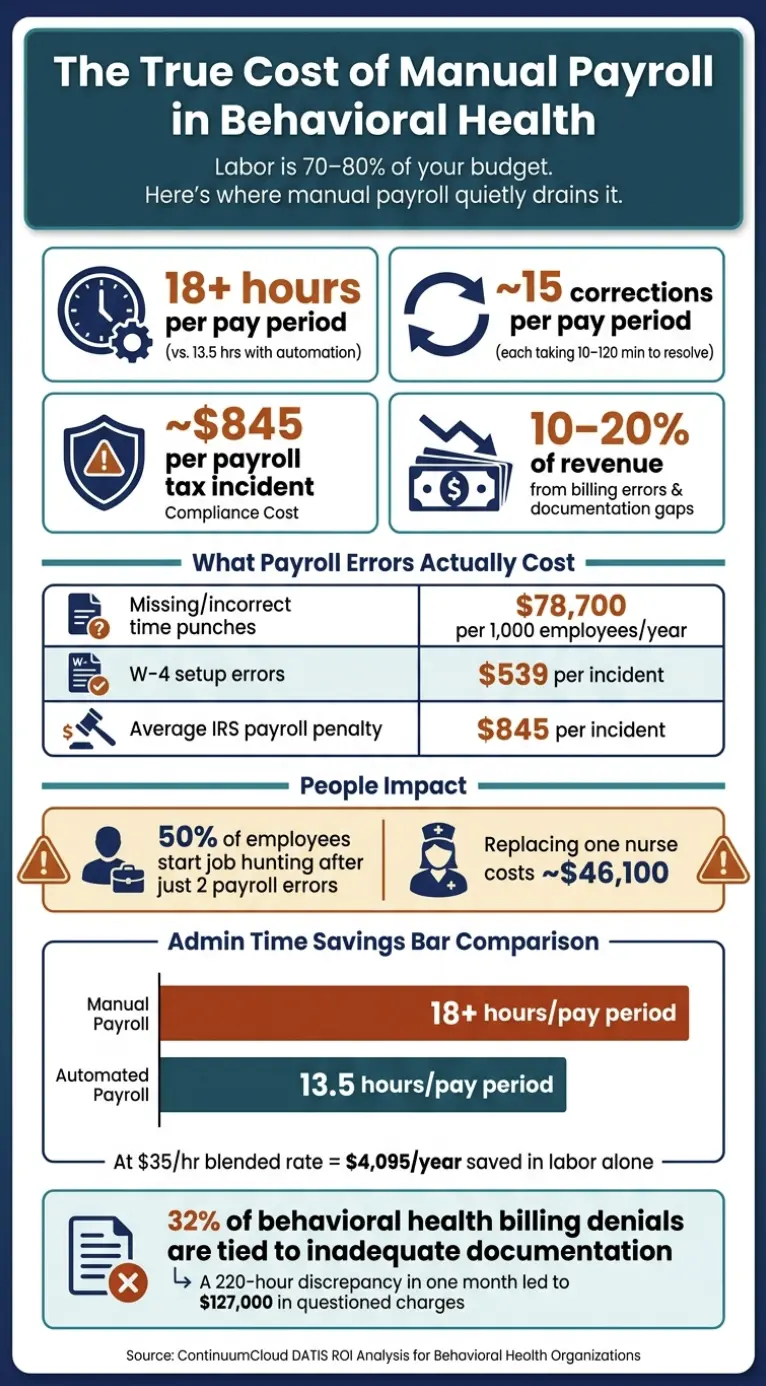
- Admin time: manual payroll can take 18+ hours per pay period
- Correction work: payroll teams often deal with about 15 corrections per pay period
- Compliance cost: payroll tax issues can cost about $845 per incident
- Revenue loss: billing errors and documentation gaps can put 10% to 20% of revenue at risk in some cases
This matters across every care setting:
- Residential: shift differentials, overnight pay, weekend rates
- Outpatient: gaps between worked time and billable time
- Community-based: travel time, outreach time, and on-call logging
- Credential-based pay: wrong rate risks when licenses expire or data is missed
I’d also keep this in mind: payroll mistakes don’t just hit finance. 50% of employees start job hunting after two payroll errors, and replacing a nurse can cost around $46,100.
A simple ROI model usually comes down to this:
- Add up yearly cost from manual labor, correction time, penalties, and revenue leakage
- Estimate savings from automation through less rework, fewer errors, and cleaner billing support
- Measure payback period and 3-year ROI using your software and setup costs
For teams in behavioral health, the main question isn’t whether manual payroll is expensive. It is. The question is how much you’re paying today in hidden cost that never shows up as a single line item.
Where Manual Payroll Creates Direct and Hidden Costs
Administrative Labor, Reconciliation Time, and Payroll Rework
Manual payroll doesn’t just slow things down at payday. The bigger drain often shows up in reconciliation, corrections, and cleaning up missed punches.
In behavioral health, payroll gets messy fast. Pay can change based on credentials, shift differentials, program assignment, and how labor needs to be split across funding streams. On top of that, HR and finance teams already spend 28 hours a week on manual compliance tasks . And manual payroll can take 18+ hours per pay period, compared with 13.5 hours when teams use vendor-supported tools.
The problem gets worse when pay changes by role, program, license, or shift. One provider may earn different rates for supervision, direct care, travel, or other reimbursable work. Manual systems often struggle to track those differences cleanly. In ABA and residential programs, retroactive changes add yet another layer. If sessions are changed weeks after the service date, the pay run may need to be reopened and checked again.
That extra labor doesn’t just eat up time. It also creates more chances for payroll mistakes, which is where a back-office headache starts turning into a money problem.
Errors, Compliance Exposure, and Employee Turnover Costs
When payroll depends on manual handling of variable pay and retroactive changes, errors become common – and harder to spot before they spread.
Missing or incorrect time punches can cost about $78,700 per 1,000 employees each year, and payroll tax violations add about $850 per incident. Manual systems also make audit trails tougher to verify, which can create risk during Department of Labor reviews tied to state wage-and-hour rules.
Then there’s the people side of it. 50% of employees begin looking for a new job after only two payroll errors. And 80% of care staff report losing significant trust in their employer after three errors in a single year. In behavioral health, where hiring is already tough, those mistakes can hit far beyond payroll.
Billing Misalignment and Lost Revenue from Inaccurate Time Data
When HR and finance work from different data, billing, labor allocation, and audit prep can all start to slip.
If a clinician’s worked hours don’t line up with the clinical record, claims can be denied. That matters because 32% of billing denials in behavioral health are already tied to inadequate documentation. On top of that, behavioral health practices lose 10% to 20% of potential revenue to preventable billing errors and claim denials.
This gets even more serious in community-based and multi-site outpatient settings, where staff move across programs and funding streams. A single error in time allocation can trigger disputed labor charges in an audit. In one documented case, a discrepancy of just 220 hours in one month led to $127,000 in questioned charges.
The table below sums up some of the most common payroll error types and what they can cost:
|
Error Type |
Estimated Cost/Impact |
|
Missing or incorrect time punches |
$78,700 per 1,000 employees annually |
|
W-4 setup errors |
$539 per incident |
|
Average IRS payroll penalty |
$845 per incident |
These costs are measurable, which makes them easier to map in a simple ROI model. The next step is to turn these buckets into annual cost, savings, and payback.
A Simple ROI Breakdown for Behavioral Health Payroll Automation
Step 1: Calculate the Total Annual Cost of Manual Payroll
Start with four cost buckets: labor, errors, compliance, and revenue leakage. In behavioral health, payroll gets messy fast because of shift differentials, overtime, and credential-based pay.
|
Cost Category |
Supported Benchmark |
How to Use It |
|
Administrative labor |
Manual payroll takes 18+ hours per pay period, compared with 13.5 hours with automated solutions |
Multiply hours by your blended HR/finance rate. |
|
Error correction |
Organizations typically face about 15 payroll corrections per pay period, and a single error can take 10 to 120 minutes to resolve |
Multiply corrections by resolution time and labor rate. |
|
Compliance exposure |
The average penalty for a payroll tax violation is about $845 per incident |
Multiply expected incidents by the average penalty. |
|
Billing misalignment |
32% of behavioral health billing denials are tied to inadequate documentation, and preventable billing issues can drive 10% to 20% revenue loss |
Estimate revenue at risk from inaccurate time data. |
At a $35/hour blended rate, manual admin time alone equals $16,380 per year, and correction work adds $2,275 to $27,300.
Use these formulas to build your estimate:
- Time cost = pay periods per year × admin hours per pay period × blended hourly rate
- Error cost = corrections per pay period × minutes per correction ÷ 60 × hourly rate × pay periods
- Compliance cost = expected incident count × average penalty
- Revenue leakage = revenue tied to billable time × portion at risk from documentation gaps
This is where the math starts to help. Manual payroll stops being an annoying back-office chore and becomes a yearly dollar amount you can point to.
Step 2: Estimate Savings from Behavioral Health Payroll Automation Across Labor, Errors, and Compliance
Behavioral health payroll automation cuts down the hands-on work needed each pay cycle. Integrated systems reduce payroll processing from 18+ hours per pay period to about 13.5 hours, can reduce manual entry errors by up to 90%, and cut audit prep time by 50% to 75%.
At a $35/hour blended rate, moving from 18+ hours to 13.5 hours per pay period saves about $4,095 per year in labor alone. That’s not small. And in behavioral health, payroll often touches multi-program labor splits, so the gain goes beyond a basic pay run.
Model savings across labor, error reduction, compliance, and revenue protection.
Once those yearly savings are on paper, you can look at how fast the system pays for itself.
Step 3: Measure Payback Period and 3-Year ROI
After you’ve estimated annual savings, calculate payback by dividing total implementation and subscription costs by monthly net savings.
- Payback period = total implementation and subscription costs ÷ monthly net savings
- 3-year ROI = (3-year savings − 3-year cost) ÷ 3-year cost
Then stretch the model across three years. Include labor savings, fewer corrections, lower compliance exposure, and any revenue recovered through better billing alignment. It’s smart to treat revenue recovery and turnover avoidance as upside. For the base case, stick to the numbers that are hardest to argue with: admin time, correction work, and penalty exposure.
The ROI case gets stronger when the software fits behavioral health workflows instead of acting like a generic payroll tool.
How ContinuumCloud‘s DATIS Supports Payroll ROI in Behavioral Health
Unified HR, Time, Attendance, and Payroll Data in One System
Payroll ROI starts long before payroll runs. If time, pay rules, and labor allocations aren’t clean up front, the math falls apart fast.
That’s the problem with separate HR, scheduling, time-tracking, and payroll tools. Teams end up re-entering the same data every pay cycle, often across disconnected systems or spreadsheets. And each handoff creates another chance for mistakes.
DATIS brings HR, time and attendance, and payroll into one cloud platform. That means less duplicate entry and less cleanup later. Instead of fixing preventable errors before payroll reaches finance, teams can spend less time on rework. The behavioral health focus matters here. It’s built to cut handoffs and trim correction work before it piles up.
Once all of that data lives in one place, the next source of ROI comes from handling behavioral health pay rules without manual work.
Automation for Complex Pay Rules and Shift Differentials
Behavioral health payroll isn’t simple. A 24/7 residential program can have the same employee earning one rate on Tuesday afternoon and a weekend differential on Saturday morning, all in the same pay period. Try doing that by hand for dozens of staff, and errors start stacking up.
DATIS handles multiple pay rates by role or credential, shift differentials, travel and mileage reimbursements, and retroactive adjustments that recalculate past sessions when pay rates change. That applies across residential shifts, outpatient differentials, and community-based travel time. For community-based teams, this can remove one of the most time-heavy reconciliation jobs in the payroll process.
The payoff isn’t just fewer errors. It also means payroll teams don’t have to chase down exceptions line by line every cycle.
Reporting and Integration That Improve Compliance and Financial Visibility
Payroll automation matters most when someone asks for proof. Audit prep is often where manual payroll gets expensive, and integrated systems can cut that prep time by 50% to 75%.
DATIS creates an audit trail that links labor dollars to services, programs, funding sources, and sites, which is what Medicaid and HRSA audits require. Its Position Control engine ties each role to a set budget line or funding source before hiring, so labor costs line up with available funding from day one. The system also performs automated exclusion checks and credential-expiration alerts to help prevent non-compliant scheduling.
For organizations that use ContinuumCloud’s EHR platform, Welligent, the link goes even further. Clinical documentation cross-references attendance records to confirm that billed hours match valid, compliant services. That helps cut billing mismatches tied to denials.
Conclusion: The Business Case for Replacing Manual Payroll
Replacing manual payroll is a financial call, not just an admin change. In behavioral health, manual work adds risk across labor, compliance, billing, and retention. That hits hard when labor already makes up 70% to 80% of a typical behavioral health organization’s operating budget. At that point, payroll inefficiency stops being a back-office problem and starts looking like a business problem. The issue isn’t whether manual payroll costs money. It’s how much of that cost you’re already absorbing today.
What Leaders Should Quantify Before Making a Payroll Decision
Before picking a system, pull the numbers that show your day-to-day cost. Start with the time your HR and finance teams spend on time and attendance each cycle. That means more than just running payroll. Count corrections, off-cycle checks, and manual reconciliation too. Manual processing averages 18+ hours per pay period.
There are three main buckets to measure:
- payroll labor time
- error-driven revenue leakage
- turnover risk tied to payroll mistakes
Turnover should be part of the model too. Replacing a registered nurse in a behavioral health setting costs an average of $46,100 [5]. And when a clinician role sits empty, the loss can reach about $30,000 in lost revenue per clinician over a three-month period. Those numbers don’t belong ONLY in an HR budget. They belong in your payroll cost analysis.
Why ROI Depends on Operational Fit, Not Just Software Price
Once leaders pin down the annual cost of manual processing, the next step is simple: test whether a system can remove those costs where they start.
The best ROI case comes from matching the system to the way your organization actually runs. Think multi-site staffing, labor split across funding streams and programs, credential-linked pay differentials, shift differentials, and audit-ready reporting without weeks of spreadsheet work. As one COO put it:
“Our agency has a number of federal and private grants tied to personnel costs and allocations. DATIS e3 is extraordinary at allowing the end user to slice information as needed for complex reporting.” – Tami Lewis-Ahrendt, Chief Operating Officer
ROI comes down to fit. Can the system handle multi-rate pay, credential-based differentials, and multi-program allocation without manual cleanup?
If your payroll stack still leans on spreadsheets, reconciliations, and retroactive fixes, the savings case is already plain. See your savings in a personalized demo.
FAQs
How do I calculate our manual payroll ROI?
Compare what you spend on manual payroll today with the cost of an integrated, automated system.
Look at four areas:
- Processing labor
- Annual error and correction costs
- Turnover and compliance risk
A simple formula is:
Total Manual Cost = processing labor + correction labor + compliance risk + turnover impact
Here’s the idea in plain English. Start with the hours your team spends each pay period on payroll prep, data entry, reviews, fixes, and follow-up. Then add the cost of mistakes: off-cycle payments, corrected filings, employee support time, and rework. After that, factor in compliance exposure, such as penalties or late filings, plus the cost of employee frustration and churn when pay issues keep popping up.
Automated systems usually cut data-entry errors by 90% and save a lot of time. That’s why break-even often shows up within a few months, not years.
If you want a quick gut check, compare:
- what payroll costs you now each month
- what the new system would cost each month after time savings and fewer errors
That side-by-side view tends to make the tradeoff pretty clear.
What hidden payroll costs should behavioral health leaders track?
Behavioral health leaders should track hidden payroll costs in four areas:
- Administrative labor tied to manual entry, reconciliations, and hard-to-manage pay rules
- Errors and corrections, including penalties, audit risk, and questioned costs across funding streams
- Turnover and recruitment when payroll mistakes chip away at employee trust
- Operational inefficiencies caused by disconnected systems, spreadsheets, billing misalignment, and weak program-level visibility
Which behavioral health payroll tasks are best to automate first?
These areas usually involve constant reconciliation and tricky pay rules. So when you automate them, you cut down on manual fixes, spreadsheet work, and duplicate data entry across your EHR, timekeeping, and payroll systems.