Funding changes can disrupt behavioral health organizations in three key areas: workforce, finances, and compliance. These shifts – whether from grant expiration, contract reductions, or payer adjustments – can destabilize operations, especially without integrated systems to link roles, funding, and costs. Here’s what you need to know:
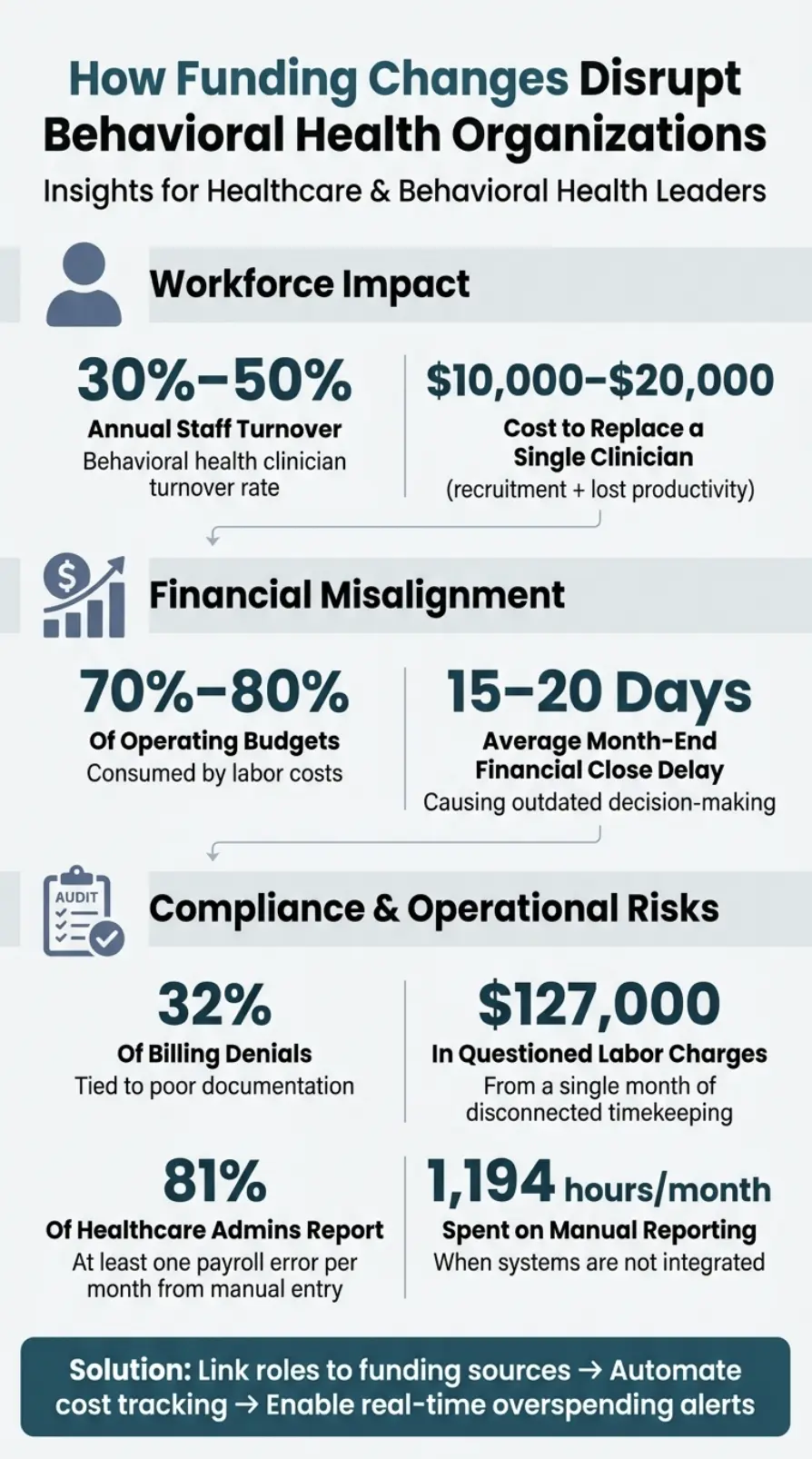
- Workforce Impact: Many organizations struggle to align staffing with funding sources. High turnover (30%-50%) and costly replacements ($10,000-$20,000 per clinician) worsen the problem when funding cuts force rapid adjustments.
- Financial Misalignment: Labor costs consume 70%-80% of budgets. Funding shortfalls often go unnoticed until payroll hits, leading to revenue gaps and shrinking margins.
- Compliance Risks: Disconnected systems lead to manual errors, audit issues, and billing denials (32% tied to poor documentation).
The solution? Link roles to funding sources, automate cost tracking, and implement real-time alerts for overspending. These steps help organizations respond quickly and maintain stability during funding shifts.
Less admin.
Stronger teams.
Better client outcomes.
See how behavioral health organizations streamline documentation, staffing, and client engagement with ContinuumCloud.
Which solution would you like to explore?
How Funding Changes Affect Behavioral Health Organizations
When funding shifts unexpectedly – like a contract reduction or the end of a grant – it can send shockwaves through behavioral health organizations. These changes impact everything from workforce planning to financial stability and compliance efforts.
Workforce Disruption
One of the first challenges is understanding how funding changes affect staffing. Many organizations don’t have immediate insight into which roles are tied to specific funding sources. This delay in making staffing adjustments comes on top of already high turnover rates in behavioral health, which range from 30% to 50% annually. The financial toll is significant too – replacing just one clinician can cost between $10,000 and $20,000 when factoring in recruitment expenses and lost productivity.
When funding cuts force unexpected staffing changes, the costs can skyrocket, and care continuity suffers. This creates a domino effect, with staffing uncertainty leading directly to financial instability.
Financial Misalignment
Labor costs are a massive part of a behavioral health organization’s budget, making up 70% to 80% of total operating expenses. If funding decreases but staffing remains unchanged, the organization faces an immediate financial gap. This imbalance often isn’t noticed until after payroll is processed, leaving little room for quick adjustments. The result? Revenue shortfalls and shrinking profit margins that can destabilize operations.
Compliance and Audit Risks
The challenges don’t stop at staffing and finances. Misaligned labor data can create compliance headaches. Without clear links between labor costs and funding sources, manual reclassifications may raise red flags during audits. For example, one organization faced $127,000 in questioned labor charges after a single month showed a 220-hour discrepancy due to disconnected timekeeping and payroll systems.
On top of that, 32% of billing denials are already tied to poor documentation. Organizations relying on manual processes are at even greater risk of audit issues, making it critical to address these vulnerabilities quickly.
Why Existing Systems Fall Short During Funding Changes
Many behavioral health organizations face operational challenges when funding changes occur, largely because their systems don’t work together. Separate tools for HR, finance, and program management often fail to integrate. For example, electronic health records (EHRs) track client sessions, payroll systems handle compensation, and general ledgers manage expenses. But none of these systems automatically link workforce costs to specific funding sources. This disconnect makes it nearly impossible to determine the true cost of running a program or identify which roles might be at risk when a grant ends or a contract changes.
Disconnected Workforce Data
When systems operate in silos, organizations are left with major blind spots. They’re forced to manually piece together data to calculate critical metrics like cost per client or revenue per labor hour. This lack of integration isolates HR, Finance, and Operations teams, leaving gaps that often go unnoticed until an audit or funding shift exposes them.
Reliance on Manual Processes
Without integrated systems, organizations rely heavily on spreadsheets for exporting, reconciling, and rebuilding reports. These manual processes are time-consuming and error-prone. In fact, 81% of healthcare administrators report experiencing at least one payroll error each month due to manual data entry. Additionally, organizations can spend as much as 1,194 hours per month just on manual reporting tasks when their systems aren’t connected. That’s a significant drain on both time and money – resources that could be better spent elsewhere if systems were automated.
Delayed Decision-Making
When month-end financial closes take 15 to 20 days, leadership is left making decisions based on outdated information.
“When the month-end close takes [15 to 20 days], you’re making decisions based on data that’s already three weeks old. Leadership is asking questions you can’t yet answer.” – Luc Lothamer, Partner, DWD Technology Group
This delay becomes especially problematic during mid-program funding changes. Decisions about staffing or resource allocation are often made too late, keeping labor costs misaligned for longer periods. Compliance gaps can also grow unnoticed, putting financial and operational stability at risk. These challenges underscore the importance of systems that can align workforce planning with real-time funding changes.
How to Align Workforce Planning with Funding Changes
The challenges of disconnected data, manual processes, and delayed decisions don’t have to be permanent fixtures. By adopting proactive strategies, organizations can transform how they handle workforce planning, especially when funding shifts occur. Successful organizations typically follow a few key practices that ensure their workforce planning stays aligned with funding changes.
Tying Roles Directly to Funding Sources
A critical first step is linking every position to a specific program, funding source, and financial structure. When roles are tied to grants or contracts at the position level, any funding change instantly highlights its impact on the workforce. This level of clarity is essential for timely decision-making.
Since labor typically accounts for 70%–80% of operating expenses in behavioral health organizations, funding changes aren’t just financial adjustments – they directly affect payroll sustainability. Understanding which roles are at risk and to what extent allows leadership to act quickly instead of scrambling for solutions.
Integrated HCM and EHR systems make this process seamless. These systems connect clinical documentation with payroll, cross-reference client sessions with attendance records, and ensure labor costs are tied only to valid, billable funding codes. Automated cost allocation further simplifies the process by dividing a single clinician’s salary and benefits across multiple funding streams – such as 50% grant-funded and 50% fee-for-service – based on actual hours worked, rather than estimates.
Tracking Labor Across Multiple Dimensions
Viewing labor costs from a single perspective isn’t enough. Organizations need the ability to analyze workforce spending across multiple dimensions – by program, funding source, and service type – all at once.
“Our agency leverages integrated systems to slice labor data across funding sources and service types, enabling precise and timely insights.”
This multi-dimensional view eliminates the blind spots caused by siloed systems. It also enables smarter decisions, such as identifying programs that are over budget before payroll closes or spotting quiet funding gaps before they grow into larger problems.
Adjusting Staffing as Funding Changes Occur
Real-time staffing adjustments remain a challenge for many organizations. Relying on month-end reconciliations can delay critical decisions, increasing misalignments and compliance risks. Adopting a continuous close model, where reconciliations are done daily or weekly, keeps finance teams informed throughout the month – not just at its conclusion.
Adding automated threshold alerts enhances this approach. These alerts notify leadership when labor costs for a specific grant or contract approach a predefined percentage of the total budget, allowing action before overspending occurs. Paired with “what-if” scenario planning, which forecasts staffing and cost impacts, organizations can shift from reactive responses to proactive management.
Conclusion: Managing Funding Changes with Confidence
Funding shifts are a given in behavioral health – being unprepared isn’t an option.
Organizations that successfully navigate these shifts share a common strategy: they establish integrated systems that align workforce roles with funding sources before challenges arise. By ensuring every role is tied to a program and funding source, making labor data accessible from multiple angles, and utilizing real-time alerts for overspending, funding changes become far less daunting.
Relying on a reactive approach can be costly to your organization. Labor typically represents 70%–80% of operating budgets, so even small funding adjustments can jeopardize payroll stability. Delayed decisions don’t just strain finances – they directly impact the people providing vital care.
FAQs
How do I know which roles are tied to a specific grant or contract?
What’s the fastest way to spot a funding shortfall before payroll?
How can we reduce audit risk when funding changes mid-program?
Another key step is implementing position control. This tool links job roles directly to approved budgets and funding sources. By doing so, you can avoid hiring for positions that lack funding and minimize the risk of mismatched reporting. These measures not only streamline processes but also help maintain compliance and financial accuracy.