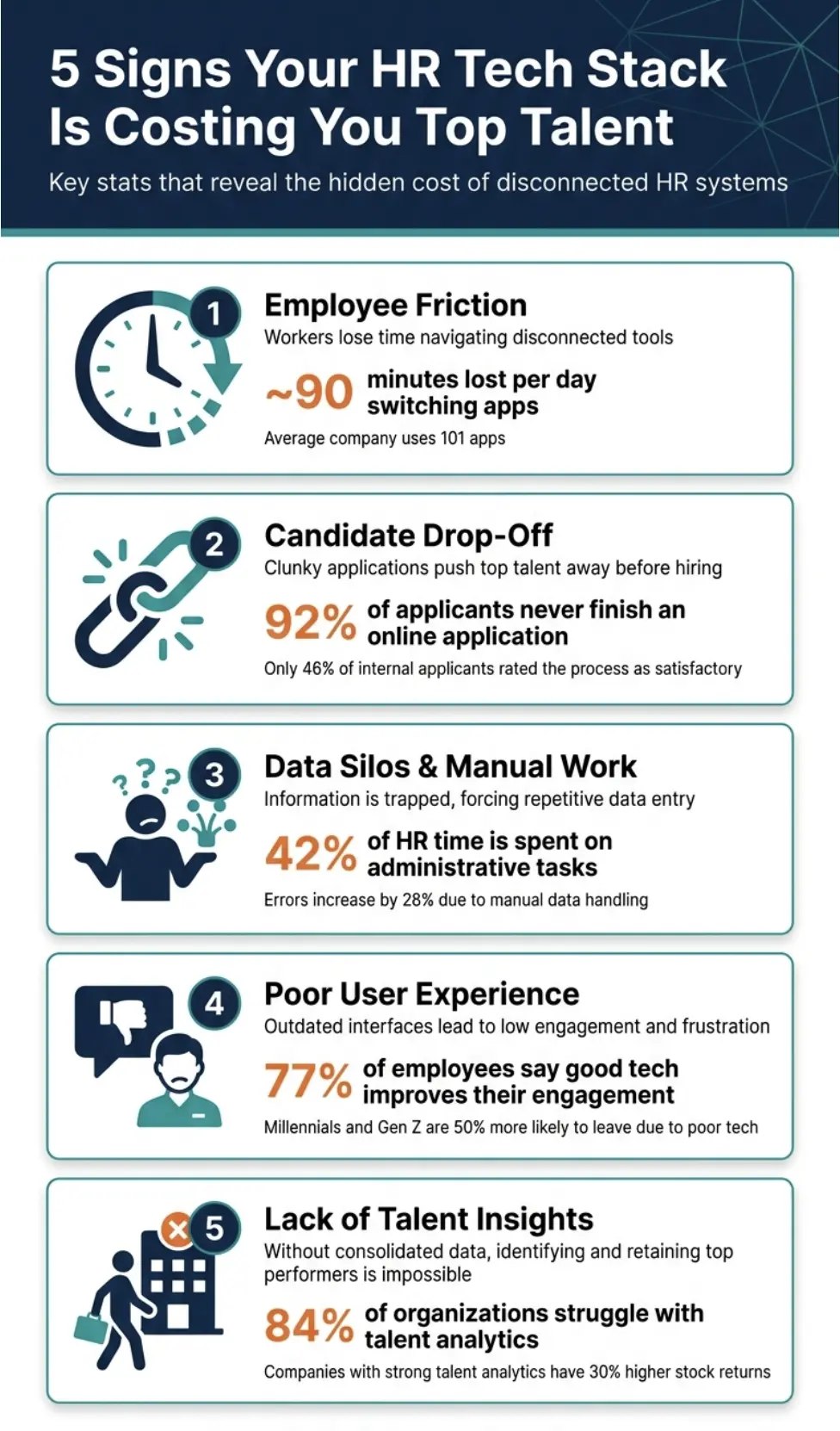
If your HR tools are hard to use, you may be pushing good people out. Keep an eye on these five clear signs: employees waste time jumping between systems, candidates quit applications, leaders spot resignations too late, reporting takes too long, and turnover costs stay hidden until after someone leaves.
Here’s the short version: when HR, payroll, scheduling, hiring, and performance data live in different places, daily work gets harder. That friction adds up. Workers can lose almost 90 minutes a day switching apps and figuring out where to go. At the same time, 92% of online job applicants never finish, only 21% of HR teams use predictive analytics, and replacing a skilled employee can cost up to 2x salary.
If I were reviewing my stack, I’d look at these five areas first:
- Employee friction: too many workflows, in too many places with no communication or clarity
- Candidate drop-off: long or clunky application steps
- Late warning signs: no clear view of burnout, feedback gaps, or overtime
- Slow reporting: exports, manual checks, and old data
- Hidden turnover cost: no single view of hiring, training, and staffing impact
The fix is simple in concept: unified HCM solution with one shared data set. That gives teams one place for hiring, onboarding, scheduling, pay, training, and reporting, so problems show up earlier and admin work drops.
|
Sign |
What it looks like |
What it points to |
|
Employee friction |
Multiple tools, repeat data entry, login issues |
Disconnected systems |
|
Candidate drop-off |
People start but do not finish applying |
Difficult or lengthy application process |
|
Late resignations |
Leaders miss warning signs until notice is given |
Lack of engagement and efficiency across the organization |
|
Slow reporting |
Hours or days spent pulling numbers |
No single source of truth |
|
Hidden turnover cost |
Costs only show up after exit |
No shared view across HR data |
That’s the core issue: your tech stack may be creating turnover long before anyone says they plan to leave.
Less admin.
Stronger teams.
Better client outcomes.
See how behavioral health organizations streamline documentation, staffing, and client engagement with ContinuumCloud.
Which solution would you like to explore?
5 Signs Your HR Tech Stack Is Costing You Top Talent
Signs 1 and 2: Disconnected tools frustrate employees, and candidates drop out before you can hire them
The first red flag shows up in day-to-day employee friction. The average company uses about 101 apps, and workers spend around 57 minutes a day switching between them, plus another 30 minutes just figuring out which tool to use. That adds up to nearly 90 minutes of lost productivity every day because the systems don’t work well together.
You can see it in simple tasks. Employees juggle multiple logins just to check a PTO balance or update benefits. Managers end up making their own workarounds, like manual spreadsheets or private notes for one-on-ones, because the HR system feels slow or awkward. And once that happens, visibility drops. Trust often drops with it. When routine work feels harder than it should, people don’t think, “I need more training.” They think, “Why is this such a mess?” That’s a systems issue.
The same pattern shows up on the hiring side. Only 46% of employees who applied to an internal role said the process was “good,” and 92% of candidates who start an online application never finish it. That’s a brutal drop-off. A clunky application process tells people what working there might feel like. For mission-driven organizations trying to hire licensed clinicians and social workers, that signal can push good candidates away before a conversation even starts.
Signs 3 and 4: You find out about resignations too late, and reporting takes days instead of minutes
After people join, disconnected systems make it much harder to spot who’s slipping away. If scheduling, performance, and engagement data all sit in separate places, leaders miss the patterns that often come before a resignation. By the time someone gives notice, the decision is often already made.
That’s part of why this stat stands out: only 21% of HR departments use predictive analytics. The issue usually isn’t lack of interest. It’s that the data lives in too many places, so teams can’t use it in a way that helps.
Reporting delays make the problem worse. If turnover-by-program reporting means exporting spreadsheets, checking numbers by hand, and trying to match data from different systems, leaders are making decisions with old information. And old information is a tough way to run HR.
Sign 5: You cannot see the true cost of turnover until after someone leaves
These earlier warning signs matter because they hide the full cost of turnover. Replacing a skilled employee can cost up to 2x annual salary once you factor in recruiting, training, and ramp-up time. But many organizations never get a clean view of that number because the costs are split across separate systems.
At the same time, median employee tenure has fallen from 4.6 years in January 2014 to 3.9 years in January 2024. In behavioral health programs, that shorter tenure puts real pressure on day-to-day operations. Teams feel it in staffing gaps, manager time, and service continuity. When turnover costs stay buried, it’s easy to brush off the early signs. And that’s usually the heart of the issue: the problem sits in the system, not in one isolated departure.
How to Build an HR Tech Stack Employees Actually Use
What these signs tell you about your systems
On their own, these signs can look like a string of process problems. Put them together, though, and a different picture shows up: your tech stack is fragmented.
The root cause: no single source of truth for people and positions
When recruiting, HR, scheduling, payroll, and performance sit in separate systems, HR has to stitch everything together by hand.
“When systems don’t sync, HR becomes the bridge, spending time rekeying data instead of managing people.”
That gap adds up fast. Fragmented workforce data costs leaders at least 3% of payroll, and only 33% of HR tech delivers highly actionable analytics because the data is spread across too many systems [2][6]. In behavioral health and human services, that often leads to slower hiring, weaker visibility into turnover, and reporting that’s harder to trust.
“As an executive, if you don’t have a clear picture of your own workforce, that should keep you up at night. It might be too late to do something about it when decisions need to be made.” – Jan Machtelinckx, Growth Leader, Korn Ferry [6]
So these five signs aren’t five separate failures. They’re one system problem showing up in different parts of the business.
A side-by-side comparison makes that gap plain.
Table: Fragmented HR tech stack vs. unified position-control-based HCM
|
Area |
Fragmented Legacy Stack |
Unified Position-Control HCM |
|
User Experience |
Multiple logins, duplicate forms, mismatched interfaces |
One portal with steady workflows from hire to exit |
|
Data Accuracy |
Manual re-entry, conflicting records, side spreadsheets |
Single source of truth with real-time updates across all modules |
|
Reporting Speed |
Weeks to pull data from silos |
Minutes instead of days for complex reports [3] |
|
Turnover Visibility |
Reactive; risk appears only after a resignation |
Predictive; links engagement and performance data to flag flight risk early |
|
Payroll & Scheduling |
Disconnected; manual matching of hours, roles, and funding sources |
Integrated; automated coordination tied to position budgets and program funding |
|
Admin Workload |
50–60% less time spent on onboarding and performance management [3] |
That’s why the fix starts with a connected HCM system.
How to fix it with a connected HR system
A connected HCM fixes the system behind all five signs. It brings recruiting, onboarding, scheduling, payroll, performance, and analytics onto the same set of data, so HR, managers, and employees all work from one source of truth. And that usually starts with the things employees touch most: login, time off, pay, and training.
What a unified HCM platform should fix first
Start with the day-to-day friction that wears people down.
Employees need one place for time off, pay, and training. That cuts down on extra logins and the steady stream of routine HR questions. For frontline and deskless workers in behavioral health and human services, that kind of simplicity matters a lot.
For HR leaders, the upside is different but just as important. Instead of spending days cleaning up spreadsheets, they get real-time dashboards and a clearer view into overtime, feedback frequency, and development gaps before those issues turn into resignation letters.
When recruiting connects to onboarding, new hire data moves over on its own instead of getting entered twice. That avoids extra admin work and added cost. When onboarding connects to performance, managers can see new hire goals from day one. That helps with the roughly 20% of turnover that happens within the first 45 days [2][7].
How DATIS by ContinuumCloud addresses this use case
Built for behavioral health and human services, DATIS by ContinuumCloud keeps those functions on the same data layer. Its position-control-based foundation gives leaders one view of people, positions, and headcount, so recruiting, onboarding, scheduling, payroll, and analytics stay in sync.
That setup helps leaders spot overtime, feedback gaps, and development gaps before they become resignations. For deskless teams, mobile self-service also matters. And when the data lives in one place, turnover risk signals show up in a single dashboard instead of being buried across separate systems.
That shared data is what makes hidden turnover risk something leaders can actually track.
Table: Turnover risk factors and how a connected system helps you track them
|
Turnover Risk Factor |
Why It’s Hard to Track in Siloed Systems |
How a Unified HCM Helps |
|
Unclear expectations |
Performance goals live in spreadsheets or separate tools |
Keeps goals tied to a single employee record visible to managers and HR |
|
Recognition gaps |
Milestone recognition gets missed when data is scattered |
Automates recognition prompts tied to tenure and performance events [2] |
|
Growth paths |
Training completion data sits in a separate LMS with no connection to performance reviews |
Connects learning progress to performance goals so development gaps are visible early |
|
Workload and overtime |
Scheduling and time data are separate from HR |
Surfaces overtime trends by role, team, and program in real time |
|
Hiring delays |
Manual handoffs between ATS and HRIS slow offer-to-start timelines |
Automates data flow from offer acceptance to Day 1 onboarding tasks [1][7] |
|
Manager feedback gaps |
Feedback frequency isn’t tracked; annual reviews are the only data point |
Tracks 1:1 cadence and goal check-ins; 54% of employees consider leaving without regular feedback [5] |
|
Early-stage turnover |
Early feedback signals are missed because annual surveys come too late |
Enables pulse checks tied to onboarding milestones to catch early disengagement [7] |
Conclusion: A better HR system can protect your staff and support care continuity
These five signs all lead back to the same issue: disconnected HR systems. That’s why system design needs to be part of any retention plan. In behavioral health and human services, this matters for a simple reason: staffing gaps don’t just hit day-to-day work. They also affect care.
Manual, disconnected processes don’t scale anymore. A unified, position-control-based HCM gives HR and operations leaders shared data they can use to spot trouble before resignations happen.
Key takeaways for HR and operations leaders
The takeaway for HR and operations leaders is simple: a lot of voluntary turnover can be prevented. But leaders need early signals, and a connected system helps make those signals clear. When people, positions, and performance data sit in the same layer, turnover risk becomes visible before it turns into a resignation.
If your stack shows these warning signs, the next step is to see a connected system in action. See what a connected HR system looks like with a DATIS demo.
FAQs
How can I tell if our HR stack is fragmented?
A fragmented HR tech stack tends to show up in the day-to-day work. Teams end up patching things together by hand because their systems don’t pass data back and forth on their own.
Common signs include:
- Entering the same employee or candidate information in more than one system
- Spreading tasks like onboarding or performance reviews across different tools
- Building reports in spreadsheets by pulling data from several sources
- Running into conflicting records, duplicate profiles, or no single source of truth
What should a unified HR system include?
A unified HR system brings core talent management work into one connected platform. That includes recruiting, onboarding, performance management, learning, and analytics.
The payoff is simple: fewer disconnected tools, less manual data cleanup, and fewer siloed workflows. HR teams get accurate, real-time workforce insights, while candidates and employees get a smoother experience from start to finish.
How do I measure the cost of turnover?
The drain doesn’t stop there. Manual data entry can cost $4.78 per entry. Teams also spend 12 hours a week reconciling disconnected systems. And when employees check out, the cost can be steep: disengagement can wipe out about 34% of an employee’s annual salary in output.