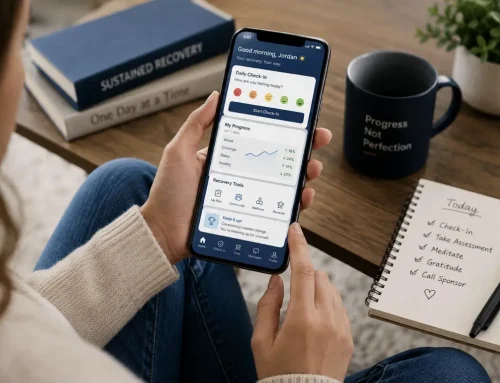
Mobile engagement apps are transforming behavioral healthcare by reducing no-show rates, improving patient outcomes, and boosting revenue through value-based care bonuses. These apps address common challenges like missed appointments and treatment dropouts by providing tools such as automated reminders, real-time symptom tracking, and secure messaging. They also integrate with Electronic Health Records (EHRs) to simplify documentation and meet payer requirements for reimbursement bonuses.
Key Benefits of Mobile Engagement Apps:
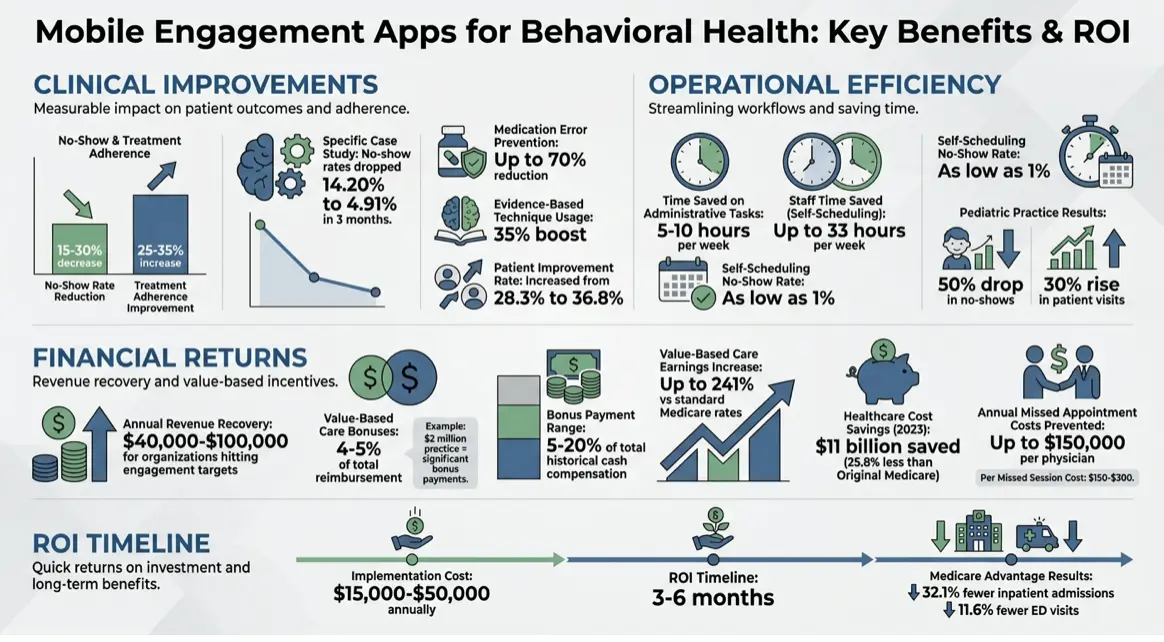
- Lower No-Show Rates: Reduce missed appointments by 15-30% with automated reminders and self-scheduling.
- Improved Outcomes: Real-time patient data enables timely treatment adjustments, increasing adherence and reducing relapses.
- Financial Gains: Practices can earn 4-5% bonus reimbursements by meeting engagement metrics tied to value-based care.
- Operational Efficiency: Save 5-10 hours per week on administrative tasks like manual data entry and reminder calls.
For behavioral health providers, tools like CaredFor offer tailored solutions, including relapse indicators, peer support, and seamless EHR integration. These features not only enhance patient care but also help organizations achieve financial success under value-based care models.
Less admin.
Stronger teams.
Better client outcomes.
See how behavioral health organizations streamline documentation, staffing, and client engagement with ContinuumCloud.
Which solution would you like to explore?
How Mobile Apps Solve Behavioral Health Engagement Problems
What Mobile Engagement Apps Do
Mobile engagement apps create a consistent connection between patients and providers, extending care beyond scheduled appointments. These apps take care of practical but crucial tasks: automated SMS reminders help patients remember their sessions, daily symptom check-ins offer ongoing insights into mental health, and secure messaging provides timely support. Together, these features tackle common engagement hurdles like missed appointments and treatment dropouts. They not only improve attendance but also generate a trackable engagement history that informs better care decisions.
The results are impressive. Platforms integrating these tools show a 25-35% improvement in treatment adherence and cut no-show rates from 14.20% to 4.91% within three months. By putting treatment access on the devices patients already check multiple times daily, these apps make engagement feel natural rather than like extra effort.
Real-Time Data Collection and User-Friendly Design
These apps do more than just manage schedules – they transform how care is delivered. Real-time data collection allows providers to shift from reacting to problems to proactively addressing them. Instead of relying on patients to recall how they felt weeks ago, providers receive up-to-date information on symptoms, medication use, and coping strategies. This enables timely adjustments to treatment plans.
Integration with Electronic Health Records (EHRs) further enhances care. Syncing patient-reported data with clinical notes improves the use of evidence-based techniques by 35%. Providers gain a complete view of the patient’s condition before appointments, eliminating repetitive questions about medical history and fostering trust.
With proper EHR integration, mobile apps remove this administrative burden, freeing staff to focus on patient care instead of data entry.
Equally important is the app’s design. Behavioral health patients often face moments of high anxiety or impaired executive function, so the interface needs to be simple and intuitive. Apps tailored for behavioral health prioritize easy navigation, clear language, and offline capabilities. This thoughtful design ensures patients can use the app effectively, even during challenging times. Moreover, seamless data integration supports the evidence needed for value-based reimbursement, making these apps a win for both patients and providers.
How Mobile Engagement Reduces No-Shows and Improves Outcomes
Lower No-Show Rates and Better Operations
Mobile apps are proving to be a game-changer in reducing no-show rates, which can be a significant financial burden for healthcare providers. Missed appointments cost physicians up to $150,000 annually. In behavioral health settings, the stakes are even higher, with each missed session costing between $150 and $300. These losses can directly threaten the financial stability of practices.
One of the most effective ways mobile engagement apps tackle this issue is through automated multi-channel reminders sent via text, email, or push notifications. Forgetting appointments is a leading cause of no-shows, and these reminders help patients stay on track. For example, a pediatric practice saw a 50% drop in no-show rates and a 30% rise in patient visits after adopting digital engagement tools between May 2021 and May 2023. Additionally, self-scheduling through mobile apps has brought no-show rates down to just 1%, saving staff as much as 33 hours per week.
An operations specialist highlighted that self-scheduling has eliminated the inefficiencies of phone-based appointment booking. Instead of spending three to eight minutes per reminder call, staff can now focus on filling last-minute openings and improving direct patient care. This streamlined process not only enhances operational efficiency but also sets the stage for better clinical outcomes. Reduced no-shows improve clinic workflows and strengthen the case for bonus reimbursements under value-based care models.
Better Clinical Results
Mobile engagement tools, when paired with integrated EHRs, create a seamless feedback loop that improves clinical care. These systems use patient-reported symptoms to adjust treatments in real time. With consistent follow-up appointments for medications and lab work, providers can proactively prevent relapses and fine-tune care plans. One physician even noted a noticeable improvement in patient care.
These integrated systems can also prevent up to 70% of medication errors by automatically cross-checking for drug interactions and unsafe dosages. Providers using such tools report a 35% boost in applying evidence-based techniques during sessions, as they spend less time on administrative tasks and more on patient care. Furthermore, when clinicians are freed from manual data entry, patient improvement rates can increase from 28.3% to 36.8%.
These advancements highlight how mobile engagement not only enhances patient outcomes but also aligns with the financial goals of value-based care. By reducing administrative burdens and improving treatment precision, these tools play a vital role in achieving better results for both patients and providers.
How to Earn Bonus Payments Through Engagement Metrics
Which Engagement Metrics Payers Reward
Providers can tap into financial bonuses by excelling in specific engagement metrics that align with value-based care principles. This care model prioritizes keeping patients healthy, and payers reward providers who excel in areas like patient satisfaction, timely follow-ups, effective management of chronic conditions, adherence to preventive care, and minimizing avoidable healthcare utilization.
For example, under the Merit-based Incentive Payment System (MIPS), bonuses are determined by performance in four key areas: quality, cost, improvement activities, and interoperability. Mobile engagement apps can play a huge role here. These tools automate tasks like sending appointment reminders, gathering patient-reported outcomes (such as PHQ-9 and GAD-7 scores), and enabling consistent tracking and messaging for measurement-based care. By collecting and leveraging this data, providers can meet the benchmarks necessary to secure reimbursement bonuses.
Calculating the Financial Returns
Boosting alumni engagement doesn’t just improve care – it can also lead to significant financial gains. Value-based care models, for instance, can increase earnings by as much as 241% compared to standard Medicare rates. High performance in these models can translate into bonus payments ranging from 5% to 20% of a provider’s total historical cash compensation. The VBA Guide explains this approach clearly:
“Ideally, incentives should be structured as a pure bonus (5% to 20% of total historical cash compensation… meaning the original components of compensation remain the same, and high performance in quality metrics results in incremental compensation.”
The financial and operational benefits extend further. Medicare Advantage patients enrolled in value-based care programs saw 32.1% fewer inpatient admissions and 11.6% fewer emergency department visits compared to those in traditional care models. In 2023 alone, value-based care saved an estimated $11 billion – 25.8% less than the cost of Original Medicare.
CaredFor: Mobile Engagement Built for Behavioral Health
What CaredFor Offers
CaredFor, part of the ContinuumCloud ecosystem, provides mobile engagement tools specifically designed for addiction and mental health programs. Unlike standard patient portals, CaredFor addresses the unique challenges behavioral health organizations face, such as high dropout rates and the need for ongoing support between sessions.
The platform simplifies patient interaction by automating appointment reminders through SMS and push notifications. Its self-service scheduling portal allows patients to book and track sessions easily. Plus, it seamlessly pushes standardized outcome data to your EHR, aligning with the growing demand for measurement-based care from payers.
What makes CaredFor stand out is its focus on behavioral health. Features like the Potential Relapse Indicator help clinicians identify at-risk patients before a crisis develops. The platform also offers a secure peer support community and a virtual events engine to combat the isolation often felt during recovery. Additionally, it supports family and alumni programming, ensuring patients remain connected throughout their treatment journey. These tools not only strengthen patient support but also help organizations achieve success in value-based care models.
How CaredFor Supports Value-Based Care Success
CaredFor takes engagement to the next level by streamlining the metrics needed for value-based care reimbursement. The platform automates data collection and tracks engagement through customized surveys and assessments, creating frequent touchpoints – or “micro-interactions” – that keep patients involved while generating detailed outcome data that payers value. These interactions are facilitated through HIPAA-compliant messaging, telehealth options, and digital care pathways that guide patients toward their treatment goals.
For organizations aiming to earn reimbursement bonuses, CaredFor’s analytics dashboard tracks key metrics like portal logins, task completions, and telehealth usage – precisely the data needed for programs like MIPS. Integration with Welligent EHR ensures that updates such as appointment changes, form submissions, and messages are automatically added to patient records, reducing administrative work and maintaining high-quality documentation. By combining clinical tools like relapse indicators with operational features such as click-to-call and rich content libraries, CaredFor helps behavioral health organizations improve patient outcomes while capturing the financial benefits of value-based care.
Conclusion: Better Outcomes and Revenue with Mobile Engagement
Mobile engagement apps aren’t just about convenience – they deliver measurable results that make a real difference both clinically and financially. On the clinical side, organizations often experience 15-30% reductions in no-show rates, improved medication adherence, and better symptom tracking through real-time patient updates. These improvements lead directly to financial gains, with recovered revenue and value-based care bonuses adding $40,000-$100,000 annuallyfor organizations that hit their engagement targets.
Value-based reimbursement models reward practices for metrics like appointment completion and care plan adherence. Practices achieving top-tier engagement can earn bonus payments of 4-5% of total reimbursement. For a practice generating $2 million annually, this translates into a meaningful financial return that aligns with their mission of delivering quality care.
CaredFor is uniquely designed to address the specific needs of behavioral health organizations, tackling challenges like high dropout rates, the need for support between sessions, and payer documentation requirements. Its seamless integration with Welligent EHR and advanced data collection tools make it easier to achieve these goals. By automating engagement tracking, CaredFor reduces administrative tasks while capturing the metrics that improve both patient outcomes and financial performance.
The investment in CaredFor pays off quickly. With annual implementation costs ranging from $15,000 to $50,000, most organizations see a return on investment within 3-6 months, thanks to reduced no-show rates alone. Add in value-based care bonuses and improved patient retention, and the financial benefits grow even further. Plus, organizations save 5-10 hours per week on tasks like reminder calls and manual documentation.
Engaging patients through their phones and offering support beyond appointments isn’t just effective – it’s transformative. CaredFor’s mobile solutions ensure organizations can achieve top-tier results in both patient care and financial success.