A category-defining change is reshaping how Treatment Centers prove their work to payers, regulators, and accreditation bodies. Most MBC platforms aren’t built for the conversation that comes next.
Walk into any payer-relations meeting at a leading SUD Treatment Center this year and you will hear a sentence that did not come up two years ago: “we need to see sustained outcomes data.”
It is a small phrase with a large consequence. For two decades, behavioral health Treatment Centers have demonstrated value to payers using episode-of-care metrics: completion rates, length of stay, discharge satisfaction, sometimes a 30-day or 90-day follow-up call. Those metrics described the treatment episode. They did not describe recovery.
That distinction is now becoming material. Payers and value-based care arrangements increasingly tie reimbursement, network placement, and prior authorization decisions to evidence of sustained recovery — the kind of evidence that requires continuous measurement long after a patient has left a Treatment Center’s care. Accreditation bodies including CARF and the Joint Commission have moved in the same direction, asking for outcomes data that follows patients past discharge.
Most Treatment Centers do not yet have a way to produce that evidence. Their MBC platforms were not built for it.
Less admin.
Stronger teams.
Better client outcomes.
See how behavioral health organizations streamline documentation, staffing, and client engagement with ContinuumCloud.
Which solution would you like to explore?
Why the Existing Toolkit Falls Short
The Measurement Based Care category, as it stands, has three structural limitations when it comes to producing longitudinal outcomes data.
First, most MBC platforms cover only the clinical stage.
They are designed around assessment administration during active treatment — PHQ-9 at intake, GAD-7 weekly, BAM at intervals, sometimes a discharge measure. Pre-admission engagement is invisible. Post-discharge measurement does not exist. The data set is, by design, a fragment.
Second, MBC platforms depend on patient compliance with portals.
Standardized assessments are typically delivered through patient portals or email links. Completion rates reflect the inherent friction of those channels: patients have to remember to log in, navigate a portal designed for clinicians, and complete instruments without context. The result is incomplete, late, or skipped data — which leaves clinicians and payer-relations teams without the evidence they need.
Third, MBC platforms stop measuring at discharge.
This is the most consequential limitation. Recovery does not stop when a patient leaves a Treatment Center; in many ways, it begins there. The 90-day post-discharge window is the period of highest relapse risk and the period payers care about most. An MBC platform that goes dark at discharge cannot demonstrate sustained recovery, because it stops producing data exactly when sustained recovery would need to be proven.
MBC platforms that haphazardly cover only the clinical stage have been made obsolete by the questions payers are now asking.
What the Shift Looks Like in Practice
The Treatment Centers ahead of this curve are not solving the problem with better portals or more frequent emails. They are solving it with continuous, mobile-first alumni engagement that captures clinical signal across the full lifecycle.
Three capabilities define the new approach:
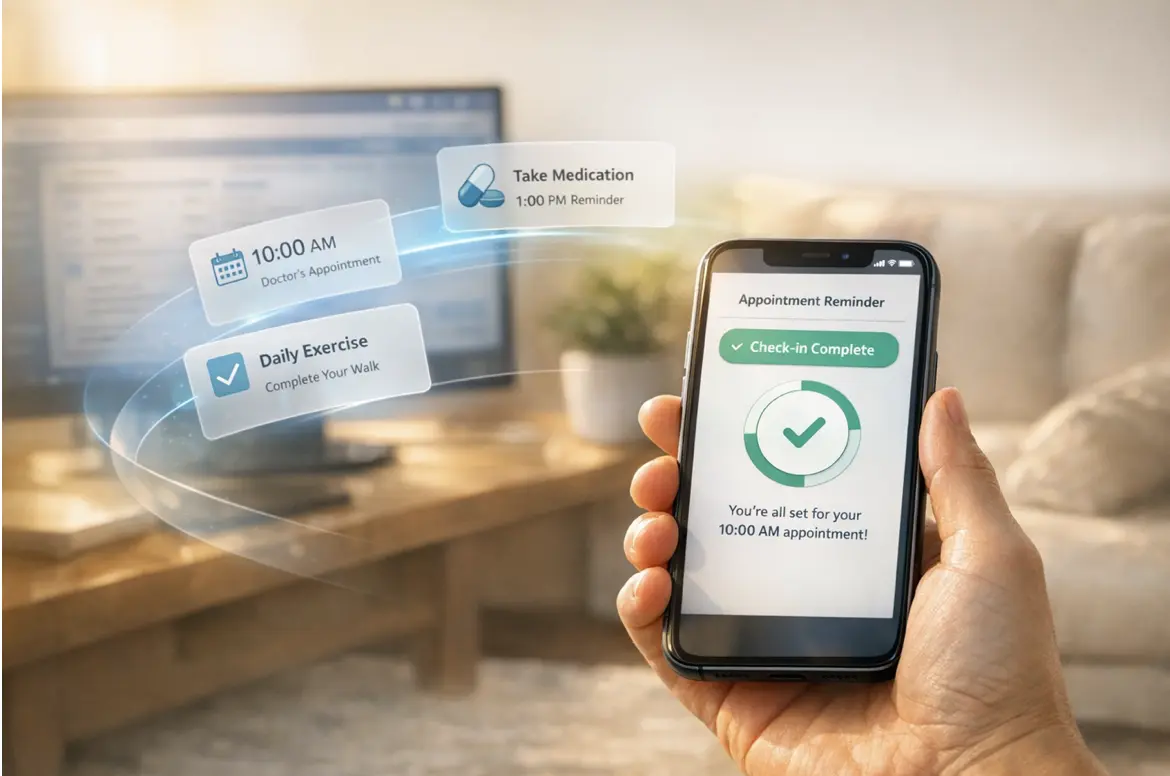
An app that lives in the patient’s pocket.
Continuous engagement requires a tool patients open daily — not because they are completing an assessment, but because their treatment plan, peer community, and self-tracking are all there. The app becomes the patient’s primary connection to the Treatment Center, which means assessment completion stops being a chore at the margins and becomes part of the daily flow.
Closed-loop completion mechanics.
The most effective platforms gate access to other features until critical assessments are completed and pair gating with positive reinforcement through Contingency Management. Patients earn points for engagement that redeem for sentimental and product rewards. The result: assessment completion rates that portal-based MBC tools cannot match.
Continuous measurement past discharge.
The same app that engaged the patient pre-admission and during treatment continues capturing data through alumni recovery. The 90-day cliff that traditionally swallows engagement becomes the period of richest signal. Treatment Centers gain access to the longitudinal evidence — sustained recovery, reduced readmissions, lower downstream cost of care — that payers and regulators are increasingly demanding.
The Clinical Encounter, Reimagined
The platform shift produces a downstream effect that is sometimes overlooked: it changes what happens in the clinical encounter.
Today, most therapy sessions in SUD treatment open with the same question: “So — how are we feeling today?” It is a question that wastes the first ten minutes of every session, because the patient must reconstruct a week of struggle on the spot, and the clinician must triage based on whatever surfaces.
With continuous data delivered through bi-directional EHR integration, the same encounter opens differently. The clinician walks in already holding the whole picture: standardized assessments, Wellness Tracker patterns, the days the data shows trouble. The opening line becomes:
Your assessments show real progress — but I want to talk about Saturdays. Tell me about Saturdays.
That is the difference between a check-in and a clinical conversation. It is also the difference between a partial-picture MBC tool and a full-lifecycle outcomes platform. Sharper questions. Earlier interventions. Stronger Therapeutic Alliance — which remains the #1 predictor of treatment plan success.
What Treatment Center Leadership Should Do Now
For executive teams looking at this shift, three actions are worth taking in the next two quarters.
1. Audit the longitudinal data gap.
Ask: what outcomes data can we produce for a patient 6 months, 12 months, or 24 months post-discharge? If the answer is “whatever the alumni director can pull together,” the gap is real and the next payer conversation will expose it.
2. Reassess assessment completion rates honestly.
Portal-based MBC tools often report completion rates that look acceptable but reflect only the patients who completed any assessment, ignoring those who never started. The denominator matters. Treatment Centers that have moved to mobile-first engagement consistently see meaningful completion improvements that hold up under audit.
3. Connect the engagement and MBC strategies.
These have historically been treated as separate initiatives owned by separate teams. The shift is toward a single platform that does both — because engagement is the mechanism by which sustained outcomes data is produced. Treatment Centers that keep them separate will keep producing partial pictures.
The Decade Ahead
The Treatment Centers that close their longitudinal data gap this year will negotiate from a position of strength next year. They will defend prior authorizations with evidence rather than narrative, secure preferred network placement, and meet parity and accreditation reporting requirements without scrambling.
The Treatment Centers that wait will find themselves answering harder questions with less data — a position that has historically not ended well in healthcare reimbursement cycles.
The category is not asking for incremental improvement. It is asking for a different kind of platform.
About CaredFor:
CaredFor is the leading patient outcomes and engagement app for SUD Treatment Centers. The patient-centric, mobile-first, white-labeled solution supports Treatment Centers across the full patient lifecycle through Care Journeys, Wellness Trackers, Contingency Management, peer support community, and continuous outcomes measurement. CaredFor is HIPAA compliant, PCI certified, and trusted by industry leaders for more than a decade. CaredFor is a brand of ContinuumCloud, backed by Battery Ventures.