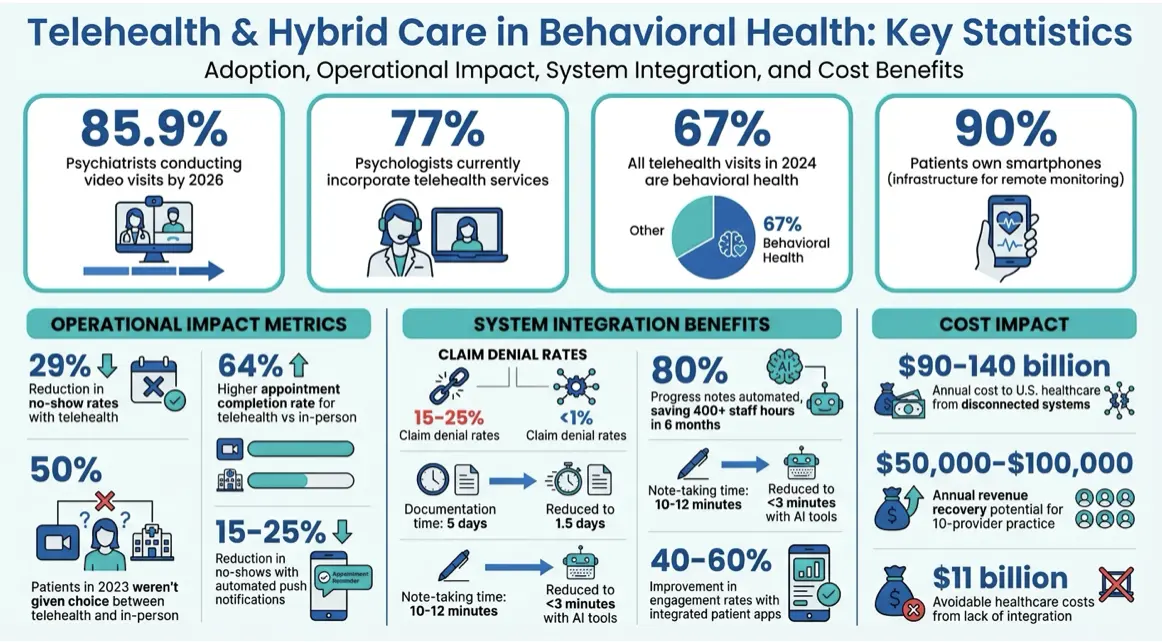
Telehealth is no longer a temporary solution – it’s a permanent part of healthcare, particularly in behavioral health. By 2026, 85.9% of psychiatrists are conducting video visits, with hybrid care models blending in-person and virtual services becoming the norm. This shift demands advanced EHR systems and alumni engagement tools to handle telehealth documentation, billing, and compliance.
Key takeaways:
- Behavioral health leads telehealth usage, accounting for 67% of all telehealth visits in 2024.
- Hybrid care models combine virtual sessions, in-person visits, and digital tools like patient apps and remote monitoring.
- Payers are enforcing stricter documentation standards, requiring EHR systems to manage consent forms, billing codes, and compliance workflows.
- Integrated systems reduce claim denial rates (from 15–25% to under 1%) and improve operational efficiency.
To succeed in this evolving landscape, healthcare providers must align their technology with hybrid care demands, ensuring seamless integration between EHRs, telehealth platforms, and alumni engagement tools.
Less admin.
Stronger teams.
Better client outcomes.
See how behavioral health organizations streamline documentation, staffing, and client engagement with ContinuumCloud.
Which solution would you like to explore?
What Hybrid Care Models Include
Hybrid care combines in-person visits with virtual sessions and digital tools, creating a system that integrates real-time interactions (like video or phone calls) with asynchronous tools such as smartphone apps, wearables, and digital therapeutics. Today, 77% of psychologists incorporate telehealth services into their practice, highlighting how integral this approach has become in behavioral health.
The most effective hybrid models follow a three-dimensional framework: balancing the type of intervention, the level of human support (from clinicians to digital navigators), and the specific needs of the patient population. This means your tech setup should go beyond basic scheduling. It must support remote monitoring, manage care transitions, and ensure clinical continuity across various touchpoints. These elements are key to meeting both clinical and compliance requirements as they evolve.
Scheduling for In-Person and Virtual Visits
A strong scheduling system is crucial for coordinating both in-person and virtual appointments. It must align patient needs with facility capacity through space-sharing and staggered schedules. Patient satisfaction takes a hit when they can’t choose their preferred visit type – nearly 50% of patients surveyed in 2023 said they weren’t given the option between telehealth and in-person sessions.
To address this, record patient preferences during intake and reassess them periodically to ensure they align with clinical needs. Your EHR system should flag when a condition requires a change in modality, reducing staff workload while maintaining quality care. Effective scheduling also sets the stage for integrating remote monitoring and offering more personalized care.
Remote Monitoring in Mental Health Care
Remote monitoring tools gather data through two main methods: active input (like patients logging symptoms) and passive tracking (such as wearables measuring sleep or activity). This data empowers clinicians with insights that lead to better treatment decisions between sessions. With nearly 90% of patients owning smartphones, the infrastructure for these tools is already widely accessible.
However, keeping patients engaged with these tools is a major hurdle – over 90% abandon standalone mental health apps within days. This is where Digital Navigators come in. These non-clinical staff members help bridge the digital literacy gap, assisting patients and providers with setup and troubleshooting. By removing technical barriers, navigators ensure patients stay connected to monitoring tools, reinforcing a seamless care experience across all touchpoints.
|
Component |
Virtual/Digital |
In-Person/Physical |
|
Best Use Cases |
Routine therapy, follow-ups, OCD exposures |
Crisis intervention, complex evaluations, severe depression |
|
Workflow Style |
Patient self-service, asynchronous chat, convenience |
Staff-managed workflows, structured clinical operations |
|
Infrastructure |
Cloud-based, device-agnostic, scalable |
Dependent on facility capacity, physical space-sharing |
When to Switch Between Virtual and In-Person Sessions
Deciding when to switch between virtual and in-person care should be guided by clinical needs and patient preferences. Certain conditions respond better to specific formats. For instance, severe depression may benefit from in-office visits to encourage engagement, while OCD exposure therapy is often more effective when conducted via telehealth in the patient’s home.
Track metrics like case consultations and care coordination, as these can decline in hybrid setups. Your EHR should document the reasons for switching modalities to streamline care coordination. For high-risk patients, such as those experiencing acute suicidality, hybrid models typically exclude virtual care, requiring clear protocols to transition these individuals to in-person treatment.
Adapting Your EHR for Hybrid Care Compliance
As hybrid care models continue to expand, ensuring your EHR system aligns with compliance standards is critical for both efficiency and meeting regulatory requirements. By 2026, payer documentation standards will become stricter, and with manual audits covering only 5%–10% of clinical notes, even small errors can lead to claim denials.
Disconnected systems add unnecessary complexity, often requiring the same data to be entered up to eight times. This inefficiency costs the U.S. healthcare system between $90–$140 billion annually. On the other hand, well-integrated EHRs can significantly reduce claim denials, bringing rates below 1%, compared to 5%–10% in fragmented setups. The difference lies in how effectively your EHR handles consent documentation, billing workflows, and system integration. A streamlined approach to consent documentation is a vital step in closing these gaps.
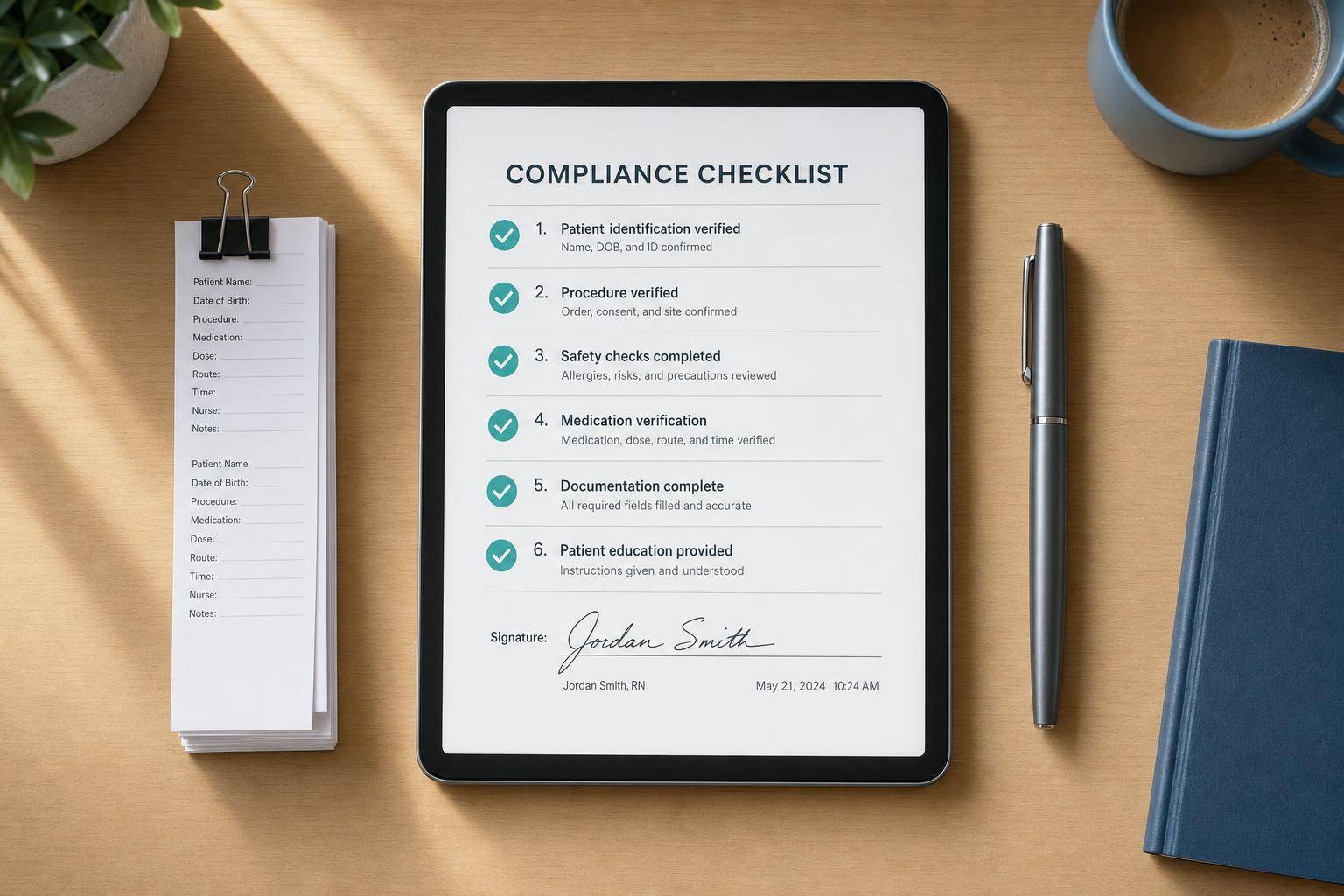
Managing Telehealth Consent Forms
Automating consent forms through your patient portal can make a significant difference. Patients can review and sign documents ahead of time, and with Welligent’s native e-signature capability, digital signatures are stored directly in the patient record — no third-party integrations required. This eliminates manual tracking and closes one of the most common sources of compliance gaps.
Your EHR should also include state-specific flags to adjust consent requirements based on the patient’s location. The Center for Connected Health Policy highlights the importance of tailoring practices to meet varying state regulations:
“The variation in state telehealth laws often means that a one-size-fits-all approach to informed consent is inadequate. Providers must adapt their practices based on state requirements to avoid regulatory issues”.
Additionally, your system should time-stamp all electronic consents and send alerts when forms are incomplete or nearing expiration.
AI-powered documentation platforms integrated with EHR systems have demonstrated measurable impact — reducing average note submission times from five days to 1.5 days and achieving 92% clinical staff satisfaction by streamlining compliance tracking and reducing manual workload.
|
Feature |
Configuration Benefit |
Compliance Impact |
|
E-Signature Integration |
Automates storage of signed forms |
Ensures consent is securely documented |
|
Patient Portal Forms |
Enables self-service consent completion |
Reduces missing documentation before care begins |
|
AI Compliance Modules |
Audits 100% of notes in real time |
Flags missing consent elements before audits |
|
Standardized Templates |
Includes mandatory fields for state needs |
Ensures state-specific documentation requirements are met |
Billing for Audio-Only Telehealth Visits
To improve billing accuracy for audio-only telehealth, sync your telehealth platform’s schedule with your EHR. This ensures that session details automatically link to clinical documentation and billing logs. Automated charge capture can pull data directly from clinical activities, helping to prevent the 3%–5% of charges that typically go unbilled due to documentation or coding errors.
AI-powered tools can audit 100% of clinical documentation in real time. These tools maintain the “Golden Thread” – the connection between diagnosis, treatment plan, and session notes – demonstrating medical necessity for payer reimbursement.
In January 2024, a behavioral health facility in Oklahoma implemented an AI system within their EHR, automating over 80% of progress notes. This saved the organization more than 400 staff hours in just six months.
Automating insurance verification and prior authorization workflows within your EHR can also save significant time. For example, Cleveland Clinic introduced prior-authorization automation in March 2026, which sped up provider notifications by 6 to 7 days and reduced peer-to-peer review times by 11 days. This cut billing cycle delays from seven days to just one, effectively eliminating revenue leakage.
Connecting Telehealth Platforms with Your EHR
To avoid the inefficiencies of manual processes, enable auto-launch functionality so providers can start telehealth sessions directly from the EHR schedule without switching platforms. Real-time data synchronization ensures that appointments, messages, and completed forms flow seamlessly between your telehealth platform and EHR, creating a single source of truth. This integration eliminates the need for manual re-entry, which often leads to billing errors and compliance gaps.
Your EHR should also support AI tools that can listen to sessions and draft clinical notes, saving them directly into the patient record. This can cut note-taking time from 10–12 minutes to under 3 minutes per session.
As Bob Bates, CEO of ContinuumCloud, puts it:
“Together we’re giving clinicians their time back while ensuring defensible, compliant documentation”.
Integrated alumni engagement tools like CaredFor can further streamline workflows by pushing digital consent forms directly into the Welligent EHR, reducing manual data entry.
This inefficiency contributes to over $11 billion in avoidable healthcare costs annually in the U.S..
Alumni Engagement Apps in Hybrid Care
As behavioral health care increasingly adopts a hybrid model, alumni engagement apps are playing a key role in maintaining clinical continuity. These apps have grown far beyond basic scheduling tools, evolving into platforms that actively support ongoing treatment. Instead of just handling appointment bookings or payment processing, modern apps now offer secure messaging, symptom tracking, and care plan management. By integrating these features into clinical workflows, engagement rates can improve by 40–60%. These tools are essential for creating a seamless hybrid care experience that connects patients and providers at every step.
Features That Support Ongoing Care
Secure messaging allows patients and providers to stay in touch between sessions, whether it’s for medication adjustments or symptom updates. Virtual waiting rooms simplify the process of joining sessions, while automated push notification reminders help cut no-show rates by 15–25%. Pre-visit questionnaires that automatically populate EHR data save providers 15–20 minutes per visit, streamlining documentation.
For behavioral health specifically, unique features include mood tracking dashboards, medication adherence reminders with dosage confirmation, and crisis buttons that connect directly to the National Suicide Prevention Lifeline (988). Secure caregiver portals also play a vital role, enabling family members to view treatment progress and goals with patient consent. Research shows that involving family in this way can boost treatment adherence by 30–45%.
How CaredFor Supports Behavioral Health Organizations
CaredFor takes these capabilities a step further by integrating seamlessly with EHR systems like Welligent, streamlining workflows and enhancing alumni engagement. This integration syncs appointments, digital forms, and client messages automatically, cutting down on manual tasks and reducing compliance gaps. The platform also offers structured care pathways that include educational content, milestone tracking, and automated check-ins to keep patients engaged between sessions.
Additional features like integrated peer support, family portals, and real-time analytics help reduce patient attrition by fostering stronger connections and enabling timely staff interventions. The app’s one-click telehealth access simplifies launching HIPAA-compliant video sessions directly from the EHR schedule – no downloads required. Digital assessments with automated scoring feed results straight into the patient record, supporting measurement-based care while lightening the administrative load for providers.
How to Implement Hybrid Care Models
Implementing hybrid care takes careful planning across technology, staff, and workflows. Treating it as a simple add-on can lead to compliance issues, frustrated staff, and a poor patient experience. Instead, hybrid care should be fully integrated into your existing systems to create a seamless approach rather than a patchwork of disconnected tools.
Training Staff for Virtual Care Delivery
Training staff for virtual care goes beyond teaching them how to start a video session. Clinicians need to understand billing compliance, such as when to use Place of Service (POS) code 10 (for care delivered to a patient at home) versus POS 02 (for other telehealth locations). They also need to know how to apply Modifier 93 or FQ for audio-only visits. Standardizing documentation workflows – like ensuring notes, e-prescriptions, and billing codes automatically update in the patient record – should be part of routine training.
Privacy is another critical area. Staff should learn best practices for camera positioning, preventing unauthorized recordings, and minimizing interruptions during virtual sessions. Assigning telehealth champions – experienced virtual care providers who can mentor and train others – can make adoption smoother. These champions can also share strategies to reduce cognitive fatigue, such as turning off notifications during appointments and scheduling breaks between sessions.
Once the team is trained, integrating telehealth and messaging systems becomes the next priority.
Making Systems Work Together
The success of hybrid care often hinges on how well systems are integrated. Disconnected platforms can cause inefficiencies like duplicate data entry and errors in documentation. On the other hand, API-based integrations allow data to flow automatically – appointments sync, digital forms populate the EHR, and session notes update patient records without manual steps.
A unified technology stack is essential. For example, use a scheduling system that lets patients choose between virtual and in-person visits from the same calendar. Automated pre-visit instructions tailored to their choice can further streamline the process. Tools like automated tech checks – where patients test their camera, microphone, and internet connection through the portal before their appointment – can save time troubleshooting.
Security should also be a top priority. Use end-to-end encryption (TLS 1.2 or higher), two-factor authentication, and signed Business Associate Agreements (BAAs) for any platform handling patient data. If your organization uses remote patient monitoring, ensure connected devices transmit data directly into the EHR using FHIR APIs, enabling real-time clinical alerts.
Tracking Performance in Hybrid Care
Measuring performance is key to refining hybrid care. For instance, telehealth can reduce no-show rates by 29% compared to in-person visits. Track appointment completion rates and revenue impact, as telehealth visits are completed 64% more often. A 10-provider practice with a 15% in-person no-show rate could recover $50,000–$100,000 annually by shifting suitable appointments to telehealth.
Clinical quality should also be monitored using tools like PHQ-9 or GAD-7 scores integrated into the EHR. Pay attention to coordination-of-care metrics and case consultation frequency, as these may decline in hybrid settings. Additionally, ensure patients are given a real choice between virtual and in-person visits. In 2023, nearly 50% of surveyed patients reported not being offered this choice, which negatively affected satisfaction.
Operational metrics matter too. Track billing accuracy, documentation errors, and how well clinician availability aligns with patient demand for in-person visits. Block scheduling – dedicating specific days to virtual visits – or interleaved scheduling (if supported by your EHR) can reduce staff context-switching. Finally, keep an eye on provider well-being. Hybrid models can blur work-life boundaries, so monitoring for signs of burnout can help address issues before they lead to turnover.
Conclusion
Hybrid Care Is Here to Stay
Hybrid care has firmly established itself as a cornerstone of behavioral health. With 77% of psychologists offering telehealth services and behavioral health making up 67% of all telehealth visits in 2024, it’s clear the industry has reached what Dan Ferris, Chief Growth Officer at LifeStance Health, describes as an “equilibrium point.” Regulatory changes are also cementing this shift, with Medicare solidifying key behavioral health telehealth provisions. For providers, adopting hybrid care models is no longer optional – it’s essential to meet the needs of all patients.
Telehealth offers measurable benefits, including a 29% drop in no-show rates and a 64% higher appointment completion rate. But success hinges on giving patients real options.
This lasting transformation in care delivery underscores the need for advanced technology to maintain quality and simplify operations.
Technology Platforms Drive Better Outcomes
Integrated technology platforms are key to overcoming the challenges of disconnected systems, such as fragmented documentation and billing errors. When your EHR, telehealth tools, and alumni engagement platform work together seamlessly, clinicians can focus on what matters most – caring for patients.
CaredFor, part of ContinuumCloud, helps behavioral health organizations navigate this shift by offering a alumni engagement platform designed to integrate smoothly into clinical workflows. Through a single portal, patients can access video sessions, medical records, secure messaging, and prescriptions, ensuring continuity of care while meeting payer compliance standards. With 85.9% already conducting video visits and stricter documentation requirements on the horizon, the technology decisions you make today will shape your ability to deliver effective hybrid care in the future. By aligning your EHR and alumni engagement tools with these principles, your organization can confidently embrace the evolving landscape of behavioral health.
FAQs
What should our EHR automate for telehealth compliance?
How do we bill audio-only telehealth correctly?
Which patient app features matter most in hybrid behavioral health?
Patient apps designed for hybrid behavioral health need to offer a range of features that prioritize convenience, engagement, and care coordination. Some of the most important tools include:
- Secure Messaging: Enables patients to communicate with their care team while ensuring privacy and confidentiality.
- Self-Service Appointment Scheduling: Gives patients the flexibility to book, reschedule, or cancel appointments without needing to call.
- Access to Treatment Plans and Documents: Provides patients with instant access to their care plans, progress notes, and other essential documents.
- Online Forms and Assessments: Simplifies the process of completing necessary paperwork or assessments before or between sessions.
- Real-Time Notifications: Keeps patients updated with reminders for appointments, medication schedules, or important updates from their care team.
These features are designed to function seamlessly on mobile devices, ensuring patients remain connected and engaged in their care journey.