Behavioral health organizations face a tough challenge: managing workforce costs while navigating complex funding rules from Medicaid, grants, and private insurance. Labor expenses make up 70–80% of their budgets, but tracking these costs accurately across fluctuating staffing needs and mixed funding models is a constant struggle. High turnover, unpredictable client demands, and disconnected systems only add to the difficulty.
Key Takeaways:
- Labor Costs: Tracking and aligning staff hours with funding streams is critical but complicated.
- Turnover Costs: Replacing a single clinician can cost $10,000–$20,000, excluding hidden impacts like lost revenue.
- Funding Complexity: Mixed funding models (contracts, fee-for-service) require precise documentation, often leading to errors without integrated systems.
- Disconnected Systems: Many organizations rely on outdated, siloed systems, making real-time cost allocation nearly impossible.
Solution: Integrated platforms like DATIS streamline labor tracking by connecting payroll, clinical, and funding data. They automate cost allocation, reduce manual errors, and provide real-time reporting to improve financial oversight and compliance.
This article explains why traditional systems fall short and how integrated tools can help behavioral health organizations better manage labor costs and funding.
Less admin.
Stronger teams.
Better client outcomes.
See how behavioral health organizations streamline documentation, staffing, and client engagement with ContinuumCloud.
Which solution would you like to explore?
Why Labor Costs Are Difficult to Track in Behavioral Health
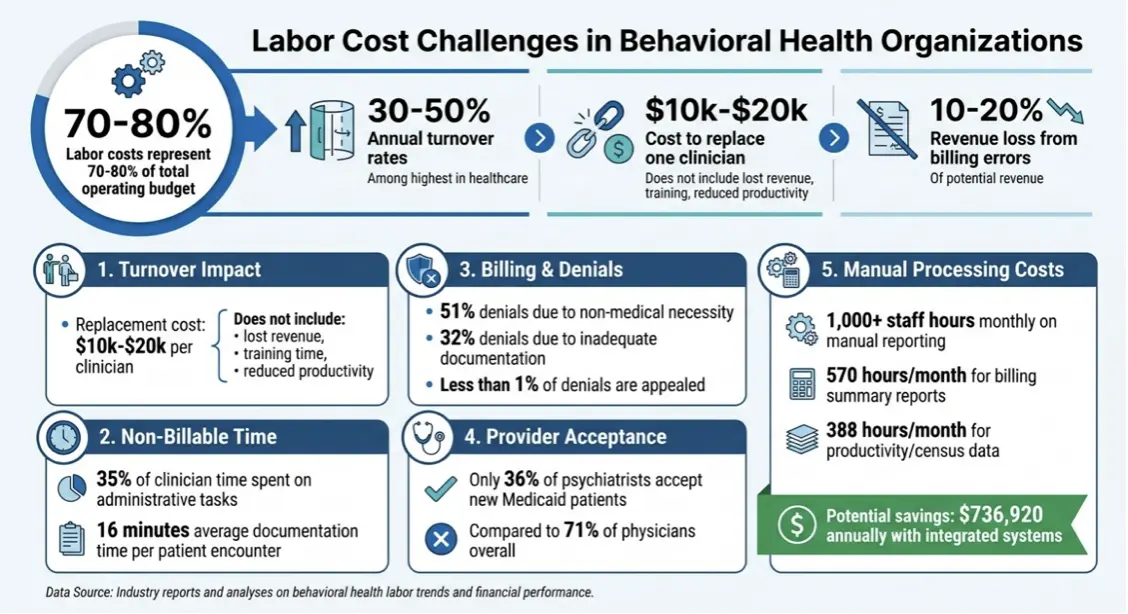
Labor costs often make up a huge portion – 70% to 80% – of the total operating budget for behavioral health organizations. Yet, accurately tracking these expenses is a major challenge. It’s not just about logging hours; it’s about linking those hours to the right clients, services, and funding streams in a field where unpredictability is the norm. This constant state of change makes real-time labor cost allocation incredibly complex.
Changing Staffing Needs Based on Client Requirements
Behavioral health services don’t follow a neat, predictable schedule like medical procedures often do. For instance, a therapist might spend 30 minutes with one client but three hours with another, depending on the situation. A relapse or life crisis can instantly change the intensity of care needed – sometimes requiring immediate one-on-one attention or even hospitalization.
This level of unpredictability turns staffing into a constant balancing act. For organizations serving diverse populations – such as those with mental health issues, substance use disorders, or co-occurring conditions – staffing often needs to shift quickly based on client needs. One week, a crisis team might need three staff members; the next, they might require five. These fluctuating demands make it tough to assign labor costs to specific funding sources in real time, especially when funders have varying documentation requirements for what qualifies as billable. Without an integrated system, aligning these labor demands with funding streams becomes nearly impossible.
High Turnover and Hiring Costs
The situation is further complicated by high employee turnover, which is a persistent issue in behavioral health. Annual turnover rates often fall between 30% and 50%, which are among the highest in healthcare. Replacing just one clinician can cost between $10,000 and $20,000, factoring in recruitment, credentialing, and lost productivity during onboarding. But these numbers only scratch the surface.
There are hidden costs, too. Temporary staffing or overtime to cover vacancies can drain budgets. Experienced staff may have to divert time from billable work to train new hires. Plus, new employees often need time to get up to speed before they’re fully productive. On top of that, when familiar clinicians leave, client relationships can suffer, potentially setting back treatment progress. Without systems that connect workforce data to funding sources, organizations struggle to measure the full financial impact of turnover, including lost revenue from unfilled positions. Real-time data integration is critical for uncovering these hidden costs and making smarter decisions about retention and staffing investments.
How Contract and Fee-for-Service Models Complicate Labor Tracking
Behavioral health organizations often rely on various funding streams – contracts, grants, and fee-for-service models – each with its own set of rules for documenting labor. This creates a logistical headache when a clinician works with clients funded by multiple sources in a single day. Allocating costs correctly in such scenarios is no small feat, making integrated tools like DATIS essential for managing these complexities.
Fixed Payments in Contract-Based Funding
Fixed payment models, while predictable, fail to account for all labor costs, especially vcfo overhead expenses like supervision, IT support, billing systems, and compliance efforts. These contracts provide a set amount for a defined scope of work, regardless of how much labor is actually required.
Take Mobile Crisis Teams, for instance. Traditional fee-for-service models don’t reimburse for critical “on-call” labor, such as 24/7 availability or travel time – key components of crisis response work. To address this, many states have adopted fixed funding models for these teams. However, this approach introduces a new challenge: fixed payments often fall short of covering team-based activities like outreach, meetings, and documentation. When contracts fail to cover actual labor costs, organizations are left with two unsustainable options: absorb the financial loss or rely on block grants to fill the gap.
“When finance and HR don’t operate in lockstep, it puts workforce plans at much greater risk.” – Carter Freeman, Vice President, VCFO
Billable Hours in Fee-for-Service Funding
Fee-for-service funding ties revenue directly to billable encounters, but this model has its own pitfalls. Clinicians spend about 35% of their time on non-billable administrative tasks, such as documentation, which averages 16 minutes per patient encounter. Tasks like prior authorizations, compliance work, and extensive documentation eat into labor time without generating revenue, making it difficult to reconcile labor costs with funding.
The reimbursement rates themselves often don’t align with labor market demands. As of 2024, only 36% of psychiatrists accept new Medicaid patients, compared to 71% of physicians overall. A major reason? Medicaid fee-for-service rates are too low to retain qualified clinicians. When reimbursement fails to meet the minimum wage requirements for attracting staff, organizations must either operate at a financial loss or turn patients away.
Mixed Funding Models That Require Detailed Tracking
The complexity grows exponentially when organizations manage both contract and fee-for-service funding. A single clinician might work under multiple funding arrangements in a single week, each requiring different documentation and cost allocation methods. The real challenge lies in ensuring that timekeeping, payroll, and general ledger systems are fully aligned.
Mixed funding setups demand rigorous tracking across all operations. In one case, an organization faced $127,000 in questioned labor charges during an audit due to a discrepancy of just 220 hours in a single month. When timekeeping, payroll, and general ledger systems aren’t integrated, discrepancies are inevitable. Manual adjustments to reclassify labor costs between funding sources often lack sufficient documentation, which can appear to auditors as unauthorized cost manipulation. Without automated systems to integrate these processes, organizations are left with error-prone manual workarounds, undermining the accuracy of cost allocation. These issues highlight why connected solutions like DATIS are so critical for managing labor tracking effectively.
Why Older Systems Cannot Connect Labor to Funding
Behavioral health organizations often juggle multiple systems – clinical EHR, billing, HR/payroll, outcomes tracking, and general ledger software – that operate independently. These disconnected systems make it nearly impossible to generate program-level reports that link labor costs to funding sources. This lack of integration is a major reason why tying labor to funding remains such a difficult task.
Disconnected Data in Separate Systems
Each system serves its purpose but fails to communicate with the others. For example, an EHR records client sessions, while payroll systems track employee hours and compensation. However, no major behavioral health EHR can seamlessly combine these datasets. This limitation makes it difficult to calculate productivity metrics like cost per client or revenue per labor hour without manually exporting and combining data.
Adding to the challenge, outcome measurement scores are often housed in entirely separate platforms managed by different teams. Grant-funded programs further complicate matters, as their performance periods rarely align with standard reporting cycles. This misalignment forces organizations to manually reconstruct data to meet compliance requirements.
This fragmented approach leaves organizations dependent on manual workarounds, which come with their own set of challenges.
Manual Processes and Data Errors
When systems don’t integrate, staff must resort to manual data transfers – a process that is time-consuming and prone to errors. For example, one organization reported spending over 1,000 staff hours each month on manual reporting tasks. Specifically, compiling a billing summary report took 570 hours monthly, while regional directors spent an additional 388 hours preparing productivity and census data. After adopting a unified analytics layer to connect their EHR and payroll systems, this organization projected annual time savings valued at $736,920.
The reliance on manual processes not only wastes time but also leads to costly mistakes. Behavioral health practices lose between 10% and 20% of potential revenue due to preventable billing errors and claim denials. Among these denials, 51% are attributed to non-medical necessity, 32% to inadequate documentation, and fewer than 1% are appealed because organizations lack the visibility needed to identify which claims are worth pursuing.
Missing Real-Time Analytics
Older billing systems are designed for transaction processing, not for analyzing patterns in real time. This makes it difficult to identify which services are most prone to denials or which funding sources effectively cover labor costs. Without real-time dashboards, organizations are left reacting to changes in Medicaid funding rules or regulatory updates instead of proactively managing their workforce.
These gaps highlight the need for integrated solutions that can bridge disconnected systems and provide real-time insights. Without such tools, organizations remain stuck in a reactive cycle, unable to strategically manage labor costs. Integrated platforms like DATIS offer a way forward, enabling organizations to connect their data and make informed decisions.
How Integrated Systems Connect Labor to Funding
Integrated systems play a crucial role in breaking down data silos within behavioral health organizations by combining clinical and payroll data into a single, streamlined workflow. When platforms like DATIS Human Capital Management (HCM) integrates directly with EHR software systems such as Welligent, the flow of clinical and payroll data becomes seamless. This connection ensures that service activities align with labor costs, addressing the challenge of matching workforce expenses to various funding sources. Here’s how this unified approach works in practice.
Connecting DATIS HCM with Welligent EHR
DATIS and Welligent, both part of ContinuumCloud, operate as a single, integrated platform. This integration ensures that workforce data and clinical documentation are synced automatically. Bob Bates, CEO of ContinuumCloud, highlights its impact:
“Together we’re giving clinicians their time back while ensuring defensible, compliant documentation.”
The system uses Welligent to track staff schedules and availability, creating the foundation for labor allocation in DATIS. For example, when a clinician logs a client session, the system cross-references that activity with attendance records. This ensures labor costs are linked only to valid funding codes. Additionally, the platform manages workflows that connect staff credentialing with payroll, ensuring only qualified employees are paid for eligible services. This integration sets the stage for automating labor cost assignments.
Automatic Labor Cost Assignment to Funding Sources
One of the standout features of this integration is its ability to automate cost allocation, eliminating the need for manual spreadsheet calculations. For instance, if a clinician splits their time evenly between a grant-funded program and fee-for-service work, the system automatically divides their salary and benefits accordingly. This is made possible by a position control engine that ties each role to a specific budget or funding source right from the moment of hire. This eliminates the need to reconcile costs after payroll processing. The system is designed to handle multiple payers, funding streams, and programs at once, while also generating performance and utilization metrics that detail how labor is distributed across services.
Real-Time Reports for Compliance and Cost Management
Beyond automating allocations, the system offers real-time reporting tools that provide immediate oversight. This eliminates the delays common in manual processes, allowing managers to track labor expenses against grants or contracts as they happen. These reports ensure that labor costs are accurately assigned to the correct funding streams. Custom dashboards and exportable reports are tailored for funders and auditors, helping verify outcomes, productivity, and compliance. For added convenience, the system can send automated alerts when labor costs for a specific contract approach a set threshold.
Additionally, the platform creates a digital trail that links every labor dollar to a specific service or program requirement. This is essential for meeting federal and state audit standards, such as HRSA and Medicaid audits. AI-powered tools enhance this process by auditing 100% of clinical documentation in real time, ensuring that billed labor hours meet compliance requirements.
Using DATIS to Connect Labor Costs with Funding
Setting Up DATIS and Connecting Your Data
Start by using the Position Control feature to define each role in your organization and tie it to a specific budget before hiring. This serves as the backbone for monitoring labor costs. Marion McLaurin, Senior VP of Human Resources, puts it simply:
“If you’re in Health and Human Services, then this is the product. This is the way to go. Because they’ve already designed it according to that industry, and it just makes sense.”
Once Position Control is in place, the next step is consolidating all your data streams. Ditch the spreadsheets and integrate Time & Attendance, Payroll, and HR data into one cloud-based platform. DATIS brings these components together, with DataConnect integration services ensuring smooth and accurate data flow across your systems. This unified approach links labor costs directly to funding, addressing many of the challenges organizations face.
Creating Reports That Show Labor-to-Funding Connections
With your data consolidated, you can start generating reports that provide actionable insights. Business Intelligence (BI) tools within DATIS turn raw workforce data into clear, concise reports that align labor hours with funding streams. This is especially crucial for organizations managing multiple grants. Tami Lewis-Ahrendt, Chief Operating Officer, underscores this capability:
“Our agency has a number of federal and private grants tied to personnel costs and allocations. DATIS e3 is extraordinary at allowing the end user to slice information as needed for complex reporting.”
The system’s automatic allocation of personnel costs to specific grants ensures revenue is accurately distributed, making audits much easier. You can also create customized reports for funders and auditors directly through the platform. DATIS has earned a 10/10 rating for its organizational charting and compliance data management capabilities. These precise reporting tools not only simplify compliance but also help measure the return on investment.
Tracking Return on Investment with Workforce Data
DATIS doesn’t just streamline processes – it also enhances financial control and efficiency. The table below highlights how key metrics improve after implementation, based on user feedback:
|
Metric |
Before DATIS |
After DATIS |
|
Payroll Processing |
Manual, time-consuming accounting and processing |
Reduced time spent on payroll processing and accounting |
|
Grant Management |
High risk of unclaimed revenue due to tracking difficulties |
Minimized risk of unclaimed revenue through precise allocation |
|
Financial Control |
Manual compliance processes |
Automated Position Control ensures financial control and funder compliance |
|
Decision Making |
Based on assumptions and manual spreadsheets |
Based on real-time analytics and actionable insights |
|
Administrative Effort |
High focus on paperwork and inconsistencies |
Streamlined, strategic processes |
The platform boasts a 4.4/5 overall rating from 23 reviews, with 91% of users reporting positive experiences. By automating workflows and eliminating manual tracking, leadership can shift their focus from tedious administrative tasks to strategic initiatives that directly enhance client outcomes.
Conclusion: Improving Labor Management in Behavioral Health
Linking labor costs to funding isn’t just about keeping the books in order – it’s about securing the financial health of behavioral health organizations. With labor expenses making up 70% to 80% of total operating costs, even minor advancements in tracking and allocation can make a noticeable difference. The real hurdle lies in navigating the complexity of reconciling diverse funding streams with disconnected payroll and clinical systems.
DATIS tackles this challenge by introducing a position-control model that shifts away from traditional headcount tracking. With this approach, every role is tied directly to a specific budget line before hiring begins. This unified system eliminates the need for juggling spreadsheets, which often leads to errors and compliance issues. As Tami Lewis-Ahrendt, Chief Operating Officer, explains:
“If you have complicated funding streams that require you to report information back to them… then there is not another tool on the market that can do for you what the e3 product can do for you.”
The automation of labor allocation further transforms how organizations handle labor costs. Instead of manually dividing an employee’s time across various grants, the system automatically assigns costs based on actual hours worked, creating a clear, audit-ready digital trail. When integrated with your Electronic Health Record, DATIS allows you to directly compare clinical productivity with labor costs, helping you pinpoint and address inefficiencies before they escalate into budgetary problems.
This streamlined approach enables leadership to rely on real-time analytics rather than outdated spreadsheets, allowing them to make informed decisions and focus on strategic, client-centered improvements. By consolidating workforce data and automating compliance processes, DATIS equips organizations with the tools they need to maintain financial stability while enhancing service quality.
FAQs
What data do we need to tie staff time to each funding source?
How does Position Control prevent grant and contract overspending?
What audit reports should we produce to prove labor-to-funding compliance
To show labor-to-funding compliance, it’s essential to create reports that verify medical necessity, clinical quality, and outcomes. These elements are crucial for passing regulatory and payer audits. Additionally, you must meet federal reporting obligations, including the Annual Federal Financial Report (FFR), Progress Reports, and FFATA reports. These reports play a key role in aligning with Medicaid, Medicare, and grant funding rules while ensuring your organization stays within both federal and state funding guidelines.