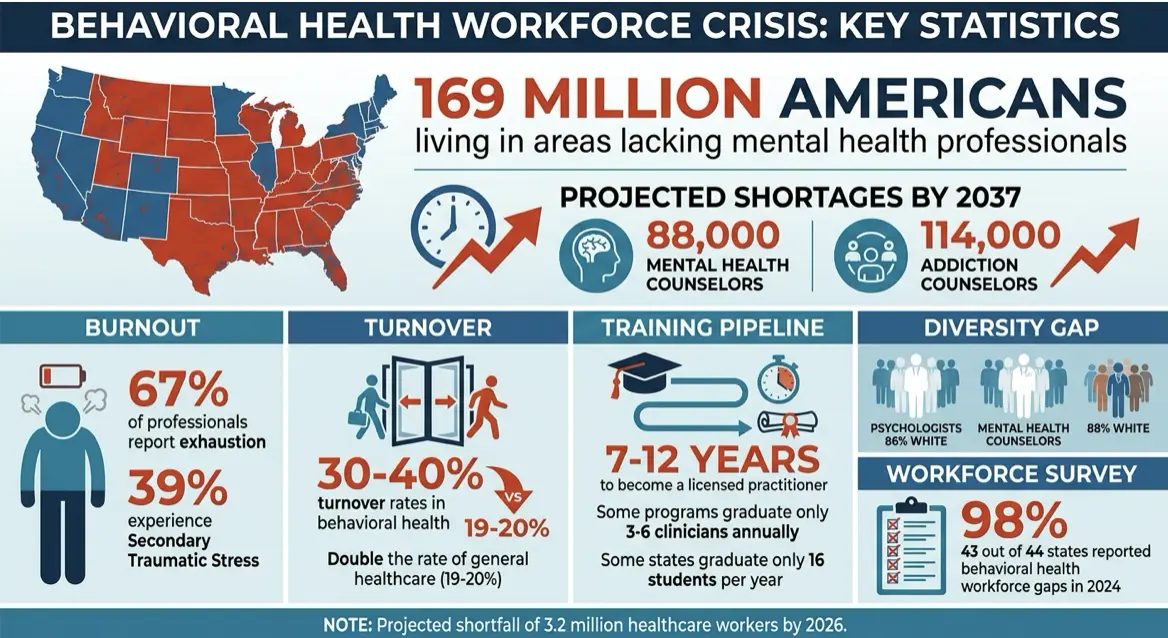
The behavioral health workforce in the U.S. is facing severe shortages, with over 169 million Americans living in areas lacking mental health professionals. High turnover rates, burnout, and underfunding are driving the crisis, leaving patients without timely care and overwhelming remaining staff. Projections indicate shortages of 88,000 mental health counselors and 114,000 addiction counselors by 2037.
Key Challenges:
- Burnout: Up to 67% of professionals report exhaustion; 39% experience Secondary Traumatic Stress.
- Turnover: Rates range from 30% to 40%, double that of general healthcare.
- Underfunding: Medicaid and private insurers fail to cover care costs.
- Aging Workforce: Training pipelines are slow, with some programs graduating as few as 3-6 clinicians annually.
- Diversity Gaps: Over 85% of professionals are white, limiting care access for minority communities.
Solutions to Build a Resilient Workforce:
- Workforce Planning: Use data to predict staffing needs and address gaps.
- Efficient Onboarding: Digitize paperwork and streamline processes for new hires.
- Automated Compliance: Track licenses and certifications to reduce administrative burdens.
- Retention Tools: Use HR management tools to monitor burnout, balance workloads, and provide personalized support.
By focusing on data-driven planning, streamlined onboarding, and technology to reduce burnout, organizations can stabilize their behavioral health workforce and improve patient care.
Less admin.
Stronger teams.
Better client outcomes.
See how behavioral health organizations streamline documentation, staffing, and client engagement with ContinuumCloud.
Which solution would you like to explore?
Examining the Shortage of Mental Health Care Professionals
What’s Causing the Behavioral Health Staffing Crisis
The staffing shortage in behavioral health isn’t happening in isolation. A mix of interconnected factors is driving professionals out of the field faster than they can be replaced. To address the problem, it’s important to understand what’s fueling it. Let’s take a closer look at the key issues affecting workforce stability.
Burnout and Mental Health Challenges Among Staff
Behavioral health work comes with a heavy emotional burden, creating what experts describe as a “cyclical crisis.” Constant exposure to client trauma can lead to Secondary Traumatic Stress (STS), a condition with symptoms similar to PTSD, such as emotional numbing and hypervigilance. Studies show that up to 39% of mental health professionals experience STS symptoms.
Adding to this, many clinicians report experiencing “moral injury” – a feeling of failing to provide adequate care due to systemic barriers like overwhelming caseloads and insufficient institutional support. Dr. Damir S. Utrzan of Horowitz Health highlights the importance of human connection in the healing process:
“It’s not the intervention, it’s not the medication, it’s the human connection which often times is a source of suffering but then also the source of healing, hope, and inspiration”.
When this connection is lost, professionals often leave the field entirely.
Turnover rates in behavioral health are alarmingly high, ranging from 30% to 40%, which is about double the rate seen in general healthcare roles (19% to 20%). Those who remain are left to manage increased workloads as colleagues depart, perpetuating the cycle of burnout. For marginalized providers, the challenges are even greater. Many face “cultural taxation” – a term describing the extra responsibilities BIPOC and LGBTQ+ staff take on while also dealing with workplace discrimination and racial traumatic stress.
Underfunding and an Aging Workforce
Behavioral health has long been plagued by funding shortfalls. Reimbursement rates from Medicaid, Medicare, and private insurers often fail to cover the true costs of providing high-acuity, complex care. Essential services like crisis care rely heavily on inconsistent state and local grants, while private insurers frequently deny claims as “not medically necessary”. This chronic underfunding limits the resources available to support both patients and staff.
At the same time, the field faces an aging workforce and a sluggish training pipeline. Becoming a licensed practitioner can take between seven and 12 years, including doctoral and postdoctoral training. In some states, clinical doctoral programs graduate as few as 16 students per year, with cohorts often limited to just three to six individuals. When experienced professionals retire or leave due to burnout, finding replacements can take nearly a decade – if replacements are available at all.
The lack of workforce diversity adds another layer of complexity. In the U.S., 86% of psychologists and 88% of mental health counselors are white. This disparity limits access to culturally responsive care for BIPOC communities and places an additional strain on the few minority providers who do enter the field.
Post-Pandemic Workforce Disruptions
While the behavioral health staffing crisis existed before COVID-19, the pandemic accelerated it significantly. Demand for mental health services surged, while many experienced clinicians opted for early retirement. Those who stayed faced heightened exposure to patient suffering in under-resourced environments, increasing their risk of compassion fatigue and burnout.
The challenges didn’t end with the pandemic. Many staff are now dealing with a “cortisol crash” – a state of physical and psychological exhaustion. Meanwhile, efforts to expand capacity are slowed by regulatory hurdles. New facilities often face multi-agency licensing requirements and must create policy manuals that can exceed 300 pages. These delays make it harder to meet the growing demand for care when it’s needed most.
How to Build a Resilient Behavioral Health Workforce
The behavioral health workforce is facing a critical shortage. In 2024, a national survey revealed that 43 out of 44 states (around 98%) reported gaps in their behavioral health workforce. This isn’t a challenge that will resolve itself – it demands proactive solutions. Organizations need tools and strategies to plan ahead, onboard efficiently, and ensure compliance to build a workforce that can withstand ongoing pressures.
Workforce Planning That Works
Effective workforce planning starts with understanding the data. Rather than relying on guesswork, organizations must evaluate factors like strategic plans, funding sources, licensing requirements, and current workforce initiatives. This analysis identifies gaps and informs actionable solutions. As Health Management Associates emphasizes:
“A standardized approach to assessing BH workforce shortages can help states and organizations better design sustainable workforce solutions, especially considering challenges federal funding changes and the need for diverse care needs across rural and urban areas across the US.”
Human Capital Management (HCM) software plays a key role in this process. It provides real-time insights into staffing levels, turnover trends, and future needs. With tools to forecast demand, track vacancies, and predict turnover risks, leadership can make smarter decisions about recruitment and resource allocation. This kind of data-driven planning ensures organizations stay ahead of staffing challenges, setting the stage for smoother onboarding.
Faster, More Efficient Onboarding
Once new hires join the team, getting them up to speed quickly is essential. Traditional onboarding processes, often bogged down by paperwork and manual tracking, can slow productivity and frustrate new employees.
Automated onboarding systems solve these issues. By allowing new hires to complete documentation digitally before their first day, and integrating compliance training into the process, organizations eliminate unnecessary delays. Administrative staff no longer need to chase down certificates or forms, and new employees experience a smoother transition. This streamlined onboarding not only accelerates productivity but also builds early engagement and retention by creating a strong first impression.
Automated Credential and Compliance Management
Maintaining compliance is another major challenge. Licenses, certifications, and training must stay current, and any lapses can put the organization at risk. Tracking these requirements manually is time-consuming and prone to errors, especially in larger workforces.
Automated credential management systems simplify this task. These platforms monitor all licenses, certifications, and training requirements in one place, sending renewal alerts well before deadlines. They also generate audit-ready reports, reducing administrative strain while ensuring compliance. By automating these processes, organizations can focus more on supporting their workforce and less on managing paperwork.
Using Technology to Improve Staff Retention
Keeping employees engaged and supported is key to improving retention. With turnover rates in behavioral health ranging from 40% to 70% and the cost of replacing a single employee averaging 50% of their annual salary, organizations can’t afford to overlook this issue. HCM technology provides practical tools to help reduce turnover.
Employee Engagement and Support Tools
Technology offers a way to identify and address potential issues before employees decide to leave. HCM systems use data analytics to detect early signs of burnout by analyzing health and absence patterns. This allows leadership to spot risks and take action. In fact, 48% of employees say they’re more likely to stay with an organization that listens to their feedback and takes meaningful steps in response.
Automated pulse surveys provide real-time feedback, helping management address concerns quickly. HCM platforms also allow organizations to create personalized employee experiences by tailoring benefits and communications to meet the needs of different roles and generations. Features like financial wellness tools, flexible scheduling options, and clear career progression plans can reduce stress and open up opportunities for growth. These tools help employees feel supported, balancing workloads and reducing burnout risks.
Workload Balancing to Prevent Burnout
Beyond engagement, technology can also help manage workloads more effectively, a critical step in preventing burnout. For example, 61% of healthcare providers cite administrative overload as a major contributor to burnout. Tasks like excessive after-hours documentation and manual credential tracking can drain morale. By integrating HCM systems with electronic health record (EHR) platforms, organizations can streamline processes like documentation, admissions, and scheduling into a single workflow.
Position-based management is another helpful tool, assigning responsibilities and budgets to roles instead of individuals. This approach maintains structure during transitions and ensures no one is overwhelmed by extra work. Real-time workload insights let managers distribute cases evenly, preventing overload. Additionally, automating tasks like license renewals and background checks reduces administrative burdens, freeing up time for staff to focus on client care. Organizations that treat retention as an investment often see stronger engagement and greater loyalty.
Conclusion: A Path Toward Workforce Sustainability
Key Takeaways
Finding long-term solutions is crucial to tackling the behavioral health staffing crisis. Using predictive analytics allows organizations to plan their workforce needs ahead of time, helping to avoid the pitfalls of understaffing. Tools like digital preboarding and structured 90-day plans can make a significant difference in retention, especially since 86% of new hires decide how long they’ll stay within their first six months. On top of that, automated credential management – discussed earlier – keeps compliance on track by offering real-time alerts across various jurisdictions.
Technology also serves as a powerful ally in retaining staff. Features such as position-based management bring stability during transitions, while real-time workload insights help prevent burnout. Given that administrative tasks are a major factor in clinician burnout, automating processes like documentation and compliance tracking is an effective strategy for keeping employees engaged and supported.
These approaches provide a clear roadmap for creating organizations that can thrive under pressure, rather than just survive.
Building Resilient Behavioral Health Organizations
Addressing staffing challenges with focused strategies can help organizations break free from the cycle of burnout and turnover. Viewing workforce sustainability as a strategic priority – not just a hiring problem – positions organizations to better handle ongoing staffing shortages. ContinuumCloud’s HCM system, DATIS, aligns with these goals, offering automated compliance workflows and integrated scheduling solutions. With a projected shortfall of up to 3.2 million healthcare workers by 2026, reducing administrative burdens and leveraging data-driven insights allows clinicians to dedicate their energy to client care.
Shifting workforce management from a reactive approach to a proactive one ensures a more stable, resilient foundation, even in the face of a growing crisis.
FAQs
Which workforce metrics should we track first?
Tracking position control metrics is a smart first step. These metrics emphasize roles and vacancies rather than focusing on individual employees, offering a clear picture of staffing needs. This approach helps align workforce planning with financial goals, ensuring resources are allocated effectively.
Another key metric to monitor is turnover rates. By analyzing these rates, you can uncover patterns that may be impacting employee retention and organizational stability. Together, these insights can lead to more informed decisions, lower turnover costs, and increased efficiency across the board.
How can we speed up clinician onboarding without risking compliance?
What are practical ways to reduce burnout using HCM data?
To tackle burnout using HCM data, prioritize workforce planning strategies such as position control. This approach enhances staffing efficiency and keeps labor costs in check. By accurately tracking roles and vacancies, you can better align staffing levels with budget constraints, which helps prevent employees from being overworked.
Additionally, consider automating credential management and simplifying onboarding processes. These steps reduce administrative workloads, freeing up time for employees to focus on patient care. In turn, this can promote a more stable and satisfied workforce.