93% of behavioral health workers report burnout. The reasons? Overwhelming administrative tasks, outdated HR systems, and increasing workloads. Burnout not only impacts staff but also leads to higher turnover, disrupted patient care, and increased operational costs.
Key Takeaways:
- Burnout symptoms: Emotional exhaustion, detachment, and reduced effectiveness.
- Main causes: Heavy administrative work, inefficient HR tools, and rising caseloads.
- Impact of outdated HR systems: Manual processes, disconnected tools, and delayed onboarding worsen stress and turnover.
- Solution: Modern HR platforms like DATIS HCM simplify workflows, automate tasks, and provide real-time insights to reduce burnout and improve retention.
Organizations that invest in better tools see reduced turnover, cost savings, and improved staff well-being. Read on to learn how outdated systems contribute to burnout and how better technology can address these challenges.
Less admin.
Stronger teams.
Better client outcomes.
See how behavioral health organizations streamline documentation, staffing, and client engagement with ContinuumCloud.
Which solution would you like to explore?
Addressing Burnout & Moral Injury for Health & Public Safety Workers – Fitzhugh Mullan Institute
How HR Technology Contributes to Workforce Problems
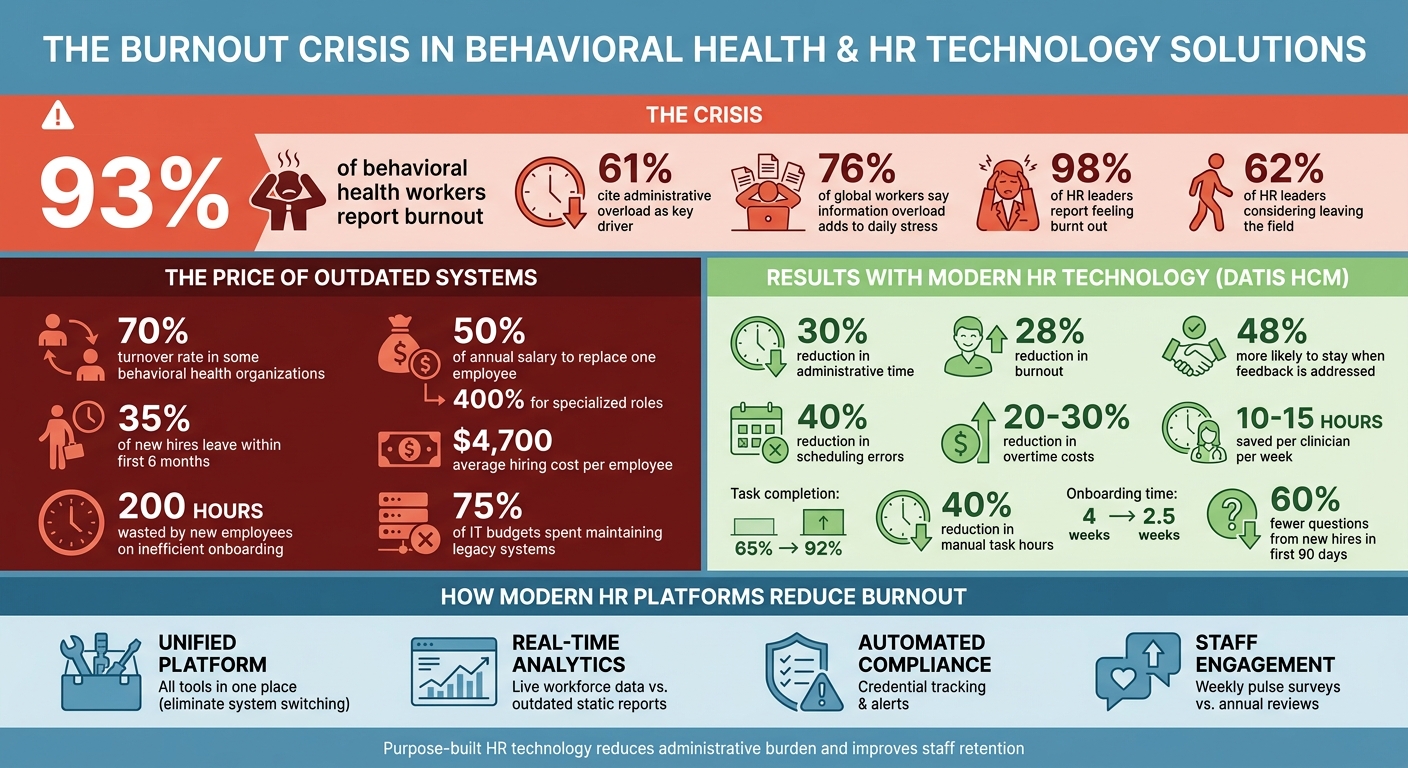
The very tools designed to simplify workforce management often add to the challenges. For instance, 61% of healthcare providers cite administrative overload as a key driver of burnout, and outdated HR systems play a significant role in this issue. Instead of reducing workloads, these systems frequently create more friction – requiring multiple logins, manual credential tracking, and hours spent reconciling data across platforms that don’t communicate with each other.
Despite investments aimed at alleviating these burdens, many directors report that HR systems actually increase clerical tasks instead of reducing them.
Administrative Overload from Outdated Systems
Legacy HR systems often create inefficiencies by focusing on tracking individuals rather than roles. When a clinician leaves, the system loses track of the position itself, leading to budgeting gaps and broken approval workflows. This forces HR teams to manually rebuild position data, a time-consuming process that becomes especially problematic in fields like behavioral health, where turnover rates can reach 70% in some organizations.
The problem worsens with systems that operate in silos. Payroll, scheduling, and talent management often run on separate platforms, requiring staff to switch back and forth between them while manually reconciling conflicting information. This constant toggling not only wastes time but also contributes to “technostress”, with 76% of global workers stating that information overload adds to their daily stress.
Another major pain point is manual credential tracking, which creates compliance risks and adds yet another layer of stress for administrators.
The onboarding process for new hires suffers greatly under these outdated systems. Manual, inefficient workflows can delay onboarding for weeks, leaving existing staff to pick up the slack. This additional workload accelerates what’s known as “caseload creep”, a leading factor in burnout. The consequences are stark: 35% of new hires in behavioral health leave within their first six months. Clunky onboarding systems are a major contributor to this early attrition, with new employees wasting around 200 hours navigating inefficient processes that could otherwise be automated. That’s time that could be better spent building relationships with clients and acclimating to their roles.
Missing Tools for Engagement and Analytics
Outdated HR systems don’t just create extra work – they also lack the tools needed to address workforce challenges proactively. For example, many organizations still rely on annual employee surveys to gauge engagement. These surveys are lagging indicators, reflecting issues from months ago rather than identifying and addressing emerging problems in real time.
Modern HR platforms should be able to analyze data from multiple sources – like attendance records, scheduling conflicts, workload metrics, and pulse surveys – to flag employees who might be struggling. Without this capability, managers are left to react to turnover rather than prevent it. For instance, a therapist might face weeks of back-to-back sessions while reporting exhaustion in pulse surveys, but without integrated systems, these red flags go unnoticed until the therapist resigns.
This lack of integration also forces HR professionals to spend more time on data entry than on meaningful employee engagement. It’s no surprise that 98% of HR leaders report feeling burnt out, with 62% considering leaving the field entirely. When HR teams are tied up in spreadsheets and manual tasks, they can’t focus on initiatives like mentorship, recognition programs, or the personalized support that helps retain staff.
The financial impact of these inefficiencies is staggering. Replacing a single behavioral health employee costs about 50% of their annual salary, and for specialized roles, that figure can climb to 400%. Yet many organizations continue to rely on systems that can’t predict turnover, measure engagement in real time, or equip managers with the insights they need to support their teams effectively.
These gaps in efficiency and real-time insights underscore the urgent need for solutions that can streamline workforce management and reduce administrative burdens.
Where Legacy HR Systems Fall Short
Older HR platforms come with technical challenges that make it harder to support the workforce effectively, often contributing to staff burnout. These issues are deeply rooted in the design and functionality of these outdated systems.
Disconnected Data and Integration Problems
Legacy HR systems often function in isolation. Payroll, scheduling, and talent management are typically housed in separate platforms, forcing employees to juggle between multiple systems throughout the day. This disjointed setup not only wastes time but also creates conflicting data that staff must manually reconcile.
Adding to the complexity, these systems rarely integrate with essential tools like Electronic Health Records (EHRs) or billing software. Without modern API capabilities, updates in one system – such as a clinician adjusting their availability – don’t automatically sync with others. This lack of integration leads to scheduling conflicts that require manual fixes, draining time and energy.
“Nobody enjoys constantly switching between systems to piece together all the necessary information, increasing user frustration as conflicting data emerge.” – ContinuumCloud
This issue becomes even more pronounced with the rise of home visits and telehealth in behavioral health. Many older platforms are desktop-dependent, leaving clinicians unable to document their work until they return to a computer. This delay results in incomplete records and after-hours work, further straining staff.
Compliance management also suffers. Legacy systems often lack automation for tasks like credential tracking, leaving HR teams to monitor these manually. The inefficiency is costly – organizations may spend as much as 75% of their IT budgets maintaining these outdated systems instead of upgrading to better solutions.
Weak Workforce Data and Reporting
Another major drawback of legacy systems is their inability to provide timely and actionable workforce insights. Most rely on static reports, requiring managers to manually gather and analyze data to spot trends in productivity or burnout. By the time this data is reviewed, it’s often outdated by weeks or even months.
Without real-time analytics, early warning signs – like a therapist working back-to-back sessions while sick days increase – can go unnoticed. This delay in identifying issues can lead to costly consequences. For example, replacing an employee can cost 50% of their annual salary, and for specialized roles, that number climbs to 400%.
Additionally, these systems often track data at the individual level rather than by role. When an employee leaves, the system loses track of the position itself, disrupting budget allocations and approval workflows. In behavioral health, where turnover rates can exceed 50%, HR teams spend significant time manually reconstructing role data instead of focusing on supporting staff. Without real-time insights, addressing burnout and turnover becomes even more challenging.
How DATIS Reduces Burnout
DATIS, part of ContinuumCloud, offers a streamlined solution tailored specifically for behavioral health organizations. By addressing the inefficiencies of legacy systems, it tackles the administrative burdens and disconnected tools that 61% of healthcare providers cite as key contributors to burnout.
All Workforce Functions in One Platform
DATIS consolidates essential workforce functions – like recruiting, onboarding, payroll, talent management, and timekeeping – into a single cloud-based system. This unified approach eliminates the need for staff to switch between multiple tools to check schedules, request time off, or review paychecks. Everything is accessible via a mobile app, whether employees are in the office, conducting telehealth sessions, or visiting clients at home.
One standout feature is its role-based tracking system. Instead of focusing on individuals, the platform tracks roles, ensuring that budget allocations, approval workflows, and credential data remain intact even when turnover occurs. This is especially valuable in behavioral health, where turnover rates often exceed 50%.
Automated compliance tracking further simplifies processes by monitoring licenses and certifications, sending alerts before they expire. Tasks like background checks, renewal tracking, and audit preparation happen automatically, reducing manual work. For example, one organization cut therapist onboarding time from four weeks to just 2.5 weeks using automated templates. This allowed HR teams to work three times faster, while new hires asked 60% fewer questions during their first 90 days.
This integration of tools and automation creates a foundation for real-time insights and smoother operations.
Live Data and Automated Processes
DATI replaces outdated static reports with real-time workforce analytics, giving managers instant visibility into critical data. For instance, supervisors can quickly identify when a clinician’s workload increases or sick days spike. The scheduling module ensures staff-to-client ratios are maintained by automatically matching shifts to qualified and available employees, even during last-minute absences. Real-time alerts for overtime help prevent overwork and reduce costly turnover – important in a field where replacing an employee can cost up to 50% of their annual salary, and for specialized roles, up to 400%.
The platform’s position-based tracking also provides precise financial oversight. By tying payroll directly to authorized roles, organizations can track labor costs in real time and allocate them accurately to specific grants or programs. This eliminates the confusion often caused by reconciling data from disconnected systems.
Keeping Staff Through Better Engagement
Beyond operational efficiency, DATIS helps reduce burnout by focusing on staff engagement. The platform replaces traditional annual reviews with weekly pulse surveys, allowing managers to address issues – like high caseloads or resource shortages – before they escalate into turnover.
The mobile self-service portal gives employees greater control over their schedules. Clinicians can view shifts, request time off, and even swap shifts without waiting for managerial approval. Open shift bidding allows staff to choose assignments that fit their preferences, reducing frustration caused by rigid scheduling.
“If you’re in Health and Human Services, then this is the product. This is the way to go. Because they’ve already designed it according to that industry, and it just makes sense.” – Marion McLaurin, Senior VP of Human Resources
For professional development, DATIS offers a learning and development module with integrated training dashboards and automated reminders for required courses. This feature helps address the critical first 90 days of employment, a period when 35% of new hires in behavioral health tend to leave. Guided workflows during this time have been shown to improve retention rates, while organizations that invest in employee growth see lower turnover overall.
Results: How DATIS HCM Improves Behavioral Health Workplaces
Reduced Turnover and Better Staff Engagement
DATIS’s platform tackles burnout head-on, helping to reduce historically high turnover rates of 40% to 70% by addressing the root causes.
Organizations using the platform report a 30% reduction in administrative time, allowing staff to focus more on client care. Weekly pulse surveys and real-time feedback have been game changers, cutting burnout by 28% and boosting retention. In fact, 48% of employees are more likely to stay with organizations that actively respond to their feedback.
From a financial perspective, cutting turnover has a huge impact. For every employee retained, organizations save up to 50% of an annual salary. Hiring costs in behavioral health average $4,700 per hire, and onboarding includes 46.7 hours of training and $986 in direct expenses. Reducing turnover not only saves money but also enhances overall staff engagement, paving the way for smoother operations.
More Efficient Operations
Improved retention creates a strong foundation for operational efficiency, and DATIS HCM takes it a step further with automation and integration. Task completion rates have jumped from 65% to 92%, while manual task hours have been slashed by up to 40%, eliminating duplicate data entry.
Scheduling has become far more accurate, with organizations seeing a 40% drop in scheduling errors. Position control and data-driven shift management have cut overtime costs by 20% to 30%, as reactive staffing decisions are minimized. Clinicians, too, have benefited, gaining back 10 to 15 hours per week by eliminating redundant documentation and manual tasks.
“It’s saved us a lot of money in the long run. It’s our best technology decision.” – Darcy Dibble, CFO, The Arc Otsego
“The main impact for the system has been time saved… Not just for payroll and HR, but for everyone.” – Michelle Mong, CFO, Folium, Inc.
Position control is another standout feature, ensuring financial stability by linking every role to a specific budget code and funding source, such as Medicaid or SAMHSA grants. This approach prevents overhiring and ensures staffing aligns with available funding.
Conclusion: Supporting Your Workforce with Better Technology
Burnout often stems from outdated or inefficient technology. With 93% of behavioral health workers reporting burnout and 61% citing administrative overload as a key factor, it’s clear that your HR system needs to work for your staff, not against them. These figures highlight the importance of systems that genuinely support clinicians in their work.
DATIS simplifies workflows by combining systems, automating compliance tasks, and offering real-time monitoring. By reducing redundant tasks, staff can reclaim valuable time. Automated compliance tracking eases the need for constant manual oversight, while position-based budgeting ensures organizational stability during staff turnover. Additionally, real-time pulse surveys allow organizations to address disengagement before it becomes a larger issue.
There’s a direct connection between staff well-being and patient care. When clinicians can save significant time on administrative tasks, they’re able to focus on what truly matters – helping people heal. Integrated systems also reduce scheduling errors by 40%, ensuring smoother operations and consistent patient care. Keeping therapists on staff helps maintain therapeutic relationships, avoiding the disruptions that can lead to patient disengagement.
A behavioral health director captured the challenge perfectly:
“How do we have the experience of our workforce be directed at supporting community members, rather than meeting all of the administrative requirements? This work is so hard, and those requirements on top of it [are] wearing our folks down.” – County behavioral health director
Investing in behavioral health software lays the groundwork for a more sustainable and effective behavioral health workplace. By cutting down on administrative burdens, clinicians can stay longer, deliver better patient care, and contribute to more efficient operations overall.
FAQs
How can we tell if our HR system is driving burnout?
What should a behavioral health HR platform automate first?
- Job postings: Simplify the process of advertising open positions across multiple platforms.
- Credential verification: Ensure licenses and certifications are checked quickly and accurately.
- Onboarding workflows: Streamline new employee setup with automated processes.
By automating these tasks, organizations can cut down on delays, improve overall efficiency, and allow staff to dedicate more time to delivering high-quality care.
How do you measure burnout risk in real time without big surveys?
Using integrated systems that connect clinical, workforce, and engagement tools can provide real-time insights. These systems allow organizations to take proactive steps to address potential issues, minimizing the need for large-scale surveys while still tackling burnout effectively.