Spreadsheets might seem like a simple solution, but they come with hidden costs that can disrupt your workforce management. Here’s why relying on spreadsheets is problematic:
- Errors Are Common: 88% of spreadsheets contain mistakes, leading to flawed decisions and financial losses.
- Wasted Time: Managers may spend over 40 hours a week reconciling disconnected data.
- Compliance Risks: Spreadsheets lack secure audit trails, increasing the risk of compliance violations.
- Outdated Data: Manual updates lead to delays, causing staffing and financial misalignments.
- Fragmentation: Different teams use separate systems, creating “version chaos” and operational blind spots.
To address these challenges, organizations need integrated workforce management systems that connect staffing, funding, and compliance in real time. This shift eliminates manual errors, improves decision-making, and saves costs. Spreadsheets may feel convenient, but they can quietly drain resources and efficiency.
How Spreadsheets Become the Default System
The Gaps That Spreadsheets Fill
Spreadsheets often step in where standard systems fall short, acting as quick fixes for operational challenges. Behavioral health organizations, for example, frequently turn to Excel when existing tools can’t handle specific needs.
HR teams, for instance, might need to track clinical licenses and certifications like PALS credentials. Standard HR systems often lack features like automated expiration alerts or safeguards to prevent unqualified staff from being scheduled. To fill this gap, they create tracking sheets. Finance teams face similar struggles when trying to reconcile basic time-tracking with complex payroll rules – like calculating shift differentials for nights and weekends or meeting union overtime requirements. Their solution? Custom allocation models in Excel. Clinical managers, on the other hand, need to calculate real-time patient-to-staff ratios, but generic tools often fail to align staffing levels with fluctuating patient acuity or census data. Their answer is manual spreadsheets.
“Most organizations do not choose to run HR this way. It simply happens. A spreadsheet becomes the employee register. An inbox becomes the approval workflow. A folder of PDFs becomes the record of truth.” – Blake Smith, Marketing Manager, ClockOn
These spreadsheets are appealing for several reasons: they cost nothing to implement, don’t require vendor contracts, and are easy to use with minimal training. For small teams or operations with low complexity, this patchwork approach feels sufficient. However, these quick fixes often mask deeper structural problems that only become apparent as the organization grows. What starts as a helpful tool can quickly lead to a fragmented and inefficient system.
The Fragmentation Problem
As each department builds its own solutions, the lack of integration between these tools creates a fragmented data landscape. Errors multiply as data is manually transferred between spreadsheets, increasing inaccuracies and causing revenue leakage.
For example, recruitment, onboarding, and payroll systems often operate in silos, requiring staff to manually stitch together data. This inefficiency can consume significant time – frontline managers may spend over 40 hours each week reconciling information from disconnected tools. Attendance records don’t sync with HR systems, and communication logs aren’t linked to incident reports. The result? A “black hole of information”, where simple questions take hours to answer and leadership begins to doubt the reliability of their data. This fragmented approach not only wastes time but also highlights the urgent need for a unified workforce management system.
The Core Disconnect in Spreadsheet-Based Workforce Management
Data Duplication and Inconsistencies
When different teams rely on separate spreadsheets, mistakes are inevitable. HR might track headcount in one file, finance monitors labor costs in another, and operations manages staffing rosters in yet another. Each team updates their own version independently, leading to what’s often called “version chaos” – a situation where multiple people work from outdated email attachments, resulting in conflicting information and overlooked updates.
And the numbers back this up: 88% of spreadsheets contain errors. It only takes one incorrect formula or a misplaced row to create a ripple effect – billing inaccuracies, flawed performance reports, and even client disputes. Teams end up wasting time manually reconciling these discrepancies, combing through email chains for approvals, and double-checking data because there’s no single, reliable source of truth.
But duplication is just one part of the problem. Inconsistent definitions across departments add another layer of complexity.
Misaligned Definitions and Metrics
The way different teams define terms can lead to confusion, and it’s more than just semantics. For instance, HR might consider an “approved position” as one that’s budget-authorized, while operations sees it as a role ready to be filled. Finance might track “pay rates” in one file, while operations focuses on “billing rates.” These discrepancies can spark client disputes and erode trust. Clinical teams face similar challenges, often struggling to differentiate between staff who are simply “available” and those who have the active credentials needed for specific shifts.
This lack of alignment forces leaders to juggle multiple sources of data, creating what researchers refer to as “decision latency” – the extra time spent cross-referencing files to answer basic questions. For example, when executives ask, “How many funded positions do we have?” the response often depends on which spreadsheet they’re looking at. Without a unified system, leaders end up relying more on intuition than on solid data, turning strategic decisions into educated guesses.
Delays in Data Updates
Even when duplication and misalignment are addressed, outdated data can still derail decision-making. Spreadsheets that lag behind real-world conditions mean leaders are making choices based on yesterday’s information. In healthcare, this can become a safety issue – scheduling staff with expired certifications due to outdated licensure data risks compliance violations and patient safety. Financial planning also takes a hit when delayed tracking of hours leads to unbudgeted overtime costs or an overdependence on costly agency staff to cover gaps that could have been anticipated.
Manual processes only add to the problem, with error rates ranging from 1% to 4%. For a small organization of 30 people, the “Decision Delay Tax” – the cost of bad hires, turnover, and missed opportunities due to poor data visibility – can climb to approximately $12,000 annually. These delays don’t just slow decision-making; they come with a hefty price tag.
“Decisions are only as good as the data behind them.” – Priya Panchal, Lead Business Analyst, CollabCRM
The Hidden Costs of Spreadsheet-Based Workforce Management
Spreadsheets may seem like a simple solution for managing workforce data, but their hidden costs can ripple through your organization – impacting finances, operations, and compliance. These costs don’t appear in a single budget line but instead create inefficiencies that hurt margins, obscure critical insights, and complicate routine audits. Let’s break down where these costs show up.
Financial Misalignment
When workforce data is scattered across spreadsheets, labor costs often disconnect from actual revenue. Without centralized systems, manual processes between recruitment, onboarding, payroll, and billing increase the likelihood of errors. These errors force back-office teams into constant, expensive reconciliations.
For instance, positions might be approved in one spreadsheet while funding allocations are tracked in another. Finance teams often discover mismatches only after labor costs have already deviated from revenue.
Research shows that most spreadsheets contain errors, meaning decisions based on this data are flawed from the start. And these errors aren’t minor. One electricity transmission company lost $24 million due to a copy-paste mistake in Excel, while a U.S. manufacturer faced an $11 million severance error from a single typo in 2005.
Behavioral health organizations face a specific challenge known as “labor cost drift”, where decisions rely on outdated or static data instead of real-time financial realities. Spreadsheets simply can’t keep up with changes like certifications, attrition, or program adjustments, leaving organizations to make decisions based on outdated snapshots. This financial instability then spills over into operational challenges.
Operational Blind Spots
Spreadsheets limit the ability of program leaders to see the full picture. Without real-time visibility into staffing needs, organizations regularly struggle with unplanned overtime, overstaffing, or understaffing.
For example, a 50-person organization using manual processes incurs over $127,000 annually in hidden costs. This includes $38,000 in error correction and $52,000 in lost productivity. Smaller teams aren’t exempt either – manual scheduling alone can cost them more than $10,000 annually, with hidden costs often five times higher than the direct expense.
In healthcare settings, these blind spots can become dangerous. Outdated credential tracking in spreadsheets can lead to assigning staff with expired licenses to critical units, creating safety and compliance risks.
“The real story isn’t about the inconvenience of filling one shift. It’s about the slow, steady erosion of morale, the ballooning overtime costs that drain budgets, and the burnout that drives our best people away from the bedside.” – Dan Robin, Pebb.io
These inefficiencies often result in “agency dependency”, where organizations rely on expensive temporary staff to fill gaps that could have been avoided with better visibility. This creates a cycle of high turnover, as chaotic scheduling and perceived unfairness push employees to leave.
As operational issues pile up, the lack of proper audit trails in spreadsheets further increases compliance risks.
Compliance and Audit Risks
Spreadsheets are inherently vulnerable when it comes to compliance. They lack secure audit trails, version control, and detailed access permissions. This makes it nearly impossible to provide a defensible timeline of changes when auditors request documentation on funding allocations or staffing decisions.
For behavioral health organizations, the stakes are even higher. HIPAA regulations require tracking every instance of accessing sensitive data, but spreadsheets can’t support this level of monitoring.
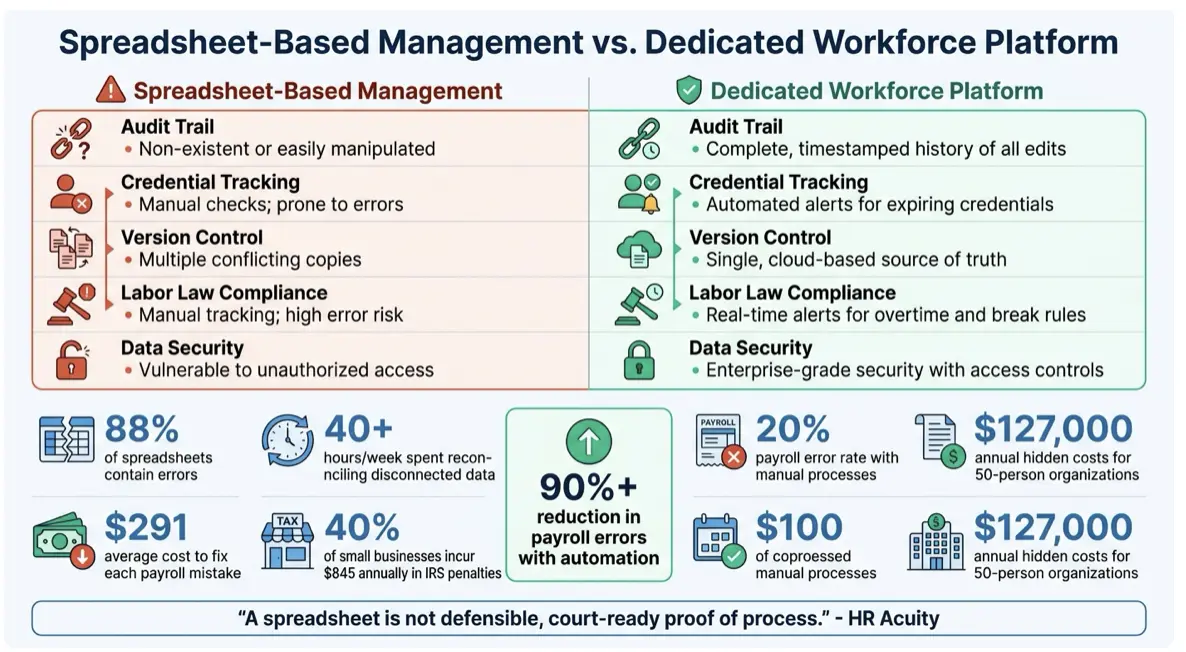
The financial consequences are real. Organizations relying on manual payroll processes face a 20% error rate, with each payroll mistake costing an average of $291 to fix. Additionally, 40% of small businesses incur $845 annually in IRS penalties due to payroll errors.
Here’s how spreadsheets compare to dedicated workforce platforms:
|
Feature |
Spreadsheet-Based Management |
Dedicated Workforce Platform |
|
Audit Trail |
Non-existent or easily manipulated |
Complete, timestamped history of all edits |
|
Credential Tracking |
Manual checks; prone to errors |
Automated alerts for expiring credentials |
|
Version Control |
Multiple conflicting copies |
Single, cloud-based source of truth |
|
Labor Law Compliance |
Manual tracking; high error risk |
Real-time alerts for overtime and break rules |
|
Data Security |
Vulnerable to unauthorized access |
Enterprise-grade security with access controls |
“A spreadsheet is not defensible, ‘court-ready’ proof of process.” – HR Acuity
When spreadsheets fail to provide consistent data or validate reporting, audit preparation turns into a reactive, high-stakes scramble. What should be a routine process becomes a costly and risky endeavor.
Why Spreadsheets Persist Despite Fixes
Behavioral health organizations have attempted to address spreadsheet issues by layering on additional reporting processes, introducing new workflows, or even hiring extra staff to reconcile discrepancies.
And yet, spreadsheets remain.
The reason? These efforts address the symptoms, not the root cause. Spreadsheets offer a sense of control without requiring upfront costs, vendor commitments, or extensive training. While these quick fixes might seem practical, they fail to address the deeper disconnect within the system.
“Spreadsheets persist because they offer the perception of control. They require no implementation cost, no vendor relationship, and no learning curve.” – Jonathan Page, Founding Partner, PHRBO
The core problem lies in the fact that most workforce management systems aren’t built with behavioral health in mind. These systems can track employees, departments, and payroll using HR management tools, but they don’t tie workforce data to funding sources, program-specific labor, or service-based costs. This disconnect creates a false sense of control that works – until operational demands outpace the patchwork solutions. Over time, temporary fixes become deeply ingrained dependencies, as seen in earlier mismatches between workforce funding and data management.
One expert describes this phenomenon as “flexibility without structure becomes fragility at scale”. Initially, a manager’s meticulously color-coded Excel file might seem sufficient. But as the organization grows – adding more staff and facing stricter compliance requirements – that same spreadsheet transforms into a critical vulnerability. If that manager leaves or is unavailable, the entire system risks falling apart. By then, the organization has become too reliant on the spreadsheets to easily let them go.
What a Better Workforce Management Model Looks Like
When organizations move beyond relying on spreadsheets, they’re not just upgrading their tools – they’re rethinking how workforce data connects to actual operations. This shift brings about three major changes.
Connecting Workforce to Funding
Every role should be tied directly to its funding source, allowing budgets to be built around staff compensation needs. Instead of starting with service budgets and then trying to reconcile costs, organizations focus on the wage levels required to attract and retain clinicians. From there, they build a funding strategy to support those needs.
“When you build budgets starting with staff compensation and retention risk, the hiring plan, reimbursement strategy, and operational plan become one integrated model.” – Carter Freeman, Vice President, vcfo
This approach ensures that all related expenses – like supervision, IT infrastructure, and onboarding – are fully accounted for. It avoids the common problem of grant-funded positions looking feasible on paper but failing to cover the full range of costs. By mapping funding directly to roles, staffing can align with real-time operational needs.
Structuring Data Around Operations
Integrated systems are designed to organize workforce data based on how services are actually delivered – whether by program, funding source, or service type. This structure makes it possible to use real-time patient census and acuity data from EHR/EMR systems for predictive scheduling, ensuring the right staff are deployed where they’re needed most.
Aligning workforce data with operations also helps cut labor costs by matching staffing levels to real-time service demand. Organizations using advanced people analytics are three times more likely to achieve cost savings. This operational alignment also sets the stage for automating reconciliation processes.
Eliminating Manual Reconciliation
With integrated operations in place, automated reconciliation becomes possible, ensuring data accuracy across the board. By connecting time tracking, payroll, and reporting systems, organizations can eliminate manual data entry and avoid version conflicts. Seamless integration between workforce management systems, payroll, and billing ensures smooth data flow.
This automation delivers measurable financial benefits. For example, automated time and attendance systems can reduce payroll errors by over 90%. Considering that each payroll error costs an average of $291 to fix – and non-automated processes often experience a 20% error rate – the savings can add up fast. Plus, payroll accuracy is critical for retention, as nearly half of employees (49%) may consider leaving after just two payroll mistakes.
Technological features like GPS-enabled time tracking with geofencing automatically verify on-site attendance, feeding accurate hours directly into payroll. Similarly, automated credential tracking ensures that staff with expired licenses or certifications aren’t mistakenly scheduled.
The Shift: From Tracking to Understanding
Spreadsheets are great for logging past data, but behavioral health organizations need to go further – beyond simply recording numbers – to truly understanding the “why” behind them and predicting future hurdles. Sure, spreadsheets can show how many positions are open, but they don’t answer critical questions: Which programs are at risk? Which funding streams are falling short? Where could the next staffing crisis hit? Relying on spreadsheets often leads to errors and creates a misleading sense of control. This makes it clear – organizations must shift from just tracking to gaining strategic insights.
Moving from disconnected data tracking to integrated systems changes the game. It eliminates the endless hours spent reconciling spreadsheets and gives leaders access to real-time, actionable information. Instead of managers wasting time juggling files, automated time and attendance tools handle the heavy lifting, allowing leaders to focus on big-picture decisions and mentoring their teams. Real-time dashboards replace outdated, static reports, making it possible to respond to patient surges immediately – rather than discovering staffing gaps too late. These systems also help match staff to the right roles by evaluating skills, certifications, and performance history, ensuring patients get the care they need from the best-suited professionals.
Move Beyond Spreadsheets
Spreadsheets might seem like a convenient tool, but their hidden costs can weigh heavily on your organization’s efficiency and bottom line. The issue isn’t about creating better formulas or more intricate tracking methods – it’s about adopting a system that seamlessly connects your workforce, funding, and compliance. This eliminates the manual handoffs where mistakes creep in and revenue quietly slips away.
ContinuumCloud’s Workforce Engine Approach directly addresses these challenges. It brings together scheduling, credentialing, payroll, and funding allocation in one centralized platform. Imagine being able to answer questions like, “How many funded positions do we have?” with a single, accurate response. Every role is linked to a program, a funding source, and a financial structure – cutting out duplication, delays, and manual reconciliations.
The impact of this integration is tangible. Organizations using integrated workforce platforms report cutting scheduling time by up to 80% and reducing overall labor costs by 35%. Automated reminders and mobile shift management have also decreased employee no-shows by 28%. These aren’t just numbers – they represent a shift from constantly putting out fires to leading with confidence and foresight.
Ready to leave behind the chaos of spreadsheets? Register for the webinar or explore our Workforce Engine Approach to see how it can transform your operations.
FAQs
When is a spreadsheet no longer “good enough” for workforce management?
What’s the biggest risk of not linking staffing to funding in real time?
What should an integrated workforce management system include?
An integrated workforce management system needs to tie workforce data directly to funding sources. By linking every role to a specific program, funding source, and financial framework, organizations gain a clear understanding of labor costs broken down by program, funding stream, or service.
Additionally, the system should enable real-time data sharing across key functions like payroll and reporting. This minimizes manual tasks, ensures data accuracy, and keeps information current. The result? Better decision-making, improved financial alignment, and stronger compliance.