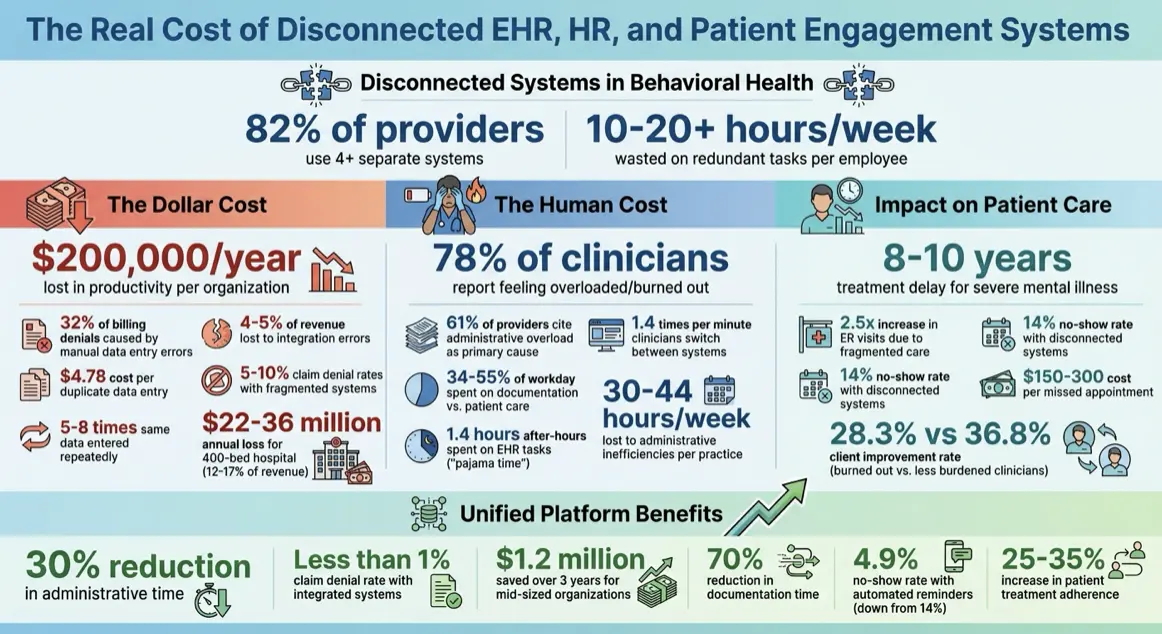
Disconnected systems in behavioral health – where EHR, HR, and alumni engagement tools operate separately – are costly and inefficient. Here’s why integration matters:
- 82% of providers use 4+ separate systems, leading to 10–20+ hours/week wasted on redundant tasks.
- Manual data entry increases errors, causing 32% of billing denials and compliance risks like expired clinician credentials.
- Organizations lose $200,000/year in productivity and face higher burnout rates, with 78% of clinicians reporting overload.
- Fragmented systems delay care, increase no-show rates, and reduce patient satisfaction and outcomes.
Switching to unified behavioral health software eliminates inefficiencies, automates compliance, and improves patient care. Integrated systems reduce claim denials, cut administrative time by up to 30%, and save mid-sized organizations $1.2 million over three years.
Key Takeaway: Consolidating tools into one platform saves time, reduces costs, and enhances care delivery. It’s not just a software upgrade – it’s a smarter way to operate.
Less admin.
Stronger teams.
Better client outcomes.
See how behavioral health organizations streamline documentation, staffing, and client engagement with ContinuumCloud.
Which solution would you like to explore?
Problems Created by Disconnected Systems
When systems like your EHR, HR platform, and alumni engagement tools don’t communicate, inefficiencies start to pile up. Instead of a smooth flow of information, staff are left filling in the gaps manually, which leads to duplicated efforts, more errors, and disrupted workflows. These issues show up as data inaccuracies, compliance problems, and wasted time.
Repeated Data Entry and Increased Errors
Disconnected systems force staff to repeatedly input the same patient information – sometimes as many as 5–8 times. Each entry adds $4.78 to costs, and documentation errors from this process contribute to 32% of billing denials. For example, an intake coordinator might record insurance details in the patient portal, while a clinician re-enters them in the EHR, billing staff input them into the revenue cycle system, and HR staff manually add provider credentials for credentialing.
Another issue? When intake data doesn’t sync with clinical notes, providers end up asking patients the same questions multiple times. This not only wastes valuable session time but also erodes patient trust.
Compliance Gaps and Reporting Difficulties
Disconnected systems also create compliance headaches that can compromise service quality. For instance, if the HR system tracks licenses separately from the EHR used for scheduling, clinicians with expired certifications might unknowingly provide care – leading to potential penalties or service disruptions. Organizations using siloed systems see a 41% increase in documentation gaps and a 26% rise in underreported incidents.
“Audit data reveals the consequences: a 26% increase in underreported incidents and a 41% rise in documentation gaps when organizations rely on siloed systems.” – Dylan Souza, Vice President of Marketing, ContinuumCloud
Manual processes, like using spreadsheets without version control or audit trails, make compliance tracking even harder. For example, 81% of healthcare administrators report at least one payroll error per month due to manual tracking. On top of that, HR and finance teams spend around 28 hours each week on compliance tasks that automated systems could handle in minutes.
And there’s more pressure on the horizon. Starting January 1, 2026, CARF accreditation will require organizations to document how they collect and use outcome data in treatment decisions. Without integrated systems, pulling this data together involves manually exporting, reconciling, and combining information from clinical, billing, and HR platforms – a process that currently takes about 1,194 hours every month. It’s clear why a unified system isn’t just helpful – it’s becoming essential.
Lost Staff Time and Reduced Productivity
Disconnected systems eat up 10–20+ staff hours every week due to redundant tasks. Clinicians, for example, switch between systems an average of 1.4 times per minute, which disrupts their focus and costs them over an hour of productivity each day. On top of that, they spend between 34% and 55% of their workday on documentation instead of patient care.
In March 2026, a behavioral health organization implemented an automation tool for prior authorizations. This system notified providers of authorizations 6–7 days faster and completed peer-to-peer review adjudications 11 days sooner than manual processes. Before automation, staff spent days calling payers, checking multiple systems, and manually tracking approval statuses.
The toll on staff is immense. Seventy-eight percent of behavioral health clinicians report feeling burned out, and 61% of healthcare providers cite administrative overload as a primary cause. Many clinicians even spend an average of 1.4 hours after-hours completing EHR tasks – often referred to as “pajama time”.
The Real Costs in Dollars and Hours
Disconnected systems drain both time and money, creating inefficiencies that ripple through every part of a healthcare organization. By breaking down wasted hours, lost revenue, and compromised patient care, the true cost of these systems becomes clear.
Hours Lost to Manual Processes
Administrative inefficiencies can rob a single practice of 30–44 hours every week, with as much as 5–8 hours spent on duplicate data entry alone. For a mid-sized clinic with ten clinicians, this adds up to over $120,000 in lost revenue every year.
One example of improvement comes from a behavioral health organization that, in May 2024, implemented an AI-powered documentation platform integrated with its Welligent EHR. This change cut documentation time by 70% and sped up note submission from five days to just 1.5 days. What used to take 10–12 minutes per session now takes less than 3 minutes.
Manual reporting and compliance tasks eat up about 1,194 hours each month across organizations. Additionally, new hires can lose around 200 hours duplicating work as they navigate disconnected and inefficient systems.
Financial Losses from Compliance and Billing Issues
These inefficiencies don’t just waste time – they also bleed revenue. Disconnected systems can cause 4% to 5% of revenue to slip through the cracks due to integration errors between clinical documentation and claims. Claim denials are another major issue, with rates ranging from 5% to 10% for fragmented systems. Alarmingly, 79% of behavioral health organizations report an increase in denials stemming from data gaps.
For example, a 400-bed hospital could lose between $22 million and $36 million annually – 12% to 17% of its total revenue – due to administrative waste. On a larger scale, poor communication and data gaps contribute to over $11 billion in avoidable healthcare costs each year in the U.S..
Human resources inefficiencies are costly, too. Payroll-tax penalties alone cost organizations $13.7 billion annually, with COBRA administration penalties averaging $110 per day per affected employee. Benefits administration costs $24 per employee each month, and fixing a single benefits enrollment error can cost $400. Overall, inefficiencies in U.S. healthcare are estimated to cost between $90 billion and $140 billion annually.
Patient Care Delays and Lower Satisfaction
Disconnected systems also take a toll on patient care. For patients with severe mental illness, delays in treatment can stretch 8 to 10 years from the onset of symptoms. Fragmented care increases the likelihood of emergency room visits by 2.5 times for these patients. Missed appointments, which cost between $150 and $300 each, can quickly add up. For instance, just five no-shows a week can lead to over $50,000 in lost revenue annually. However, integrated systems with automated reminders can reduce no-show rates from 14% to below 5%.
The impact extends to clinical effectiveness. Burned-out clinicians report a client improvement rate of just 28.3%, compared to 36.8% among less burdened colleagues. When clinicians spend two hours on administrative tasks for every hour of patient care, it affects both staff morale and patient outcomes.
“Fragmentation doesn’t save money, but it changes who suffers. It could be the patient, the clinician, the staff member, or the healthcare system.” – Azizi A. Seixas, PhD, Associate Professor, University of Miami Miller School of Medicine
These delays and inefficiencies underscore why integration is not just helpful – it’s essential. The financial and human costs of disconnected systems make a strong case for adopting integrated solutions to improve outcomes across the board.
Why Integration Solves These Problems
The solution to disconnected systems isn’t adding yet another tool – it’s replacing scattered software with a unified platform that brings together EHR, HR, and alumni engagement in one place. A shared data layer eliminates hidden costs, automates compliance, and ensures patients receive faster, more coordinated care. By reducing manual tasks, as outlined below, organizations can focus more on delivering quality care.
Reducing Manual Work Through Integration
Integrated platforms streamline workflows by allowing staff to enter patient data once, automatically distributing it across scheduling, billing, documentation, and communication modules. This eliminates the $4.78 cost per data entry.
One organization saw progress note time reduced by 70%, saving 400 staff hours in just six months. Overall, integrated platforms have helped organizations cut administrative time by 30%, with some reporting a 20% to 40% drop in manual task time.
Real-time updates across systems also remove the need for manual reconciliation. For example, when a clinician updates a patient’s progress in the EHR, the platform instantly adjusts staff schedules in the HR module and triggers reminders in the engagement tool.
Compliance tasks are also automated. Credential tracking systems monitor license and certification expiration dates, sending alerts 30, 60, and 90 days in advance. This ensures only properly credentialed staff are scheduled for billable shifts, reducing the risk of service interruptions.
Meeting Compliance Requirements More Easily
Unified platforms turn compliance from a tedious, manual task into an automated process. Instead of relying on spreadsheets to track credentials, these systems handle primary source verification and conduct monthly checks against OIG and SAM.gov databases to maintain eligibility.
Billing accuracy also improves significantly. Organizations using integrated EHRs report claim denial rates of less than 1%, compared to the 5% to 10% rates seen with fragmented systems. Since 32% of billing denials are caused by insufficient documentation, integrated systems flag errors in real time, ensuring claims are accurate before submission.
Take an example from May 2024: an organization implemented an AI-powered documentation platform integrated with their Welligent EHR. This change reduced documentation time by 70% and improved note submission timeliness from five days to just 1.5 days.
Audit preparation also becomes far simpler. With unified platforms, organizations can generate instant reports complete with tamper-proof audit trails, cutting prep time by 50% to 75%. Tasks like tracking training, license renewals, and policy acknowledgments are automated, eliminating the need for error-prone manual searches.
The EHR is not failing. The absence of a data layer underneath all of your systems is the problem.
Granular privacy controls further ensure compliance, managing complex requirements like 42 CFR Part 2 for substance use disorder records through role-based access and automated consent tracking.
Improving Patient Communication and Care Quality
Integration doesn’t just benefit operations – it directly improves patient outcomes. When engagement tools sync with clinical records, patient adherence to treatment plans increases by 25% to 35%. Automated appointment reminders also reduce no-show rates from an industry average of 14.2% to as low as 4.9%, saving organizations tens of thousands of dollars annually.
Patients gain access to secure portals where they can view records, track progress, and provide self-reported data, encouraging active participation in their recovery. About 45% of patients report better care quality after adopting integrated EHR systems.
For clinicians, integration means having a complete, instantly accessible record – including diagnoses, medications, and treatment plans – available at every interaction. These systems can also prevent up to 70% of medication errors by automatically checking for drug interactions.
“The fact that you can have an encounter with a patient and focus on that patient with all the cognitive skills that are required of us… it’s liberating.” – Dr. Leopoldo Pozuelo, Center Director of Adult Behavioral Health, Cleveland Clinic
Integrated platforms also ensure seamless care transitions, such as moving from residential to outpatient settings. Behavioral care plans and medication lists transfer without gaps, reducing the $11 billion in avoidable healthcare costs caused by missing information. Providers using these systems have even reported a 35% increase in evidence-based techniques during sessions.
How to Move from Multiple Systems to One Platform
Switching from a patchwork of systems to a unified platform can transform how your organization operates. But doing it right takes careful planning to avoid disruptions. By auditing your current setup, testing new tools, and tracking outcomes, you can streamline workflows and see faster returns on your investment.
Review Your Current Systems and Find the Gaps
Start by mapping out where inefficiencies occur. Look for areas where staff are duplicating data, compliance tracking is inconsistent, billing is delayed, or workflows are clunky. For example, disconnected systems can eat up 10 to 20+ hours per week per employee, and manual reporting can cost organizations an average of 1,194 hours monthly. Billing cycles in fragmented setups often take seven days to process, compared to just one day in unified systems.
If you’re still using spreadsheets to manage staff credentials and licenses, you might be facing a 41% increase in documentation gaps. Check your claim denial rate, too – fragmented systems often result in denials for 5% to 10% of claims because clinical and billing data don’t sync properly. Since 32% of denials are tied to documentation errors caused by disconnected systems, this audit helps pinpoint where revenue is slipping through the cracks.
“When systems don’t talk to each other, staff become the integration.” – Mia Ballan, LifeLoop
Before making any changes, record baseline metrics. Track how many hours staff spend on manual tasks, error rates, and patient no-show percentages. This data will help you measure the impact of the transition later on.
Test and Roll Out the New Platform
To minimize disruption, take a phased approach. Start small – implement the new platform in one location or program first. Test workflows, adjust, and then expand to other areas. This step-by-step rollout ensures you can onboard new parts of the organization without interrupting existing services.
Here’s a real-world example: In March 2026, Cleveland Clinic introduced prior-authorization automation, which sped up notifications by 6 to 7 days, cutting down on treatment delays for patients.
Set up automated reminders for credential expirations (e.g., 30, 60, and 90 days in advance). This ensures only properly credentialed staff are scheduled for billable shifts during and after the transition. Train your team on the new workflows, emphasizing that patient data will only need to be entered once. The platform will handle the rest, distributing the information across scheduling, billing, documentation, and communication modules.
Track billing cycle performance as you roll out the system. Unified platforms often reduce administrative time by 30–40%. Documentation becomes much quicker, too – AI-powered tools integrated with EHRs can cut note-taking time from 10–12 minutes per session to under 3 minutes.
Once the platform is fully implemented, measure its impact to ensure it’s delivering the improvements you need.
Track Results and Measure Improvement
Set clear KPIs to evaluate your return on investment. Focus on metrics like claim denial rates (unified systems often achieve less than 1%, compared to 5%–10% in fragmented setups), billing cycle delays, and recovered revenue from previously missed charges.
Don’t forget to monitor patient-facing metrics. For instance, syncing engagement tools with clinical records can boost patient adherence by 25%–35%. Automated appointment reminders can reduce no-show rates from the industry average of 14% to as low as 4.9%, saving your organization tens of thousands of dollars annually.
Staff satisfaction and retention are also key. Since 60% of behavioral health professionals point to EHR frustrations as a major cause of burnout, improving system usability can help reduce turnover. Considering that replacing a single employee costs between $30,000 and $50,000, this can lead to significant savings.
Lastly, track how long it takes to prepare for audits. Unified platforms can reduce prep time by 50%–75% by generating instant, tamper-proof reports. They can also prevent up to 70% of medication errors through real-time cross-checks.
“Fragmentation doesn’t save money, but it changes who suffers. It could be the patient, the clinician, the staff member, or the healthcare system.” – Azizi A. Seixas, PhD, Associate Professor, University of Miami Miller School of Medicine
Keep an eye on metrics like Days Sales Outstanding (DSO) and overall revenue cycle performance. These numbers will show whether the transition is delivering the financial and operational improvements you set out to achieve.
Conclusion: What You Gain from Integration
Switching to a unified platform can save time, money, and energy. By cutting out repetitive data entry, speeding up billing cycles, and reducing administrative tasks, staff can dedicate more time to what truly matters – caring for patients.
The financial benefits are hard to ignore. Organizations using integrated platforms report IT cost reductions of 20–35%, which translates to annual savings of $200,000–$500,000 for mid-sized providers. Claim denial rates drop to under 1%, while compliance errors decrease by as much as 90%. These changes typically result in a 3x return on investment within 18 months, with total savings reaching $1.2 million over three years.
Patient care also gets a boost. Automated reminders help reduce no-show rates, and integrated records improve treatment adherence. Plus, with fewer frustrations tied to electronic health records (EHRs), staff are less likely to experience burnout. This is especially important when replacing just one employee can cost between $30,000 and $50,000, and 60% of behavioral health professionals say EHR issues are a major source of stress.
Making the switch to a unified platform starts with a plan. Audit your current systems to identify inefficiencies and consider piloting the platform in one department. Many organizations see a 20% jump in efficiency within the first 30 days. By integrating EHR, HR, and alumni engagement tools, you’ll not only cut waste but also improve financial performance and clinical outcomes.
With these proven benefits, there’s no reason to let disconnected systems hold you back. Schedule a free assessment or request a demo to see how a unified platform can transform your operations. The sooner you start, the sooner you can achieve better care and sustainable growth.
FAQs
How do I know if our systems are truly costing us money?
What should be integrated first: EHR, HR, or alumni engagement?
Integrating an Electronic Health Record (EHR) system is the first step. When EHR systems are disconnected, they create inefficiencies such as duplicate data entry, compliance challenges, and delays in patient care. These issues not only slow down staff productivity but also negatively affect patient outcomes.
After establishing a centralized EHR, the next focus should be on integrating HR systems for workforce management and alumni engagement tools to streamline communication. A unified EHR foundation ensures these additional systems can work together smoothly, minimizing errors and boosting overall efficiency.
How can we switch platforms without disrupting care?
Switching platforms while maintaining uninterrupted care calls for a unified system that brings together clinical, workforce, and engagement tools. This approach cuts down on manual data entry, reduces errors, and keeps care delivery seamless.
A phased implementation is key. Start with data migration, followed by thorough staff training and system testing. This ensures workflows stay efficient during the transition. Leveraging automation for compliance, billing, and documentation can also simplify the process, helping maintain high standards of care throughout the switch.