AI is already solving real problems in behavioral health. From cutting documentation time by 70% to flagging high-risk patients faster, the right tools are easing workloads and helping clinicians focus on patient care.
Key takeaways:
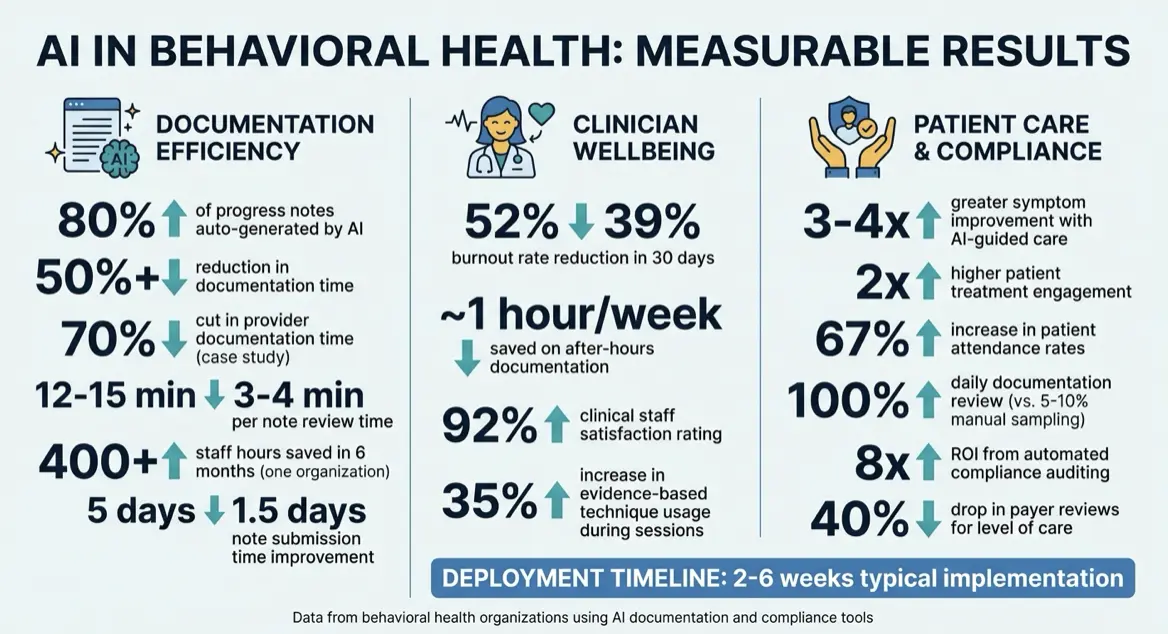
- Documentation Efficiency: AI tools draft 80% of session notes, reducing time spent by over 50%.
- Burnout Reduction: Burnout rates dropped from 52% to 39% in one study, with clinicians saving an hour weekly on after-hours tasks.
- Patient Safety: AI triage flags high-risk patients using real-time data, improving care outcomes.
- Scheduling Automation: AI reduces no-shows and simplifies appointment management.
The tools that work integrate directly into systems like behavioral health EHRs, ensuring compliance, protecting sensitive data, and streamlining workflows. But human oversight remains critical to avoid risks like AI errors or bias.
Bottom line: AI is a tool to support – not replace – clinicians, and it’s already delivering measurable results in behavioral health.
AI Applications That Deliver Measurable Results Today
Three key AI tools – ambient documentation, AI triage, and scheduling automation – are already transforming behavioral health by delivering measurable efficiency gains through behavioral health software.
Ambient Documentation: Cutting Down Note-Taking Time and Alleviating Burnout
Ambient AI tools listen to sessions and draft clinical notes in real time, allowing clinicians to review and finalize notes in just 3–4 minutes, compared to the usual 12–15 minutes. These systems also reference patient history and treatment goals to ensure compliance with regulations. Impressively, AI can generate up to 80% of a progress note’s content within minutes of a session ending, reducing documentation time by over 50%.
One case study highlighted a savings of more than 400 staff hours in just six months. Another study involving 272 clinicians showed a drop in burnout rates from 52% to 39% within 30 days, while time spent on documentation outside regular hours decreased by nearly an hour per week. By streamlining documentation, clinicians can focus more energy on patient care – where AI triage takes center stage.
AI Triage: Faster Identification of High-Risk Patients
AI triage tools analyze patient data, such as PHQ-9 and GAD-7 scores, to highlight high-risk trends and provide real-time prompts based on severity levels. This allows care teams to intervene earlier and allocate resources more effectively.
These systems also enhance compliance monitoring. Instead of manually sampling just 5–10% of notes, automated systems can scan 100% of daily documentation, immediately identifying care gaps and risks. For example, one organization shifted from manually reviewing 15% of notes annually to auditing 100% daily. This change not only improved compliance but also delivered an 8x return on investment.
The clinical impact has been striking. Patients whose care was guided by AI insights showed 3 to 4 times greater symptom improvement and were twice as engaged in their treatment. Additionally, the use of AI tools in behavioral health has been tied to a 67% rise in patient attendance rates. In another instance, an AI assistant was developed within four weeks to guide users through breast cancer risk assessments, determine mammogram eligibility, and connect high-risk individuals with clinical experts for follow-up scheduling.
Scheduling Automation: Lowering No-Shows and Easing Administrative Load
AI-powered scheduling systems further enhance efficiency by automating appointment bookings, sending reminders, and reducing administrative workload. These tools integrate seamlessly with telehealth platforms, capturing session data in real time and syncing it directly to patient files without manual input.
How ContinuumCloud Delivers AI Solutions Through ClinicallyAI
ContinuumCloud has integrated ClinicallyAI’s technology directly into its Welligent EHR platform, seamlessly embedding features like ambient documentation and real-time compliance auditing into the tools clinicians already rely on. This approach eliminates the need for app switching, extra devices, or workflow interruptions. Instead, clinicians can generate notes and perform audits directly within their familiar EHR environment. By improving both documentation and compliance without disrupting daily routines, the platform ensures that AI enhances clinical care rather than complicating it.
At the heart of this integration are two key tools that transform how documentation and compliance are handled:
- Clinical Notes AI: This tool uses “Chart-Aware” technology to pull relevant data from the entire client record, including diagnoses, treatment plans, and interventions. By maintaining the “Golden Thread” of continuity required for regulatory compliance, it ensures that every note aligns with medical and regulatory standards. Unlike generic AI tools, this system is context-aware, referencing the patient’s longitudinal history for accuracy. It even supports over 150 languages, converting multilingual conversations into precise English documentation.
- Comply: This tool automates 100% of chart reviews at the point of care, replacing the outdated practice of manually reviewing just 5–10% of notes. It flags gaps and provides real-time guidance to clinicians, eliminating the need for quality teams to chase corrections weeks later. Organizations using Comply have seen a 40% drop in payer reviews for level of care placement. One reported an 8x return on investment by transitioning from annual manual audits to daily automated reviews.
The results speak for themselves. Deployment takes just two to six weeks, and organizations have reported significant operational improvements:
- One organization cut provider documentation time by 70% and reduced note submission delays from five days to just 1.5 days, with 92% of clinical staff expressing satisfaction.
- Another saved over 400 staff hours in six months, with the AI system completing more than 80% of each progress note automatically.
- A third organization achieved a 50% reduction in documentation time and a 35% increase in the use of evidence-based techniques during sessions, as clinicians could focus more on their patients instead of manual note-taking.
These outcomes highlight how ClinicallyAI’s tools deliver measurable benefits, making clinical workflows more efficient and effective.
Risks and Limitations to Consider
AI can bring real improvements to your operations, but it’s important to understand its limitations to use it effectively and responsibly.
Data privacy is a major concern. Behavioral health records often contain highly sensitive information, so any AI tool you use must comply with HIPAA regulations and be SOC 2certified to safeguard Protected Health Information (PHI). Look for vendors offering Zero Data Retention (ZDR) options, which process session data without storing it on the provider’s servers.
Another risk is AI hallucinations – when generative AI produces content that sounds accurate but isn’t. This is why every AI-generated note must be reviewed and edited by clinicians before being added to a patient’s record. As Psychiatry.org emphasizes:
“Current AI systems are designed as tools to augment and support clinician expertise, not to replace the fundamental roles of clinical judgment, therapeutic alliance, and empathy in patient care”.
In short, AI should act as a co-pilot, not an autopilot.
Training requirements also deserve attention. Even user-friendly AI tools require staff to adjust their workflows. For instance, dictation tools struggled to gain traction among psychiatrists, with adoption rates falling below 50%, because they disrupted natural documentation habits. The fix? Start with small pilot programs using tech-savvy “champions” to showcase success before scaling the tool across your organization. Studies suggest that well-structured pilot programs can reduce burnout while boosting adoption rates.
Algorithmic bias is another challenge, especially when it comes to marginalized populations. AI models trained on non-representative data risk producing biased or inappropriate recommendations. Shockingly, only 3% of mental health apps have published clinical evidence to back their claims. Before implementing an AI system, consider using evaluation frameworks like the American Psychiatric Association (APA) App Evaluation Model to assess its functionality, privacy safeguards, and potential biases. Human oversight is critical to address these issues.
Finally, human oversight is non-negotiable. AI cannot interpret body language, tone, or facial expressions during sessions. It also lacks the ability to build therapeutic alliances or handle crisis situations with the nuance clinicians provide. Your team remains legally and ethically responsible for all diagnoses, treatment plans, and clinical decisions, regardless of AI input. Make sure protocols are in place for when AI tools go offline, and train staff to avoid over-reliance on automated systems. By addressing these risks head-on, you can ensure that AI enhances your operations without compromising ethical or clinical standards.
Conclusion: Choosing AI Tools That Work Today
AI is making waves in behavioral health, but it’s essential to focus on tools that deliver measurable results right now. Applications like ambient documentation, AI triage, and scheduling automation are already proving their worth. These tools are helping reduce clinician burnout while ensuring compliance – a win-win for organizations and their staff.
The key to success lies in choosing AI solutions that integrate seamlessly with your existing systems, especially your EHR. Tools designed to work within your EHR can reference critical data like diagnoses, goals, and interventions, ensuring compliance and supporting payer approval. Features like real-time compliance auditing – which reviews 100% of documentation – are far superior to traditional manual audits that only sample a fraction of records.
Security and compliance are equally critical. Ensure any AI tool you adopt is HIPAA-compliant, SOC 2-certified, and offers Zero Data Retention options to protect sensitive patient information. These solutions are designed for quick deployment, often within two weeks, and don’t require additional hardware.
ContinuumCloud’s partnership with ClinicallyAI is a prime example of how practical AI can transform workflows. For instance, one provider reported a 70% reduction in documentation time starting in May 2024. Note submission times dropped from five days to just 1.5 days, and clinical staff gave the solution a 92% satisfaction rating. Another organization saved over 400 staff hours in just six months, with AI completing more than 80% of each progress note automatically.
To make the most of AI tools, start small with a pilot program. Involve tech-savvy team members, protect clinicians’ charting time, and ensure full oversight of AI-generated content. This approach helps reinforce the benefits of workflow integration while maintaining trust and accuracy.
As one clinician put it:
“The fact that you can have an encounter with a patient and focus on that patient with all the cognitive skills that are required of us… it’s liberating.”
FAQs
How do we pick an AI tool that fits our EHR workflow?
When selecting an AI tool for your EHR workflow, it’s essential to consider a few critical factors. Start with integration compatibility – the tool should seamlessly work with your existing system. Next, look at workflow alignment to ensure it fits naturally into your processes without causing unnecessary disruptions. Ease of use is equally important; the tool should simplify tasks, not add extra steps.
Additionally, confirm that the tool adheres to healthcare regulations and prioritizes data security to protect sensitive information. Lastly, evaluate its potential to provide measurable ROI – like cutting down documentation time, enhancing accuracy, and offering dependable support when needed.
What should we require for HIPAA, SOC 2, and Zero Data Retention?
How do we pilot AI safely without adding clinician burden?
To ensure AI is implemented safely and without adding to clinician workload, it’s best to start small. Focus on integrating AI tools into existing workflows – think AI-powered documentation or compliance auditing within the EHR. These types of tools can deliver immediate benefits, like cutting down documentation time, which makes them a great starting point.
From there, gradually expand your AI use. Always prioritize clinician oversight to maintain trust and accuracy. Simple changes, like moving patient intake to digital forms, can streamline processes and save time. These steps not only reduce disruption but also help prevent burnout among healthcare professionals.