Most behavioral health groups do not fail on intent. They fail on day-to-day follow-through. When 93% of workers report burnout, no-show rates sit at 20% to 40%, and denial rates are 85% higher than other medical fields, small workflow problems turn into care and revenue problems fast.
If I had to sum up the article in one line, it would be this: the best-run organizations connect six parts of the business and treat them as one system.
They focus on:
- One connected platform for clinical work, staffing, payroll, scheduling, and patient communication
- Clear ownership for access, outcomes, retention, and staff workload
- Less charting friction so clinicians spend less time on notes and more time with patients
- Structured hiring, onboarding, training, and supervision to cut early turnover
- Better patient follow-through through simple communication, shared decisions, and fewer access barriers
- Dashboards with set review cycles so teams act on problems before they grow
Here’s the core point in plain English: better results usually come from tighter daily systems, not from working harder.
A few numbers make that clear:
- 40% of people in the U.S. lived in a mental health shortage area
- Virtual visits show about 12% no-show rates vs. 25% for in-person visits
- Automation can cut intake work from 4 hours to 45 minutes
- Clinician turnover often runs 30% to 40% per year
Scaling Behavioral Health with Trust and Technology | Expanding Access Podcast
Quick Comparison
| Practice | Main job | Likely effect |
|---|---|---|
| Unified platform | Connect staff, clinical, and patient workflows | Less duplicate work and fewer handoff errors |
| Leadership ownership | Give one person one number to own | Faster action on access, quality, and staffing issues |
| Lower documentation load | Cut extra clicks, duplicate entry, and after-hours charting | More clinician time and less burnout pressure |
| Structured staffing | Standardize onboarding, training, and supervision | Lower churn and steadier caseloads |
| Patient engagement | Make it easier for patients to book, show up, and stay in care | Fewer missed visits and better retention |
| Dashboards and review cycles | Track a short list of metrics on a set cadence | Earlier fixes and better team follow-through |
The article’s main idea is simple: when leadership, staffing, patient access, and data review all line up, care gets more stable and the business side gets less fragile.
Why Discipline in Day-to-Day Operations Matters in Behavioral Health
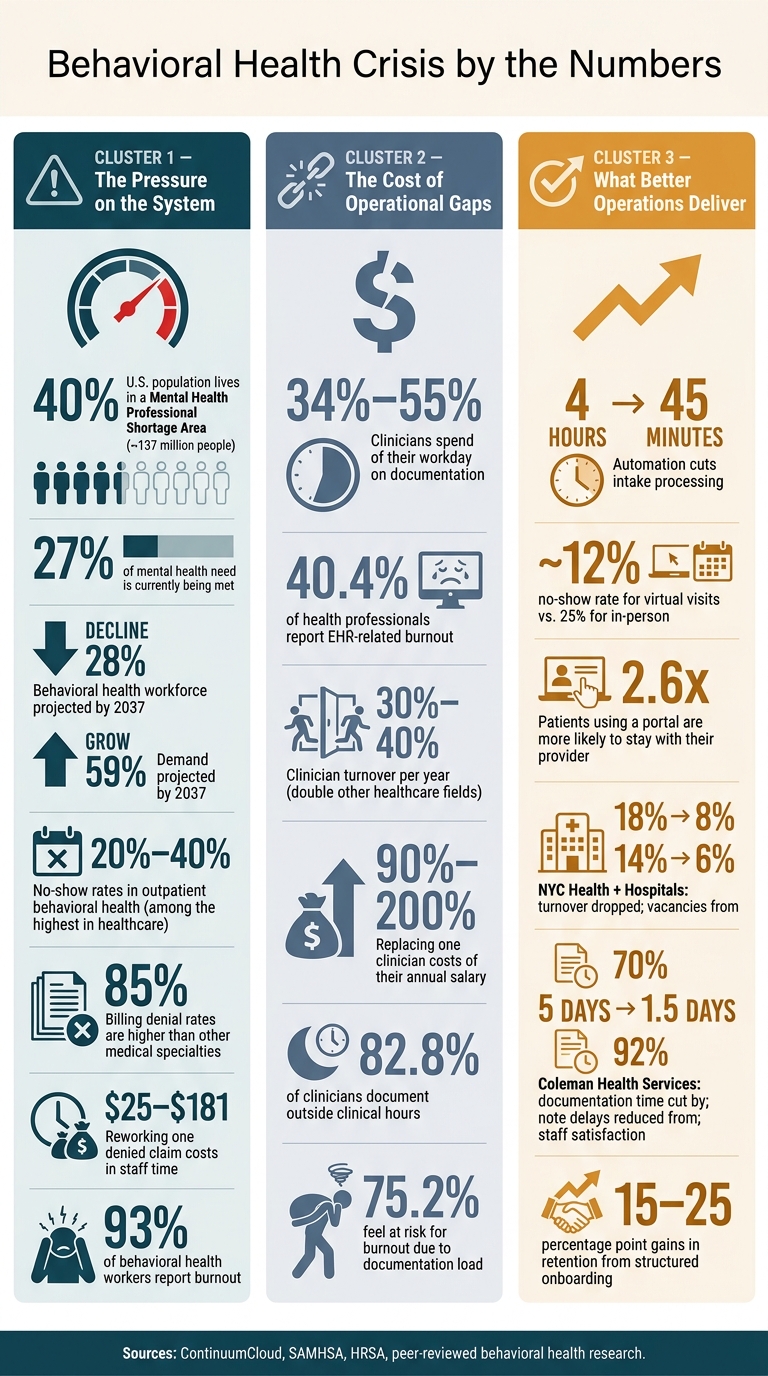
Behavioral Health Crisis by the Numbers: Why Operational Discipline Matters
Behavioral health organizations are getting squeezed from both sides. Demand is climbing, and the workforce is moving the other way. Federal projections estimate the behavioral health workforce will decline by 28% between 2022 and 2037, while demand grows by 59%.
You can feel that gap in day-to-day operations. As of late 2025, about 40% of the U.S. population – roughly 137 million people – lived in a Mental Health Professional Shortage Area, and only about 27% of need was being met. In that kind of setting, every scheduling mistake and missed appointment hits twice: it wastes staff time and cuts into revenue. Outpatient behavioral health settings report no-show rates of 20% to 40%, some of the highest in healthcare. For clinics running on thin margins, that’s not just a finance issue. It also means fewer people get seen.
The cost climbs even more when payer rules get tighter. Reimbursement is being tied more closely to outcomes, documentation quality, and access metrics. At the same time, behavioral health billing denial rates are already 85% higher than in other medical specialties. And reworking just one denied claim can cost between $25 and $181 in staff time. If workflows are inconsistent, organizations can slip behind on clinical work and cash flow at the same time.
That’s a hard spot for community mental health centers, substance use treatment programs, and safety-net clinics. These groups often care for high-acuity, underserved populations while working with Medicaid reimbursement rates that leave little room for mistakes. In plain terms, the daily calls leaders make about scheduling, staffing, documentation, and follow-up can decide whether the mission holds together financially.
The six practices below show how high-performing organizations turn that pressure into more reliable care. The first practice is connecting clinical, workforce, and patient workflows in one system.
1. Use a Unified Platform Like ContinuumCloud to Connect EHR, Workforce, and Patient Engagement
Most behavioral health organizations still work across disconnected systems. The EHR lives in one place. Scheduling sits somewhere else. Payroll and patient communication tools are off on their own. The result? Staff spend time re-entering data, fixing mismatches, and chasing down missing details instead of focusing on care.
High-performing organizations deal with this by connecting clinical, workforce, and engagement workflows in a unified behavioral health software system.
ContinuumCloud brings together Welligent for EHR and clinical workflows, DATIS e3 for HR, payroll, and scheduling, and CaredFor for digital patient engagement. That means one record across clinical, operational, and engagement data, without manual handoffs or duplicate entry. When a clinician logs a session in Welligent, that information can move into workforce and payroll workflows and also trigger follow-up outreach through CaredFor.
That kind of connection matters because the admin load is heavy. Behavioral health clinicians spend 34% to 55% of their workday on documentation, and 40.4% of health professionals report EHR-related burnout. Among those who spend more EHR time outside work hours, the odds of burnout are 2.43 times higher. A unified platform helps cut that burden by reducing duplicate entry, pre-filling prior information, and keeping assessments, treatment plans, and progress notes tied together in one record.
Unified systems can also reduce billing errors by linking timekeeping, scheduling, and clinical documentation. But the connection only pays off when leaders measure whether it’s improving access, quality, retention, and staff well-being.
2. Hold Leadership Accountable for Access, Quality, Retention, and Staff Well-Being
Technology helps, but it doesn't fix much unless leaders own the outcome.
In a lot of organizations, metrics sit in a weird middle ground. They're everybody's concern, which often means they're nobody's actual job. High-performing organizations handle this differently. They give specific leaders specific numbers and then measure performance against those numbers. That kind of ownership matters most when it reaches the day-to-day work clinicians do.
Behavioral health turnover runs between 30% and 40% each year – double the rate in other healthcare fields – and replacing one clinician usually costs between 90% and 200% of that person's annual salary. That's not just an HR problem. It's an operating risk.
The groups that make progress here set clear ownership across four areas:
- One leader owns access
- Another tracks outcomes
- HR owns retention
- An executive owns burnout and workload equity
Top performers don't treat these as side metrics. They build them into job descriptions, scorecards, reviews, and board reports. That's how data starts to drive action.
When leaders own the numbers, they move faster on scheduling, caseloads, and supervision. Once that ownership is in place, the next step is removing the friction that slows clinicians down.
3. Cut Documentation Burden and Administrative Friction for Clinicians
Once leadership owns the problem, the next choke point is documentation.
Clinicians spend too much time on work that does nothing to improve care. The drag shows up in all the usual places: duplicate data entry, jumping between disconnected tools, manual prior authorization follow-up, and clunky note templates. Put all of that on top of emotionally heavy caseloads, and the strain builds fast.
A quality improvement survey found that 82.8% of clinicians regularly documented outside clinical hours, and 75.2% felt at risk for burnout because of documentation load. In behavioral health, that tradeoff is hard to ignore. Every minute saved on charting is a minute that can go back to patient care, follow-up, or crisis response. Cutting this burden is one of the fastest ways to win back clinician capacity.
Integrated documentation workflows can cut note time, reduce submission delays, and save hundreds of staff hours. And the answer is bigger than AI alone. Standardized templates, delegated admin tasks, and automation can reduce documentation time and give clinicians more room to focus on care.
One stat makes the point clearly: automation can shrink intake processing time from 4 hours to 45 minutes. That gives time back to care without adding headcount. In practice, that’s where standardized templates and automation tend to deliver the fastest gains.
4. Build Structured Staffing, Onboarding, Training, and Supervision Programs
Behavioral health turnover often runs above 25% per year, and replacing even one clinician can cost a lot. The reasons usually aren’t mysterious. Roles are fuzzy, early support is thin, and supervision varies from person to person. That’s why retention starts before someone gets their first caseload.
A structured onboarding, supervision, and training plan can cut early churn. Organizations that use a defined 90-day onboarding process and regular supervision have reported 15–25 percentage point gains in retention over time. New clinicians should have a named supervisor before Day 1, with the first supervision session already on the calendar. Early onboarding should cover culture, EHR use, compliance training, and shadowing. Caseloads should build gradually through day 90, not all at once. Formal check-ins at 30, 60, and 90 days make it easier to spot friction early and deal with it before it turns into resignation.
Supervision plays a big part here. It’s the point where onboarding shifts into day-to-day support. Research keeps linking high-quality supervision with lower emotional exhaustion and higher job satisfaction. And the format matters. Weekly or biweekly sessions work best when they follow a clear agenda that covers case consultation, risk management, and clinician well-being. When supervision is inconsistent, early-career staff are much more likely to leave.
Training also needs to continue after the first 90 days. It should be role-specific, ongoing, and protected on the calendar so it doesn’t get pushed aside when things get busy. That includes regular refreshers on risk assessment and evidence-based practices, plus skill-building tied to each role. When people can see where they’re headed and how they’ll keep growing, they’re more likely to stay.
5. Improve Patient Engagement Through Clear Communication, Shared Decisions, and Fewer Barriers
Once staffing and supervision are set, the next test is simple: can patients actually stay in care? In behavioral health, patient engagement is a major day-to-day challenge. People miss appointments, leave early, or never get past intake. Often, it’s not about motivation alone. It’s because basic access issues get in the way. High-performing organizations don’t treat engagement like a one-off reminder or a single phone call. They build it into the system.
A big part of that system is shared decision-making, or SDM. SAMHSA describes it as helping people in treatment have informed discussions with providers about the services they receive. In practice, that means clinicians and patients decide together on treatment type, visit frequency, delivery format, and crisis plans. When people help shape the plan, they’re more likely to stick with it. Staff should be trained on structured SDM frameworks, use plain-language decision aids, and record patient preferences so those choices carry from one visit to the next.
Communication tools can also cut a lot of friction out of intake, scheduling, and follow-up. Virtual visit no-show rates are about 12%, compared with 25% for in-person appointments. Patients who use a patient portal are 2.6 times more likely to stay with their current healthcare provider. Tools like automated reminders, two-way secure messaging, and self-scheduling make it easier for patients to stay on track and easier for staff to manage the work. When those tools connect to core workflows, teams can track outreach, confirm attendance, and follow up without bouncing between systems. And that same level of follow-through should apply to barrier removal, not just reminders.
Reminders matter, but they don’t fix the root problem on their own. Transportation issues, schedule conflicts, confusing intake steps, and cost concerns can knock people out of care before treatment even starts. A simple Ask, Advise, Assess, Assist, Arrange workflow helps staff spot those issues early and work through them with the patient. That might mean offering telehealth, finding a more flexible time slot, or making a warm handoff to another service. The difference is pretty clear: some organizations expect patients to figure it out alone, while others deal with roadblocks as part of every care conversation.
Follow-up after visits should be routine, not left to chance. Reach out after missed visits. Book the next appointment before the patient leaves. Make next-step scheduling, missed-visit follow-up, and plan review part of the standard workflow.
6. Track Clinical and Performance Data With Dashboards and Regular Review Cycles
Disciplined teams use dashboards to make day-to-day work visible, not just to summarize results after the fact. That matters because dashboards, paired with regular review cycles, help teams act early. Without that rhythm, burnout, patient drop-off, and billing problems often show up too late.
High-performing organizations keep an eye on a tight set of metrics across four areas: clinical outcomes, access and engagement, workforce health, and financial performance. For clinical care, that means tracking PHQ-9 and GAD-7 trends over time, not just at intake. On the operations side, teams often watch:
- No-show rates
- Wait times
- Documentation lag
- Third-session retention
- Time from inquiry to first appointment
The goal isn't to gather more data for the sake of it. The goal is to make sure each metric leads to action.
Dashboards also work better when each role sees the numbers it can actually use. Clinicians need a clear view of patient progress and caseload status. Program managers need program-level trends, filtered by team or service line. Executives need high-level KPIs, such as access, outcomes, turnover, and financial performance, measured against targets.
A simple review rhythm helps keep things moving:
- Weekly huddles
- Monthly program reviews
- Quarterly leadership reviews
Each meeting should follow the same basic pattern: review the data, spot what's off-target, assign one clear action to one owner, and check progress in the next cycle. When systems pull clinical, scheduling, and workforce data into one view, these reviews get much easier. That's what turns a dashboard from a passive report into a working management tool.
The next section compares how these six practices differ in day-to-day impact.
Side-by-Side Look at the 6 Practices and Their Impact
These six practices don’t all work the same way. Some can improve day-to-day output fast. Others take more time, but their gains tend to last longer. The table below compares each one across four criteria, which helps the next pattern stand out.
| Practice | Clinician Productivity | Patient Engagement | Organizational Performance | Feasibility |
|---|---|---|---|---|
| 1. Unified Platform | Cuts duplicate work across scheduling, documentation, messaging, and reporting. | Makes coordinated reminders and communication easier for patients and care teams. | Reduces fragmentation and centralizes access, utilization, and performance monitoring. | Moderate: requires phased rollout, data migration, and change management. |
| 2. Leadership Accountability | Keeps clinicians focused on clinical work instead of operational guesswork. | Keeps access and follow-through metrics visible and actionable. | Supports oversight of access, quality, retention, and staff well-being. | High: depends on consistent dashboard use and leadership discipline. |
| 3. Cut Documentation Burden | Reduces clicks, duplicate entry, and after-hours charting. | Gives clinicians more time and attention during sessions. | Reduces burnout pressure and prevents documentation from driving turnover. | High: can start with templates, workflow cleanup, or AI-assisted note support. |
| 4. Structured Staffing | Shortens onboarding and helps new staff become productive sooner. | More stable staffing supports continuity and steadier care relationships. | Reduces turnover and keeps caseloads more stable. | Moderate: requires standard processes, training, and workforce coordination. |
| 5. Patient Engagement | Lowers time spent on manual rescheduling and follow-up outreach. | Improves appointment adherence, response to outreach, and completion of recommended care. | Improves available appointment time by reducing missed appointments. | High: reminders, easier scheduling, and telehealth support can be implemented quickly. |
| 6. Dashboards and Review Cycles | Helps identify overbooked or underused staff before problems escalate. | Makes trends in symptoms, follow-up, and outreach easier to act on. | Supports continuous improvement by making access, quality, utilization, and retention visible. | Moderate: works best with clean, integrated data and a regular review cadence. |
What jumps out here is that these practices reinforce each other.
A unified platform gives teams one place to work, which makes dashboards more useful. Better dashboards make leadership accountability sharper because leaders can spot issues instead of guessing. Structured staffing brings more stability, and that steadier workforce makes patient engagement easier to maintain. In turn, stronger engagement helps protect schedule capacity and overall performance.
Put simply, this isn’t six separate fixes. It’s a connected system, and the overlap between these practices points to the shared habits behind high-performing organizations.
What High-Performing Organizations Have in Common
Put the six practices together, and one pattern stands out: high-performing organizations run leadership, operations, staffing, and patient experience as one system, not four separate parts.
The clearest common thread is alignment between what leaders say matters and what teams do each day. Priorities don't just live in slide decks or planning documents. They show up in workload design, documentation, staffing, and patient communication. That kind of alignment works best when leaders can see what's happening in real time.
The second pattern is measurement used for management, not just reporting. Top performers track access, clinical outcomes, workforce indicators, and financial performance together instead of keeping them in separate silos. They review those metrics on a regular cadence and use them to make small, targeted changes rather than waiting until a crisis forces action. You can see the same habit in the way teams reshape daily work.
The third pattern is lower administrative friction at every level. Integrated workflows cut documentation time and give clinicians more space to focus on care.
Taken together, these habits point to a shared operating model, which the conclusion pulls together below.
Conclusion
High-performing behavioral health organizations run care delivery, workforce management, and patient workflows as one connected system, not as separate functions handled in silos. That kind of alignment turns day-to-day operations into part of the care model itself.
The payoff shows up in the numbers. One health services organization cut documentation time by 70% and reduced note delays from five days to 1.5 days, with 92% staff satisfaction. That’s the point: small workflow fixes can improve both care capacity and the patient experience.
Patient engagement and regular review cycles help those gains stick. They support better continuity, fewer missed visits, and a clearer view of performance across the organization.
The organizations in the best position for long-term impact treat operational discipline as part of care. Simplify workflows, support staff with HR management tools, engage patients, and measure results. These are practical levers that close the gap between intent and outcomes through execution.
FAQs
Where should we start first?
Start with your revenue cycle, especially billing and claims management, to fix bottlenecks and cash flow problems. At the same time, make your EHR the core system that supports day-to-day operations.
From there, connect your HR systems to support workforce management, including position control. Roll out changes in phases across programs so you can test workflows, spot issues early, and keep disruption low before expanding further.
How long does it take to see results?
Many organizations see meaningful workflow gains soon after rollout. For efficiency-focused projects, like moving to one shared platform, some report a 20% efficiency gain in the first 30 days.
AI-powered documentation tools are often live in two to six weeks, and teams can feel the impact right away. Bigger integrations may take a few months, but strong results often show up within the first six months.
Which metrics matter most?
Focus on seven core behavioral health metrics: no-show and attendance rates, patient progress, per-patient revenue, provider performance, program completion, clinical notes completion time, and patient feedback ratings.
Taken together, these metrics give you a clear view of patient engagement, treatment results, staff output, billing speed, compliance, and overall service quality.