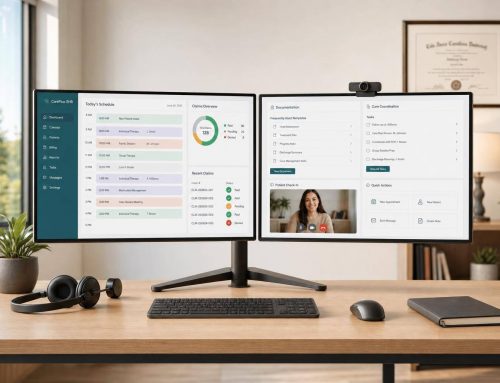
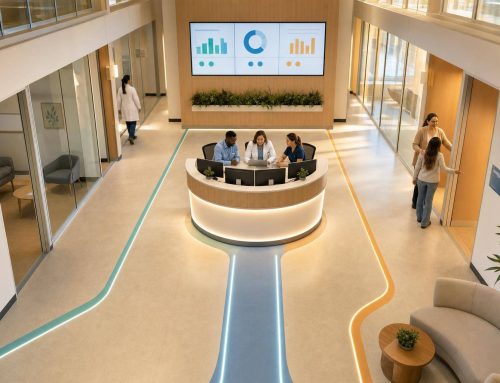
Clinicians can spend nearly half their day on EHR and desk work, while direct patient care gets far less time. In behavioral health, that strain often shows up in repeat data entry, disconnected systems, missed compliance steps, and charting that spills into nights and weekends.
Here’s the short version: modern behavioral health EHRs can cut note time, reduce rework, and help teams stay on top of billing, compliance, and care coordination. The biggest gains usually come from a few core changes:
- Behavioral-health note templates for intakes, plans, progress notes, group sessions, and discharge
- Auto-filled fields that pull in demographics, diagnoses, insurance, and session details
- Dynamic forms that show only the fields needed for that visit
- Role-based task routing so intake, clinical, and billing work goes to the right person
- Cloud access for mobile teams, telehealth, and same-day charting
- Connected records that keep treatment plans, risk details, and follow-up tasks in one place
A few numbers make the problem clear:
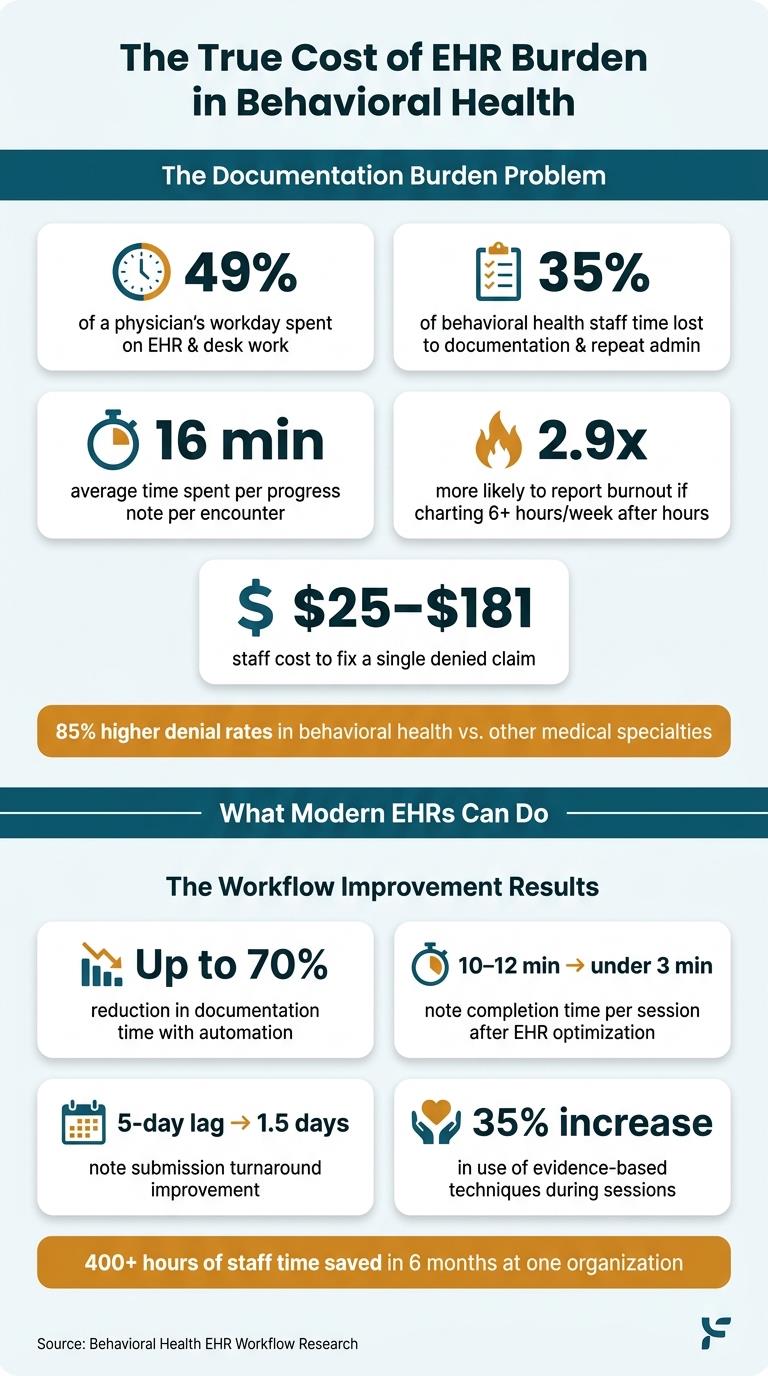
- Physicians spend about 49% of their workday on EHR and desk work
- Behavioral health staff spend nearly 35% of their day on documentation and repeat admin work
- Progress notes can take about 16 minutes per encounter
- Staff who do more than 6 hours a week of after-hours EHR work are far more likely to report burnout
- Fixing one denied claim can cost $25 to $181 in staff time
What this means for you: if your team is retyping the same data, fixing claim issues, chasing signatures, and charting after hours, the workflow – not just the workload – is the problem.
Modern EHRs help by doing three things at once: they reduce duplicate work, make required documentation easier to complete, and keep team communication tied to the patient record. When that setup is paired with clinician input, staff training, and tracking of same-day completion, after-hours charting, and note turnaround time, teams can spend less time at the keyboard and more time with patients.
That’s the core idea of this article: less paperwork, cleaner workflows, and more attention for care.
Less admin.
Stronger teams.
Better client outcomes.
See how behavioral health organizations streamline documentation, staffing, and client engagement with ContinuumCloud.
Which solution would you like to explore?
Where Clinical Workflows Break Down Today
Behavioral health clinicians spend nearly 35% of their workday on documentation and repetitive admin work instead of direct patient care. That drag doesn’t come from one single issue. It builds across intake, notes, billing, and team coordination.
Repetitive Data Entry and Disconnected Systems
The clearest problem is also the most draining: staff enter the same details again and again. A new client’s name, date of birth, insurance ID, and referral information might go into a scheduling tool, then into the clinical record, then through manual billing checks. Every extra step takes time and creates more chances for mismatched records, denied claims, and broken client histories.
The strain shows up most in intake, treatment plans, progress notes, and care coordination. During intake, basic client details move across several systems that don’t sync. In treatment planning, goals often get typed back into each note instead of carrying forward. Progress notes take about 16 minutes per encounter, and clinicians often re-enter diagnosis and service codes every time. In care coordination, outreach and transition details are often tracked outside the EHR – or never logged at all.
When systems don’t connect, staff rewrite data instead of reusing it. Behavioral health denial rates are 85% higher than in other medical specialties, and fixing one denied claim can cost $25 to $181 in staff time. That’s not just a billing issue. It’s a documentation workflow issue that hurts records and slows care well before a claim ever goes out.
Compliance Requirements That Add Workflow Friction
Things get worse when compliance depends on memory. If templates don’t prompt for required items – start and end times, modality, diagnosis linked to the service, and measurable goals tied to the treatment plan – clinicians have to keep track of all of that on their own. That’s where gaps start.
If templates and alerts don’t line up with payer rules, staff spend more time chasing signatures and fixing missing details. Treatment plan updates due every 90 days, co-signatures for supervised clinicians, and medical necessity documentation all add steps that can easily get missed without automated tracking. And when fields don’t match the session, clinicians end up clicking through extra boxes that add work but not better care.
After-Hours Charting and Fragmented Team Communication
Back-to-back sessions leave little room to document between visits, so notes spill into evenings and weekends. After a while, that becomes normal. And 60% of behavioral health professionals say EHR challenges are a top reason for burnout.
Team communication problems pile on. When updates live in separate notes and folders, people miss safety concerns and follow-up slows down. A supervisor may give feedback in a hallway conversation, but it never reaches the record. A fax from an outside provider may get scanned into a generic folder with no alert to the treating clinician. That’s what daily work looks like when documentation tools and communication don’t connect. Responses get delayed, handoffs get weaker, and follow-through depends too much on memory.
Modern EHRs are built to cut this friction by connecting documentation, billing, and team communication in one workflow.
How Modern EHRs Cut Documentation Work
Modern behavioral health EHRs cut documentation slowdowns by guiding notes, routing tasks, and linking day-to-day workflows.
| Modern EHR Capability | Documentation Burden Reduced |
|---|---|
| BH-specific templates (SOAP, DAP, GIRP, BIRP) | Missed required fields, inconsistent note formats, compliance gaps |
| Auto-populated fields and pulled-forward history | Repetitive data entry, re-typing diagnoses and goals each session |
| Dynamic forms with conditional logic | Excessive clicks, irrelevant fields cluttering the screen |
| Role-based task routing | Duplicate effort, unclear ownership, manual transfers |
| Cloud and mobile access | After-hours charting, in-office charting, telehealth gaps |
| Group note master templates | Manual duplication of session details across each participant’s record |
The biggest time savings show up when these tools fit behavioral health documentation from intake through discharge.
Behavioral-Health-Specific Templates and Structured Notes
A modern behavioral health EHR comes with configurable templates for intakes, assessments, treatment plans, progress notes, group sessions, and discharge. These are built around note formats clinicians already know, like SOAP, DAP, GIRP, and BIRP.
That matters because good templates speed up documentation without flattening the clinical story. They blend structured data and narrative context. Structured fields like diagnosis codes, risk level, and screening scores such as PHQ-9 and GAD-7 create searchable data for reporting. Narrative sections give clinicians space to document therapeutic detail and clinical judgment that checkboxes alone can’t show. Put together, they support compliance without reducing care to a form.
Templates also keep treatment plans tied to session notes, so progress documentation stays linked to the care plan without forcing staff to re-enter the same information over and over.
Once the note format is set, automation can take over much of the repeat typing.
Automation, Role-Based Workflows, and Dynamic Forms
Auto-population pulls demographics, insurance details, diagnoses, and session metadata from scheduling straight into the clinical note. That alone can cut a lot of low-value typing.
Dynamic forms trim the screen down to what fits the encounter. A crisis assessment can surface detailed risk questions. A routine outpatient therapy note can put goals and interventions front and center. If a patient screens negative for substance use, those fields collapse. This kind of conditional logic cuts clicks and helps clinicians stay focused on what matters in that session.
Role-based workflows make ownership clear. Intake staff handle consent and demographics. Clinicians complete assessments and notes. Billing staff get finished documentation through automated routing instead of waiting for manual handoffs. Less duplicate work, less confusion, fewer dropped tasks.
Organizations using this kind of automation have reported documentation time cuts of up to 70%. In some cases, note completion times have gone from an average of 10–12 minutes to under 3 minutes per session.
Cloud Access and Connected Workflows Across the Organization
Cloud-based access means clinicians don’t have to be in a physical office to finish documentation. Mobile teams and telehealth staff can chart in real time, whether that’s during a community visit or right after a virtual session. Instead of rebuilding notes from memory later, they can document while details are still clear.
That keeps charting moving during the workday instead of spilling into evenings.
When all programs use one centralized system, staff across locations can work from the same up-to-date record. A care coordinator at one site can see the same treatment plan, risk assessment, and progress notes as a clinician somewhere else. That makes transitions between levels of care smoother because the record moves with the patient.
Connected workflows can also tie the EHR to staffing and alumni engagement tools. Staffing assignments, clinician credentials, appointment reminders, and digital outcome measures can feed into the same clinical workflow instead of living in separate systems. That cuts handoffs and avoids extra data entry across multiple platforms.
What Better Workflows Look Like in Practice
When EHR workflows fit the way behavioral health teams actually work, the difference shows up fast. Documentation takes less time, coordination gets smoother, and clinicians can give patients more of their attention. You should see that in day-to-day work: faster charting, cleaner handoffs, and more time spent in session instead of at a keyboard.
Less Time Charting and Less Work After Hours
The first sign of a better workflow is simple: notes get finished faster, and they get finished during the workday. When organizations rebuild documentation around behavioral-health-specific templates and automation, average documentation time per encounter often drops by 20–30%, because clinicians don’t have to keep retyping the same things.
That matters for staff well-being too. Clinicians who spend more than 6 hours per week charting outside scheduled hours are 2.9 times more likely to report burnout. So when a workflow supports same-day chart closure, it takes some of that pressure off. In one organization, provider documentation time dropped by 70%, and note submission turnaround went from a five-day lag to just 1.5 days. Clinical staff also rated the experience at 92% satisfaction.
More Consistent Care Coordination and Clinical Follow-Through
Those time savings don’t just help the person writing the note. They also improve how information moves across programs. If outpatient, intensive outpatient, and residential teams all work from the same clinical record, a residential clinician can review earlier outpatient notes, see which triggers, coping strategies, and family dynamics have already been identified, and build from there instead of starting from scratch. Treatment goals, risk assessments, and progress notes stay with the patient rather than getting lost during handoffs.
Clear task ownership helps too. When follow-ups, outreach calls, and care transitions are assigned to specific team members with due dates and status tracking, fewer tasks slip through the cracks. Responsibility is clear. Completion is visible. Gaps show up sooner.
One organization saved over 400 hours of staff time within six months while AI-powered documentation automated more than 80% of each progress note.
More Time and Attention for Patients
When clinicians aren’t rebuilding notes from memory at 9:00 p.m. or clicking through redundant screens in the middle of a session, they can stay more focused on the person in front of them. That shift has clinical weight. One organization reported a 50% drop in documentation time, average note submission times of 4.4 hours, and a 35% increase in the use of evidence-based techniques during sessions. Less time on documentation means more attention for patients.
Keeping those gains in place takes clinician input, training, and regular tracking.
How Organizations Can Make EHR Workflow Improvements Last
Workflow gains don’t stick on their own. If no one owns them, teams slip back into old habits. The way to make improvements last is pretty simple: involve clinicians, train people well, and keep an eye on documentation burden.
Once better workflows are in place, the next job is making sure they hold up across teams and service lines.
Design Workflows with Clinician Input
It starts with EHR setup. One practical way to do this is to run structured design sessions that map the patient journey from intake through discharge, then shape the EHR around those day-to-day steps.
That matters because clinicians know which fields help care move forward and which ones just add clicks. At the same time, compliance and operations leaders can check that leaner templates still meet payer and regulatory rules. When clinicians are involved early, organizations tend to see better EHR satisfaction, stronger adherence to documentation standards, and a closer match between the system and actual clinical thinking.
Train Teams and Track Documentation Burden
Training also plays a big part here. Role-based, scenario-driven learning helps people build habits that cut documentation time without lowering clinical quality. That might mean showing a therapist how to finish a progress note during a session or walking a care coordinator through task routing in a way that fits their daily work.
It also helps to name team coaches in each service line. These coaches give clinicians a go-to person for everyday questions and send feedback back to the people who manage EHR setup. That closes the loop instead of letting small workflow problems pile up.
To keep gains from slipping, track a few clear measures:
- Same-day completion
- After-hours charting
- Note turnaround time
These numbers can flag burden early and help teams keep standards high. And the payoff is pretty direct: when clinicians spend less time wrestling with the EHR, they can spend more time with patients.
Conclusion: Less Documentation, More Patient Care
Documentation burden in behavioral health is a real, measurable problem – and it has real consequences for clinicians and the patients they serve. When clinicians spend 1–2 hours documenting for every hour of direct care, something has to give.
Modern cloud-based EHRs can help shift that balance by cutting duplication, making compliance workflows simpler, and keeping information connected across care teams.
But software alone won’t fix the problem. The organizations that get lasting results are the ones that pair the right EHR with deliberate workflow redesign, clinician-led configuration, and steady measurement. That’s how you get less time at the keyboard, fewer notes finished at midnight, and more attention for the people who need care most.
FAQs
How do modern EHRs reduce note time?
Modern EHRs cut note time by replacing manual entry with integrated workflows built for behavioral health. AI-powered tools and ambient listening can create structured, chart-aware notes during sessions, which can drop completion time from 10–12 minutes to under 3 minutes.
They also save time by linking treatment plans, goals, and outcomes straight to notes. On top of that, templates, voice-to-text, and master notes for group therapy cut down on repetitive data entry.
Which workflow fixes matter first?
Start with clinical documentation. It eats up the biggest share of a clinician’s time – about 35% of the workweek – and it’s one of the main drivers of documentation-related burnout. AI-assisted tools can shrink note completion time from 10–12 minutes to under 3 minutes.
After that, turn to revenue cycle work like billing and claims, or to intake workflows, depending on where your biggest operational bottleneck shows up.
How can teams sustain EHR workflow gains?
Teams keep EHR workflow gains when they treat documentation as a business decision, not just a box to check for compliance.
A phased approach tends to work best. Start with the core functions first, like documentation and scheduling. Once those are working well, roll out more advanced features over time. That way, teams don’t try to do everything at once and end up tripping over their own feet.
It also helps to keep a close eye on what happens after launch. Monitor user engagement, feature adoption, and system performance on a regular basis. At the same time, gather user feedback and keep the system up to date so small issues don’t turn into bigger ones.
Leadership should track key performance indicators as well. That makes it easier to measure ROI and see whether the system is paying off over the long haul.