If I had to sum it up in one line: behavioral health groups are replacing old EHRs because the old systems now cost too much time, too much money, and too much compliance risk.
In 2026, this is no longer just an IT project. I see it as a business call tied to revenue, staff burnout, reporting, audits, and care quality. Old systems were built for record storage and claims. They were not built for CCBHC reporting, ONC data-sharing rules, AI note tools, or strict consent controls for SUD records.
Here’s the short version:
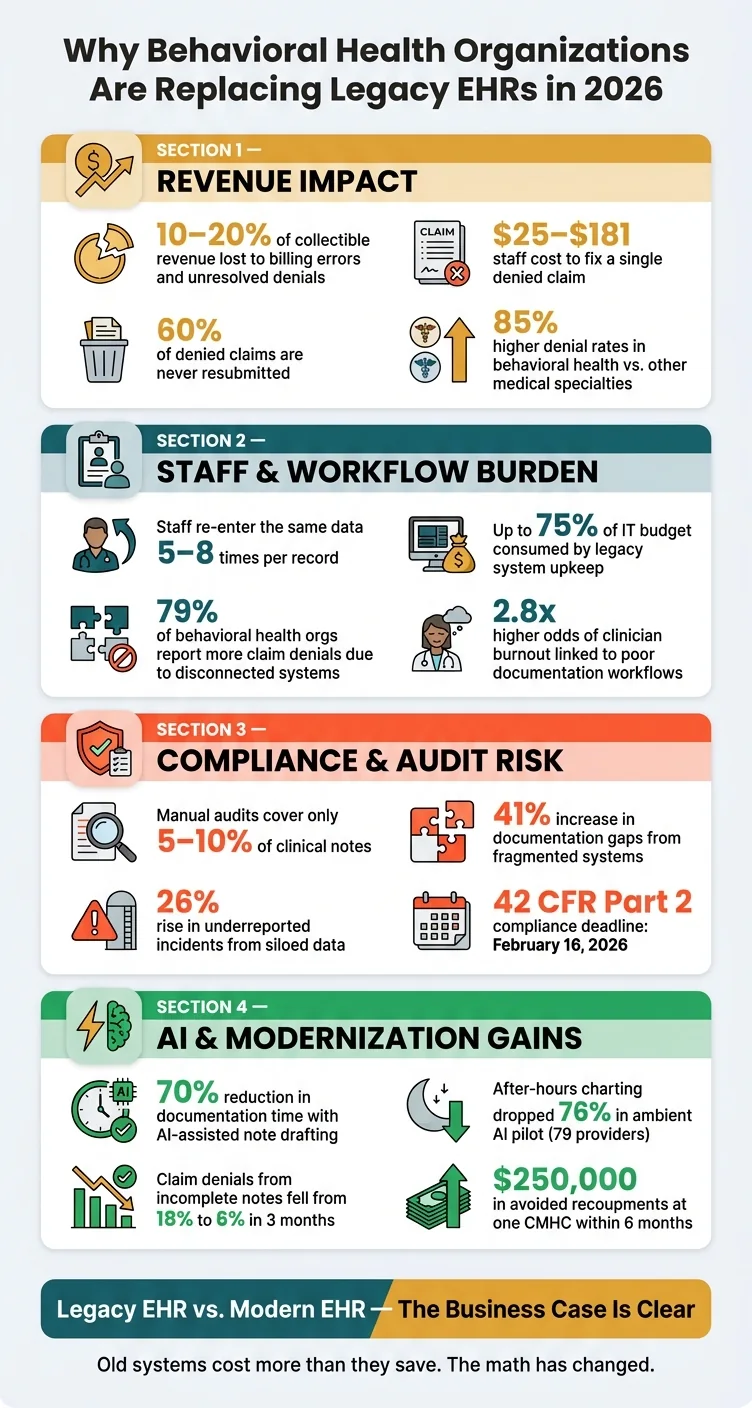
- Revenue loss is a big driver. Behavioral health groups can lose 10% to 20% of revenue from billing mistakes and denied claims tied to disconnected systems.
- Clinician burnout is part of the math. Poor documentation time is linked to 2.8x higher odds of burnout.
- Disconnected data hurts both care and billing. It leads to more denials, more missing documentation, and slower decisions.
- Manual work is expensive. Staff may enter the same data 5 to 8 times, and fixing one denied claim can cost $25 to $181.
- AI note tools are now a basic ask. Some teams cut note time by 70%, while also lowering denial rates tied to incomplete notes.
- Compliance risk is growing. 42 CFR Part 2 rules, HIPAA logging, and CCBHC reporting now demand better consent controls, audit trails, and structured data.
- Modern EHR buying criteria are clear. Buyers want behavioral health workflows, FHIR-based data exchange, built-in reporting, AI support, and role-based access controls.
- Success should be measured. I’d track minutes per note, denial rate, days in A/R, audit-prep hours, and staff satisfaction after go-live.
A simple way to think about it: if an EHR forces staff into side spreadsheets, duplicate entry, manual chart pulls, and after-hours notes, it is no longer just old – it is expensive.
| Area | Legacy EHR problem | What teams want now |
|---|---|---|
| Documentation | Too many clicks, slow note work, after-hours charting | AI-assisted drafting with clinician review |
| Billing | Missing data, denials, rework | Cleaner claims and better first-pass acceptance |
| Reporting | Manual exports and chart review | Structured data and built-in CCBHC reporting |
| Compliance | Weak consent controls and audit logs | Part 2 controls, role-based access, 6+ years of logs |
| Care coordination | Siloed data across programs | Unified patient view across settings |
| IT spend | Heavy upkeep and custom fixes | Less maintenance and fewer workarounds |
If you’re reading this to decide whether an upgrade is worth it, the core answer is simple: organizations are switching because old EHRs no longer support how behavioral health care is delivered, billed, and audited in 2026.
The Hidden Cost of Legacy EHRs in Behavioral Health (2026)
Less admin.
Stronger teams.
Better client outcomes.
See how behavioral health organizations streamline documentation, staffing, and client engagement with ContinuumCloud.
Which solution would you like to explore?
How Legacy EHRs Are Holding Organizations Back
Legacy EHRs slow behavioral health teams because they were built for storage and billing, not for high-volume documentation, cross-program coordination, or real-time reporting. That gap hits teams first in the day-to-day work: documentation and scheduling.
Rigid Workflows Mean More Clicks, Delays, and Staff Frustration
Legacy systems often force staff to enter the same information more than once. They also create long treatment-plan workarounds and add extra steps for progress notes, coding, and scheduling.
That friction adds up fast. Treatment plans take longer when the system can’t support co-occurring disorders, complex assessments, or social needs without manual workarounds. Picking visit types, interventions, and diagnostic codes can mean bouncing through multiple windows, with little ability to pull forward structured data from earlier sessions. Scheduling has the same problem. Many legacy systems can’t handle group visits or cross-setting care, so staff end up managing calendars outside the EHR.
That kind of setup wears people down. A cross-sectional survey of 282 clinicians across 3 health systems found that slow system response times, heavy data entry, and poor navigation were among the factors strongly tied to high stress and burnout. The result is simple: slower throughput and less staff capacity.
The same rigid design also makes it harder for leaders to get a clear view across programs.
Disconnected Data Weakens Reporting and Care Coordination
Disconnected data is one of the biggest hidden failures in legacy systems. When outpatient, residential, and crisis programs each keep separate documentation silos, key details can slip through the cracks during transitions. Medication changes, updated care plans, and recent hospitalizations may exist somewhere in the system, but not in one unified view.
The numbers make the problem hard to ignore. 79% of behavioral health organizations report more claim denials because of data gaps caused by disconnected systems. Fragmented systems are also linked to a 41% increase in documentation gaps and a 26% rise in underreported incidents.
That fragmentation leads to denials, missed incident reporting, and slower decisions. Without unified reporting, leaders lose timely visibility into utilization, payer mix, and program performance. That makes it harder to manage CCBHC performance and technology needs and decide where growth makes sense.
You cannot do this work without data. You cannot fly this plane completely blind.
These workflow and reporting gaps also push labor costs higher and slow reimbursement.
The Hidden Costs of Outdated EHR Systems
Those workflow breakdowns don’t stay hidden for long. They show up in payroll, denied claims, and the scramble before an audit.
Manual Workarounds Drive Up Labor Costs and Slow Reimbursement
When systems don’t talk to each other, staff must do the work by hand. In practice, that often means entering the same information into scheduling, clinical, and billing tools again – sometimes 5 to 8 times for a single record.
That kind of repeat work eats up staff time, but it also hits cash flow. In behavioral health, denial rates can be 85% higher than in other medical specialties because progress notes are incomplete or authorizations are missing. Then comes the cleanup. Fixing just one denied claim can cost $25 to $181 in staff time. And because the process is slow and manual, 60% of denied claims are never resubmitted.
The result is hard to ignore: organizations can lose 10%–20% of collectible revenue to billing mistakes that could have been avoided and denials that never get sent back in.
| Cost Category | Operational Impact | Estimated Financial Effect |
|---|---|---|
| Manual workarounds and duplicate data entry | Staff re-enter data across systems and handle tasks the EHR should automate | Scales poorly across programs or sites |
| Billing rework | Staff review charts, chase missing signatures, and reprocess denials | 10%–20% loss of collectible revenue |
| Claim corrections | Staff investigate, correct, and resubmit denied claims | $25–$181 per claim in staff time |
| IT maintenance | Patches, custom interfaces, and legacy support contracts | Up to 75% of IT budget consumed by upkeep |
There’s also the IT side of the bill. Old systems often need patches, custom interfaces, and support for aging tools. In some cases, upkeep alone can consume up to 75% of the IT budget. That’s money spent keeping the lights on instead of improving care or operations.
Compliance Gaps Raise the Cost of Audits and Corrective Action
Legacy systems create another layer of cost, and it tends to surface during audits. If audit trails are weak, it becomes much harder to show who opened a record, when someone changed it, or whether staff completed the required fields.
Manual audits usually cover only 5%–10% of clinical notes. That leaves most notes unchecked, which is where risk starts to build. And when payers or regulators spot a problem, the price goes far beyond the finding itself. Teams must pull records, gather proof, pay outside consultants, shift leadership time, and put corrective action plans in place. Fixing problems late is almost always more expensive.
For organizations working under CCBHC requirements, the pressure is even higher. The reporting load includes structured data collection and regular reporting on encounter, outcome, quality, staffing, access, utilization, costs, and outcomes data.
In other words, old EHRs turn compliance into a manual chore when it should be built into the system. That’s a big reason AI-assisted documentation and workflow automation now sit near the center of many EHR replacement decisions.
AI-Assisted Documentation and Clinical Workflows

Legacy EHRs push clinicians into manual note work that eats up hours that should go to patient care. AI-assisted documentation takes much of that load off without taking away clinician responsibility. And the upside isn’t just moving faster. It also means cleaner notes that support reporting, billing, and audit trails.
AI Can Cut Documentation Time Without Removing Clinician Control
Here’s how it works in practice: AI listens during a session, drafts the note, and the clinician reviews and signs it. The clinician still owns the final clinical judgment and signs the record.
That setup can make a big difference. One outpatient psychiatry clinic using an NLP-powered note-generation tool cut documentation time from 2.5 hours per day to 45 minutes – a 70% drop – while claim denials tied to incomplete notes fell from 18% to 6% within three months. In an ambulatory pilot using ambient AI documentation across 79 providers, the share of clinicians spending 8 or more hours per week on notes outside work hours dropped from 31.6% to 7.6% – a 76% relative decrease. On top of that, clinicians edited less than one-quarter of AI-generated content in 84% of notes.
The effect is direct: less after-hours charting, fewer denials, and cleaner records for billing and compliance. But none of that means much unless the draft stays easy to review, traceable, and compliant.
Workflow Automation Improves Record Quality and Follow-Through
AI can also do more than draft notes. It can flag missing fields, pending signatures, and overdue treatment-plan reviews before those gaps turn into bigger problems.
That matters a lot in behavioral health settings spread across outpatient, residential, MAT, and crisis services. Over time, documentation habits can drift. People skip steps, wording changes from team to team, and records start to look uneven. Standardized templates and routing rules help keep that from happening, and they do it without asking staff to rely on memory alone.
The payoff shows up in the numbers. A community mental health center serving approximately 5,000 patients reduced audit findings tied to missing safety plans and inconsistent symptom tracking by 80% within six months, avoiding an estimated $250,000 in potential recoupments.
Still, control matters. Every AI-generated note should preserve draft history, edits, and the final signature. AI should prompt for missing details and flag inconsistencies, but it should never finalize clinical content without human review. Those guardrails matter most when records also need to meet consent, privacy, and reporting rules.
CCBHC and Compliance Readiness
Once documentation gets faster, compliance becomes the thing that makes or breaks the system. AI can help clinicians finish notes sooner. It cannot patch weak consent settings, loose access permissions, or poor reporting controls.
Consent, Privacy, and Access Controls Are Now Non-Negotiable
SUD records, psychotherapy notes, and standard clinical notes do not follow the same rules. The EHR needs to enforce those differences clearly and separately.
Under 42 CFR Part 2, SUD records need tighter consent and redisclosure controls than standard HIPAA-covered information, and compliance is required by February 16, 2026. That means a modern EHR should treat consent as structured data, not as a scanned PDF buried in the chart. It should tag and isolate SUD records so they don’t move into patient portals, HIE feeds, or routine data exports unless there is valid consent in place.
Access controls matter just as much. Role-based access should limit each user to only the data needed for that person’s job. HIPAA audit logs also need to show who accessed which record, what they did, when they did it, and the stated purpose. Those logs must be kept for at least six years.
Reporting Readiness Matters for CCBHC Performance and Audits
Compliance isn’t just an admin problem. It’s a core part of EHR selection.
SAMHSA’s 2023 CCBHC Certification Criteria require structured quality measure reporting for all people receiving CCBHC services, with annual reporting due nine months after year-end. In plain terms, access, outcome, and quality measures need to be captured in a structured way at the point of care, not stitched together later through manual chart review when reporting season hits.
A modern EHR builds measure logic into the clinical workflow itself. That helps cut reporting gaps and makes audits move faster.
CCBHCs also face annual independent financial audits, and any findings require corrective action plans. Here’s what that should look like in practice:
| Compliance Area | What a Modern EHR Should Do |
|---|---|
| HIPAA Security & Privacy | Role-based access, encryption at rest and in transit, tamper-evident audit logs kept for 6+ years |
| 42 CFR Part 2 | SUD record tagging, granular consent tracking, redisclosure notices, emergency access controls with automatic logging |
| Consent Management | Centralized consent registry, real-time enforcement, revocation workflows with effective dates, patient portal controls |
| Audit Readiness | Exportable audit logs, linked clinical and billing records, configured reports for HIPAA and Part 2 reviews |
| CCBHC Quality Measures | Structured data capture for required measures, embedded measure logic, state- and SAMHSA-aligned reporting templates |
Part 2 violations carry severe penalties. For CCBHCs, missing audit standards can lead to loss of designation, loss of grant funding, and corrective action plans that bring years of added oversight.
That is why a legacy EHR that depends on manual workarounds isn’t just inefficient. It’s a liability.
These requirements set the minimum bar for a modern behavioral health EHR. They also set the baseline for judging the next generation of behavioral health platforms.
What to Look for in a Next-Generation Behavioral Health EHR and How to Measure Success
Core Selection Criteria for 2026
Once compliance is covered, the next step is simple: will the EHR cut manual work and improve day-to-day results? The right system should make documentation easier, tighten up billing, and make reporting less of a chore. What matters most is whether staff can get through normal work without hacks, side spreadsheets, or extra clicks.
Purpose-built behavioral health functionality comes first. The system should natively support psychiatry, psychotherapy, SUD treatment, IDD, ABA, group therapy, and residential care. It should also support configurable behavioral health templates and program-specific fields.
Interoperability is baseline in 2026. That means FHIR R4 APIs, USCDI v3, and bidirectional exchange with primary care, labs, pharmacies, and HIEs.
Implementation support has a direct effect on adoption and go-live risk. A smart way to test this is to have frontline staff demo common tasks and count the clicks, pauses, and bottlenecks.
| Selection Area | What to Confirm |
|---|---|
| Behavioral health workflows | Native support for SUD, IDD, ABA, residential, child and family services, and CMHC programs |
| Configurable documentation | Admin-adjustable templates, conditional logic, required vs. optional fields |
| Interoperability | FHIR R4, USCDI v3, ONC certification, HIE connectivity, EPCS |
| Compliance controls | 42 CFR Part 2 segmentation, role-based access, audit logs, consent tracking |
| Reporting and analytics | Pre-built CCBHC measures, ad hoc report builder, scheduled delivery, no manual exports |
| AI and automation | Note drafting with clinician review, automated alerts, coding checks |
| Implementation and support | Migration plan, role-based training, named support, uptime SLAs |
Success Metrics from Modernization
Picking a system is only half the job. It matters only if the new EHR moves the numbers that led you to replace the old one in the first place. Look at whether it cuts documentation time, reduces denials, and lowers the hours spent getting ready for audits.
Track average minutes per note, note completion time, denial rate, days in A/R, and audit-prep hours. Claims performance – first-pass acceptance rate, denial rate, and days in accounts receivable – should get better as cleaner documentation feeds straight into billing workflows. Audit preparation effort, measured in staff hours needed to assemble records and reports, should fall as exportable logs and pre-built reports take the place of manual chart pulls.
Baselines in the legacy system need to be set before go-live. Without that, you can’t tell if the money, time, and effort paid off. Track documentation completion, denial trends, reporting timeliness, and staff satisfaction every month during year one, then adjust training and system setup as needed.
FAQs
×
How do we know when our EHR is too costly to keep?
A workflow audit can show if your EHR is draining more money than it should.
Some warning signs hit the bottom line fast. That includes 10% to 20% losses in collectible revenue tied to billing errors, missed prior authorizations, and claim denials of 5% to 10% or more.
Other red flags show up in day-to-day work. Staff may spend 10 to 20 hours each week on manual tasks. Clinicians may spend 35% to 55% of their day on documentation instead of patient care. You might also see constant workarounds, like using spreadsheets to fill gaps, along with weak real-time visibility into capacity, performance, or payer trends.
×
What should we prioritize first in a 2026 EHR replacement?
Start with the EHR as the foundation. Once you have one central system in place, add HR integrations and alumni engagement tools.
For the rollout, begin with scheduling and documentation first. Then layer in more advanced features over time. It also makes sense to put revenue cycle automation near the top of the list, especially for billing and claims.
Set baseline metrics early so you can track performance across three key areas:
- Clinical performance
- Operational performance
- Financial performance
That way, you’re not just putting new software in place. You’re also giving your team a clear way to measure what’s working and where things need attention.
×
How can we measure ROI after switching to a modern EHR?
Set baseline metrics before implementation. Then measure ROI across clinical quality, operational efficiency, and financial performance.
Look at symptom improvement, alumni engagement, and how often clinicians use evidence-based techniques. Track documentation turnaround time, time per note, staff turnover, and workarounds. Review first-pass claim success, manual reporting hours, and Days Sales Outstanding.
The key is where care and business outcomes change. Focus on clinical decision points, not generic adoption stats.