Alumni engagement can be a game-changer for behavioral health organizations. While 85% of treatment centers have alumni programs, most fail to use them effectively. Here’s why it matters:
- 25–50% of new admissions can come from alumni referrals – at little to no extra cost.
- Extending engagement to 18–24 months (vs. the typical 90–100 days) reduces relapse rates and improves recovery outcomes.
- Alumni programs provide valuable feedback and data for value-based care contracts.
The problem? Many programs lack structure, consistent follow-up, and tools to track results. Leading organizations succeed by using dedicated staff, automated platforms, and data-driven strategies to maintain connections and grow referrals.
Want to turn alumni into advocates and fuel growth? Focus on long-term engagement, clear processes, and measurable outcomes.
The Post-Discharge Opportunity
Why the Post-Discharge Period Matters
Discharge marks the beginning of a tough and often unpredictable recovery journey. Recovery isn’t a one-time event – it’s an ongoing process, and the first weeks and months after discharge are pivotal. As Andrew Averill, Director of B2B Marketing at Recovery.com, explains:
“The post-discharge period – often the most vulnerable time – is where long-term recovery is truly forged.”
This period is a major transition. Patients move from the structured environment of institutional care to the unstructured reality of daily life. And with this shift comes challenges. Setbacks are common in recovery, and relapse can become part of the process. Without consistent follow-up, providers lose the ability to offer timely support or guide patients back on track when they falter. Research shows that maintaining engagement for 18 to 24 months is far more effective for long-term recovery than the shorter 90 to 100-day periods often used.
By focusing on this critical stage, organizations can turn alumni engagement into a powerful tool – not just for patient recovery but also for sustained organizational growth. Without this support, the risks for both patients and providers grow significantly.
What Happens When Organizations Stop Engaging
When engagement ends at discharge, patients lose a vital lifeline of support. Ben Wilkins, General Manager for Cared For, highlights the importance of connection in recovery:
“The opposite of addiction is connection. So what are we connecting to? Are we connecting to an algorithm or are we connecting to a person? We want to build that human-to-human connection.”
Without ongoing engagement, the bond between patients and providers weakens. This not only impacts recovery outcomes but also deprives organizations of valuable data needed for value-based care. It also eliminates opportunities for low-cost alumni referrals, forcing providers to rely on expensive digital marketing strategies instead. Perhaps most concerning, during moments of crisis, the lack of an established connection can delay urgent care due to the complexity of readmission processes.
Why Most Alumni Programs Don’t Work
Many organizations have alumni programs, but only a few manage to make them effective growth tools. The challenge lies in overcoming three major shortcomings that prevent these programs from becoming engines of engagement and meaningful outcomes.
No Consistent Engagement Plan
One of the biggest issues is the lack of a reliable engagement strategy. Most programs rely on occasional check-ins or generic newsletters, which fail to provide the timely, personalized support alumni need during their recovery journey. This inconsistent approach often leads to engagement dropping off after just 90–100 days – far shorter than the 18–24 months needed for sustainable recovery and referral-building. Without a long-term plan, alumni may feel neglected at critical points in their recovery, and organizations miss out on the chance to build strong, lasting connections that could lead to referrals and reduce reliance on expensive digital marketing.
Missing Structure and Process
Another common failure is the lack of a clear structure and process. Many programs operate without dedicated staff or a well-defined engagement plan, leaving alumni unsure how to stay involved. One particularly damaging oversight is skipping pre-discharge onboarding. When alumni resources are introduced only after discharge, the opportunity to build engagement habits during the residential phase is lost. High-performing programs address this by integrating alumni platforms early, ensuring a seamless transition into ongoing support. Even programs with some structure often lack a measurable framework, making it impossible to assess their impact effectively.
No Way to Track Results
The inability to measure outcomes is another significant barrier. Without proper tracking tools, organizations can’t identify relapse risks, demonstrate program benefits, or show payers the return on investment. This lack of data is especially problematic in value-based care models, where payers increasingly require evidence of long-term engagement – often 18 months or more. Effective measurement can also drive a significant portion of new admissions, with alumni referrals accounting for 25% to 50% of these opportunities. Without tracking, programs are left guessing about what works, what doesn’t, and how to replicate success across different facilities.
These issues collectively limit the potential of alumni programs, keeping them from becoming powerful tools for growth and improved patient outcomes.
Empower Behavioral Health with Tailored Solutions
Discover cloud-based EHR, HCM, and Patient Engagement platforms designed to streamline workflows, enhance workforce management, and improve client outcomes for behavioral health organizations.
How Leading Organizations Approach Alumni Programs
Top organizations view alumni engagement as more than just a follow-up process; they see it as a strategic tool for growth. By implementing structured systems, leveraging technology to enhance connections, and monitoring performance in real time, these organizations transform alumni programs into powerful engines for long-term success.
Building a System for Engagement
Successful programs often designate alumni coordinators and recruit alumni themselves to foster genuine peer connections. However, the real game-changer comes when organizations go beyond basic social media and adopt HIPAA-compliant platforms tailored for recovery support. Bradford Health Services exemplifies this shift. In 2024, they introduced the Encyrcle platform across 25 facilities under the leadership of CMO Chandler Keel and National Director of Alumni Services Jennifer Gibson. This move replaced manual phone calls with automated text workflows for sobriety anniversaries and check-ins. The results were striking: a 100% year-over-year increase in alumni referral inquiriesand a 2x boost in admissions.
Another key element is contingency management, where alumni earn points for positive actions like attending meetings or completing assessments. These points can be exchanged for gift cards or merchandise, providing a practical incentive for continued engagement. Leading organizations also prioritize onboarding patients at least two weeks before discharge to establish strong engagement habits early. With these systems in place, creating a structured, repeatable process becomes the next logical step.
Creating Structure and Repeatable Processes
Consistency is crucial. High-performing programs establish a timeline of touchpoints that begin before discharge and extend for 18 to 24 months. Using multi-channel outreach, they connect with alumni through text messages for check-ins, email newsletters for updates, and virtual support groups to build community. Some organizations also offer “Care Journeys”, which are short, guided courses designed to help alumni navigate specific challenges, such as the transition immediately after discharge or building healthy relationships.
Automation is another critical component. Platforms can schedule messages for key milestones and send alerts when engagement drops, freeing up staff to focus on individuals who may be at higher risk. Jennifer Gibson of Bradford Health Services highlights the benefits of this approach:
“Encyrcle keeps us connected with our alumni, not just through the automated touchpoints, but by providing alerts when someone is potentially at risk. These timely notifications allow our team to step in quickly”.
This strategy ensures that staff efforts are directed where they’re needed most, rather than on routine check-ins.
Using Data to Improve Results
With secure systems and organized processes in place, data becomes a powerful tool for driving results. By turning alumni programs into measurable growth engines, organizations can not only increase referrals but also improve quality metrics essential for value-based care contracts. Engagement scores – calculated through points assigned to actions like event participation, surveys, and digital interactions – are tracked via dashboards to monitor outcomes across facilities.
Chris Thompson, CEO of Sober Sidekick, discovered that alumni who support others are five times more likely to stay engaged. Using this insight, he revamped the app’s onboarding process, resulting in a 70% increase in user posts and achieving 93% accuracy in predicting relapses two weeks in advance. This data-driven success also helped secure $4 million in funding at a valuation 40% higher than anticipated.
The connection between engagement data and business metrics underscores the value of these programs. Bradford Health Services now uses Encyrcle to link alumni touchpoints with referral inquiries, providing clear evidence of program effectiveness. As CMO Chandler Keel explains:
“Encyrcle has given us a clear and consistent way to track the overall ROI of the alumni program we’ve developed”.
This level of transparency is increasingly vital for securing value-based care contracts, where payers demand proof of sustained engagement and outcomes tracking over 18 to 24 months.
The Alumni Engagement Flywheel
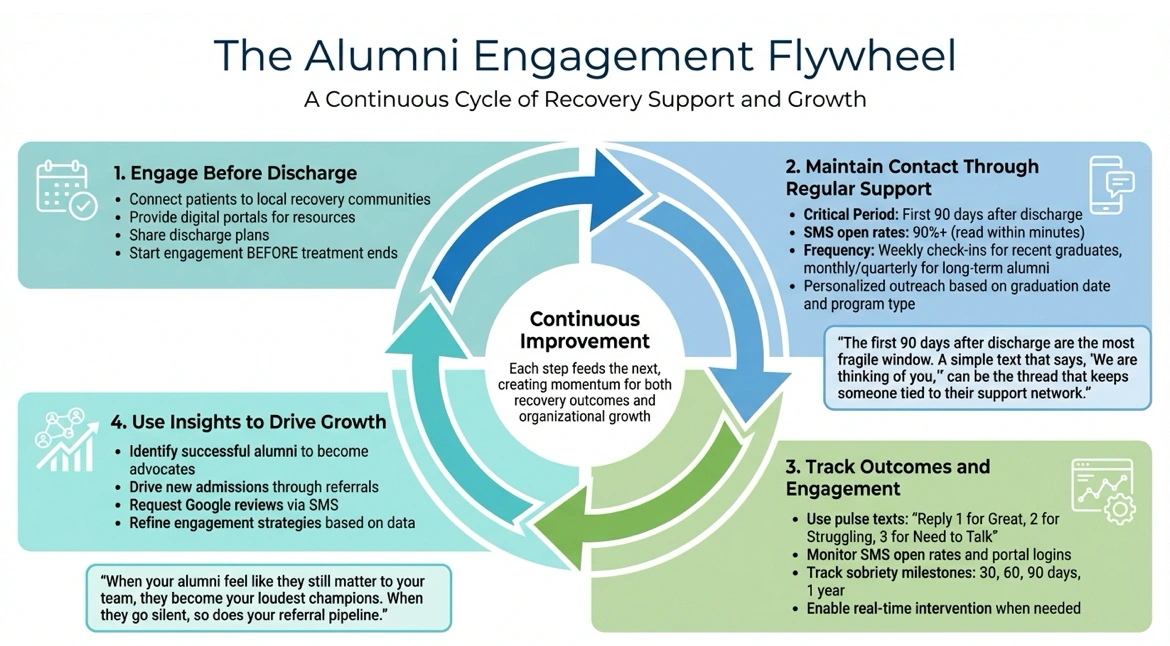
Building a strong alumni engagement program can become a powerful cycle of growth, starting well before a patient leaves treatment and evolving throughout their recovery journey. This four-step process creates a momentum that benefits both recovery outcomes and organizational growth.
Step 1: Engage Before Discharge
Engagement begins before patients complete treatment. Counselors can help patients connect with their local recovery communities by recommending meetings or groups, while digital portals can provide easy access to resources and discharge plans. These early steps set the stage for ongoing support and connection.
Step 2: Maintain Contact Through Regular Support
The first 90 days after discharge are critical. During this time, automated SMS messages can be highly effective, with open rates often exceeding 90% – and most messages read within minutes. Tailor outreach by grouping alumni based on when they graduated or the type of program they attended. For example, those who recently completed treatment might benefit from weekly check-ins, while others further along in recovery could be contacted monthly or quarterly. Mira Gwehn Revilla from Curogram emphasizes the importance of this period:
“The first 90 days after discharge are the most fragile window. A simple text that says, ‘We are thinking of you,’ can be the thread that keeps someone tied to their support network”.
Step 3: Track Outcomes and Engagement
Tracking alumni progress can help organizations intervene when needed. Simple pulse texts like, “How is your recovery going today? Reply 1 for Great, 2 for Struggling, 3 for Need to Talk”, allow for real-time responses and support. Beyond individual check-ins, monitoring metrics like SMS open rates, portal logins, and sobriety milestones (30, 60, 90 days, and one year) provides valuable data on engagement and progress.
Step 4: Use Insights to Drive Growth
Engagement data can do more than just track progress – it can fuel growth. For example, identifying alumni who are excelling in their recovery creates opportunities to turn them into advocates for the program. These advocates can drive new admissions through word-of-mouth and glowing online reviews. SMS broadcasts can even be used to request Google reviews, boosting the organization’s reputation and online visibility. As Mira Gwehn Revilla explains:
“When your alumni feel like they still matter to your team, they become your loudest champions. When they go silent, so does your referral pipeline”.
Using these insights not only strengthens referral networks but also helps refine earlier engagement efforts, creating a continuous cycle of improvement and growth.
Conclusion
Alumni engagement has the potential to act as a strong driver of growth for treatment organizations, as highlighted by the challenges, shifts, and opportunities discussed earlier. While 85% of treatment organizations report having an alumni program, only a small percentage successfully leverage these programs to create meaningful impact. The difference lies in having the right structure, consistent practices, and effective tools.
Organizations that treat alumni engagement as a systematic approach reap measurable benefits. For example, a well-balanced admissions strategy often includes 25–30% of new admissions coming from alumni referrals, with top-performing programs reaching as high as 50%. These referrals come with zero acquisition costs, significantly reducing the need for expensive digital marketing. Additionally, sustained alumni engagement over 18–24 months provides the kind of long-term data that supports better reimbursement rates within value-based care models.
To achieve these outcomes, organizations must move beyond outdated methods like unstructured social media groups or manual outreach. Modern platforms, such as CaredFor, Part of ContinuumCloud, extend the engagement window to an average of 18 months – far surpassing the typical 90 to 100 days seen on traditional social platforms. These tools also offer HIPAA-compliant features, AI-powered sentiment analysis, and automated triage, allowing teams to focus on building genuine, person-to-person connections. As one expert insightfully puts it:
“The opposite of addiction is connection. So what are we connecting to? Are we connecting to an algorithm or are we connecting to a person? We want to build that human-to-human connection.”
An impactful alumni program goes beyond fostering connections – it transforms former patients into advocates, improves clinical outcomes, and creates a sustainable pipeline of referrals. By following the engage–support–measure–grow model, organizations can drive both recovery and long-term success. ContinuumCloud offers the tools to make this a reality, from onboarding patients pre-discharge to tracking engagement over time. Want to turn your alumni program into a growth engine? Book a demo with ContinuumCloud and build a system designed for lasting results.
FAQs
What should an alumni program actually include?
Equally important is leveraging data-driven tracking. By monitoring metrics such as relapse rates and patient-reported outcomes, programs can evaluate their effectiveness, fine-tune their approaches, and showcase their impact clearly.